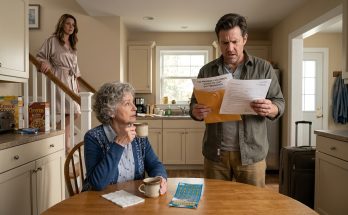
My seventy-sixth birthday arrived almost three years after Paige handed me the scratch ticket.
This time, I did not cook.
That was my first victory.
Graham hosted.
Not because he insisted.
Because he asked.
“Would you like dinner here?”
“Yes.”
“What do you want?”
“Nothing complicated.”
“That is not food.”
“Roast chicken.”
“Fine.”
“Potatoes.”
“Fine.”
“Chocolate cake.”
“You hate chocolate cake.”
“I’ve changed.”
He laughed.
Paige called separately.
“Are gifts allowed?”
“Yes.”
“Price limit?”
I almost said no gifts.
Old habit.
Instead:
“Use judgment.”
“That is dangerous.”
“I trust you.”
She became quiet.
“Thank you.”
On the evening of my birthday, I arrived at their house at six.
Not carrying food.
Not carrying serving dishes.
Not carrying emergency groceries.
Only my purse.
Graham opened the door.
“You brought nothing.”
“That was difficult.”
“I’m proud.”
“Don’t ruin it.”
Owen was already there from his apprenticeship program.
He had grease beneath one fingernail he apparently missed.
Chloe had grown taller.
Still sketching buildings.
Still undecided whether architecture would remain the answer.
Good.
Ruth had come from Richmond with Joanne, her bridge-playing friend.
I approved reluctantly.
Melissa arrived late because Common Ground held a meeting.
I did not know what they voted on.
That still occasionally bothered me.
Progress remained annoying.
Paul came too.
Carol sent flowers.
Leonard called earlier.
His voice weaker now but still sarcastic.
Andrea mailed a card with a photograph of Frank Sloan’s empty metal box filled with herbs.
She had taken my suggestion literally.
Basil grew where old guilt had been stored.
That pleased me more than symbolism should.
Dinner was loud.
Ordinary.
Graham overcooked the potatoes.
Paige forgot the rolls.
Owen complained about work.
Chloe argued that houses needed more color.
Ruth criticized Graham’s knife technique.
Nothing needed fixing.
I noticed anyway.
Then chose not to.
After dinner came cake.
Chocolate.
Too rich.
Perfect.
They sang.
I hated it.
They did it anyway.
I blew out three candles because seventy-six would have endangered the smoke alarm.
Then Paige placed a small wrapped box in front of me.
Everyone became suspiciously quiet.
I stared.
“What is this?”
“A birthday gift.”
“Why is everyone staring?”
“No reason,” Owen said badly.
I looked at Graham.
He had the face of someone hiding something.
Old alarm flickered.
A plan.
A decision.
Something arranged.
Then I laughed.
Apparently some reflexes never disappeared entirely.
I opened the paper.
Inside was a scratch ticket.
Two dollars.
For several seconds, I could not speak.
Paige watched me.
Not smirking like years ago.
Not making a joke at my expense.
Nervous.
“I thought maybe it was too much.”
I touched the ticket.
Same type.
Not identical design.
But close enough.
Graham said, “We can throw it away.”
“No.”
Chloe leaned in.
“Scratch it.”
Owen said, “If she wins again, I’m quitting work.”
“No,” everyone said at once.
We laughed.
Paige handed me a quarter.
I recognized it.
Not the exact same coin from years ago.
Obviously.
Still, the gesture returned everything at once.
My seventy-third birthday.
The tilted homemade cake.
Graham’s wineglass.
The children laughing.
Paige joking about bus fare.
Me scratching silver coating while nobody watched.
Eleven million dollars appearing beneath my hand.
The ticket against my chest while I washed dishes.
The first secret.
The first choice.
The entire road after.
I looked at Paige.
“Why this?”
She answered carefully.
“Because the first one became something nobody intended.”
“Yes.”
“And I wanted this one to just be a gift.”
No test.
No lesson.
No apology.
Just a gift.
I smiled.
“That is acceptable.”
“High praise.”
I scratched.
Everyone watched this time.
First symbol.
Nothing.
Second.
Nothing.
Third.
Nothing.
A tiny prize marker appeared.
Ten dollars.
Owen shouted.
“We’re rich!”
Everyone laughed.
I laughed hardest.
Paige leaned toward the ticket.
“You won ten?”
“Yes.”
Graham said, “Coffee’s on you.”
The line.
Almost the same line from years earlier.
But everything around it had changed.
I looked at him.
“You remember.”
“Of course.”
I held up the ticket.
“Bus fare.”
Paige laughed until she cried.
Then I did too.
Ten dollars.
The amount felt absurdly precious.
Not because of value.
Because this time nobody needed the result to transform anything.
No secret fortune.
No leverage.
No escape hatch.
No test of character.
Just ten dollars.
I put the ticket beside my plate.
Then Chloe said, “What are you going to do with it?”
“Retire.”
“You’re already retired.”
“Then more retired.”
“Buy lemon cookies,” Ruth said.
“Leave.”
We laughed again.
Later, gifts continued.
A new gardening trowel from Graham.
He asked whether I wanted one weeks earlier.
I said yes.
Paige gave me a scarf.
No emotional symbolism.
Just a scarf I liked.
Owen gave me a tiny metal sculpture he made from discarded engine parts.
It looked vaguely like a bird.
“What is it?”
“A heron.”
“It looks injured.”
“It’s art.”
Chloe looked offended.
“I approve.”
Melissa’s gift was a framed photograph from our train trip.
The one I had taken of her pressing her face against the observation-car window.
She had hated it.
Now she framed it.
“Why?”
“Because I looked happy.”
Good.
Ruth gave me nothing.
“I traveled two hours.”
“Fair.”
After dessert, Graham stood.
I immediately said, “No speech.”
He sat.
Everyone laughed.
“Actually,” he said, “I was getting water.”
“Good.”
He got water.
No speech.
That felt like its own gift.
As the evening ended, people left gradually.
Paul first.
Then Ruth and Joanne.
Melissa stayed until nearly midnight because she and Paige got into an argument about nonprofit staff salaries.
Healthy.
Carol called during cleanup.
Leonard sent a rude text about chocolate cake.
The house slowly quieted.
I helped carry one plate.
Paige stopped me.
“You’re the guest.”
“I can carry one plate.”
She considered.
“Okay.”
Not no.
Not automatic service.
One plate.
I liked that.
At the door, Graham walked me outside.
“Do you want me to drive you?”
“No.”
“It’s dark.”
I looked at him.
He froze.
“Doctor said reduce night driving.”
“He did.”
“So?”
“I arranged a taxi.”
His face relaxed.
“Good.”
Not offended.
Not relieved because he got control.
Just glad I had considered the actual risk.
The taxi would arrive in five minutes.
We stood on the porch.
Graham looked older now.
Not old.
But older than the son I still sometimes imagined.
Gray near his temples.
Lines around his eyes.
The man who had tried to arrange my future because uncertainty frightened him.
The man who later sat beside me in a hospital and asked whether I wanted him to stay.
The same man.
Changed through practice.
“Good birthday?” he asked.
“Yes.”
“Even the ticket?”
“Especially.”
He smiled.
“Mom.”
“Yes?”
“I’ve been thinking.”
“Dangerous.”
“When you won…”
I waited.
“If you had told us that night, what do you think would’ve happened?”
I considered.
“You and Paige would have lost your minds.”
He laughed.
“Probably.”
“You would have made spreadsheets.”
“Definitely.”
“Paige would have started paying off everything mentally.”
“Yes.”
“I would have said yes to too much.”
“Probably.”
“And maybe we would’ve avoided some pain.”
“Pine Harbor?”
“Maybe.”
He looked down.
“Or maybe money would’ve hidden the problem longer.”
That was possible too.
If I had revealed the fortune immediately, perhaps generosity would have covered resentment.
Perhaps Graham would have seen me as capable because money made independence obvious.
Perhaps Paige would have treated me differently because wealth changed my usefulness.
Perhaps none of us would have learned anything.
But I did not know.
And I no longer needed to create a perfect alternate timeline.
“I don’t know,” I said.
Graham smiled.
“Your favorite answer.”
“Yes.”
The taxi appeared.
Before I walked away, Graham said, “I’m glad you won.”
I looked at him.
“Are you?”
“Yes.”
“Because of the trusts?”
“No.”
“The loan?”
“No.”
“Common Ground?”
“Partly.”
“Then why?”
He thought.
“Because it gave you enough freedom to stop being afraid of disappointing us.”
That hurt.
In the best way.
“I wish I hadn’t needed millions for that.”
“So do I.”
“But?”
“But you did it.”
Yes.
I had.
Not perfectly.
Not all at once.
I kissed his cheek.
“Good night.”
“Call when you’re home.”
“I will.”
Not because he commanded it.
Because I knew he would worry.
There was no loss of autonomy in kindness freely given.
At the cottage, the driver waited until I unlocked the door.
I turned on the kitchen light.
Yellow still.
Of course.
I called Graham.
“Home.”
“Good.”
“Good night.”
“Night, Mom.”
I hung up.
Placed my purse on the chair.
Then removed the scratch ticket.
Ten dollars.
I laughed.
The house was quiet.
My alert device sat on my wrist.
A pair of grab bars were visible down the hall.
Evidence of aging.
Evidence of choice.
Both.
On the refrigerator hung photographs.
Thomas at the lake.
Daniel with the building.
Melissa on the train.
Owen with a tiny trout.
Chloe beside her yellow-kitchen painting.
Graham and Paige with the children.
Ruth holding terrible bread she insisted was excellent.
Life.
Not arranged perfectly.
Not finished.
I poured water.
Then sat at the table where so many decisions had been made.
The lottery prize had changed the practical conditions of my life.
That was undeniable.
It bought the cottage.
Protected the grandchildren’s education.
Created financial options.
Helped seed Common Ground.
Allowed me to say no without fearing where I would sleep.
Money mattered.
Pretending otherwise would have been sentimental nonsense.
But it had not done the most important work.
Money did not make Graham listen.
Practice did.
Money did not make Paige tell the truth.
Consequence and choice did.
Money did not reconcile Melissa and me.
Conversation did.
Money did not transform Thomas into someone simpler.
Truth made him more complicated and more human.
Money did not teach me how to help.
Failure did.
Neither did it teach me how to receive help.
Age did that.
Fear helped.
So did love.
I thought of the first birthday ticket.
Paige gave it carelessly.
I received it quietly.
Nobody understood what was happening.
The numbers appeared.
Eleven million dollars.
And my first instinct was secrecy.
At the time, I thought the secret protected the money.
Later, I understood it protected something else.
My ability to see how people treated me when they believed I had little power.
That information hurt.
But it also showed me my own role.
I had trained people to rely on me by rarely saying no.
I had hidden resentment instead of risking conflict.
I had confused sacrifice with proof of love.
I had judged people for assumptions while making plenty myself.
There had been no single moment when everyone else became wrong and I became wise.
That would have been a cleaner story.
Not the true one.
The true one was slower.
Everyone changed unevenly.
Relapsed.
Apologized.
Tried again.
Sometimes the person who needed correcting was Graham.
Sometimes Paige.
Sometimes Leonard.
Often me.
I stood and took Thomas’s photograph from the refrigerator.
His face remained sixty-eight.
I was older now than he had ever been.
That still felt impossible.
“Happy birthday to me,” I said.
No answer.
I smiled.
“Your family is exhausting.”
Still nothing.
“You were right about some things.”
I waited.
“And very wrong about others.”
Better.
“I miss you.”
That remained true without erasing anything else.
I kissed two fingers and touched the frame.
Then returned it.
Not shrine.
Not judge.
Not instruction.
A photograph of a man I loved.
Enough.
The next morning, I took the ten-dollar ticket to the corner store.
The cashier scanned it.
“Ten dollars.”
“I know.”
“Want cash or more tickets?”
I laughed.
“Cash.”
She handed me a ten-dollar bill.
That was the entire transaction.
No miracle.
No secret.
No attorney.
No property company.
No hidden account.
Just ten dollars.
On the way home, I stopped at a bakery.
Coffee and one pastry cost almost all of it.
I sat outside.
People passed.
Nobody knew me.
Or perhaps someone did after the article.
Nobody approached.
Fine either way.
I ate slowly.
Then my phone buzzed.
Family group.
Owen:
Grandma what did you do with winnings
Chloe:
SHE BETTER NOT BUY LEMON COOKIES
Paige:
Her money, her choice.
Graham:
Correct.
Ruth:
She owes me bread.
Melissa:
Buy a sports car.
Paul:
Invest aggressively.
I laughed aloud.
Then typed:
Coffee. Pastry. Nearly broke again.
Owen:
terrible financial management
I replied:
Inherited trait.
The messages exploded.
Laughter.
Arguments.
Paige defending herself.
Graham blaming Thomas.
Melissa blaming Daniel.
Ruth blaming everyone.
I put the phone down.
The sun was warm.
Coffee strong.
Pastry excellent.
Nothing dramatic waited around the corner that morning.
No unresolved account.
No hidden letter.
No stranger carrying documents.
The central conflict of my life had once seemed to be whether my family valued me.
Then whether money would corrupt us.
Then whether secrets could be repaired.
Eventually I understood the deeper question.
Could we love one another without turning love into authority?
Not perfectly.
But yes.
Could I help without making myself indispensable?
Sometimes.
Could they help me without taking over?
More and more.
Could money exist in a family without becoming a vote on who mattered?
Yes, if we kept choosing that.
Would we fail again?
Certainly.
That no longer frightened me.
A good family was not one that stopped making mistakes.
It was one where mistakes did not require silence to survive.
I finished my coffee.
Folded the empty pastry wrapper.
Stood.
No one was waiting to tell me where to go.
No one had chosen my room.
No one had planned my afternoon.
I could drive home.
Visit Ruth.
Call Melissa.
Ignore everyone.
Garden.
Read.
Tour another senior community someday.
Sell the cottage someday.
Stay.
Leave.
Ask.
Say no.
Say yes.
Need someone.
Be needed.
None of those choices, by themselves, would prove whether I was loved.
That was the freedom the lottery could never purchase.
I walked toward my car.
In the bakery window, I caught my reflection.
Seventy-six.
Older.
Not fragile.
Not invincible.
Not anyone’s burden.
Not anyone’s bank.
Just Evelyn.
And that was finally enough.
The End
Read more original stories on Feel Every Story.
A Two-Dollar Birthday Joke Left Me Holding a Fortune While My Family Went Back to Dinner Without Looking Twice
Part 44 of 44