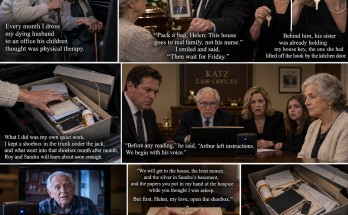
Roy Mercer waited until the last mourner had stepped off the porch before he put his hand around my wrist. His fingers were warm from the crowded house, mine cold despite the August heat. Behind him, the funeral flowers crowded the hallway in white and yellow towers, filling Arthur’s home with the heavy sweetness of lilies. The undertaker’s car had barely disappeared at the end of Hawthorne Lane. Roy leaned close enough that I could smell coffee and the sharp mint he chewed when he was angry. “Pack a bag, Helen,” he said. “You’ve had nine years here. That’s enough.”
For a moment I thought grief had made me misunderstand him. Then his grip tightened. His eyes moved past me toward the staircase, the dining room, the walnut cabinet Arthur had restored by hand. He wasn’t looking at the home where his father had lived. He was inventorying it. “Excuse me?” I asked. Roy lowered his voice. “The house belongs to Dad’s real family. You were his nurse before you became his wife. Don’t make this ugly.”
Sandra stood several feet behind her brother, still wearing the black dress she had worn to the cemetery. She had removed her shoes and was carrying them in one hand. In the other was a brass key. I recognized the green plastic tag attached to it. My house key. It normally hung on the little hook beside the kitchen door. Sandra noticed me looking and closed her fingers around it. The movement was small, almost casual, and told me more than anything she could have said.
I looked back at Roy. Nine years of swallowed replies rose in my throat. Nine years of hearing him introduce me as Dad’s caretaker when strangers asked who I was. Nine years of Sandra correcting people who called me their stepmother. Nine years of smiling through holiday dinners while the two of them spoke about Margaret, their mother, as if loving Arthur after her death were an insult to her memory. I could have answered all of it then. Instead, I gently pulled my wrist free.
“Friday,” I said.
Roy frowned. “What?”
“Wait until Friday before you move anything.”
He stared at me as if I had spoken in another language.
Sandra stepped closer. “What happens Friday?”
I bent down and picked a wilted carnation off the floor. Its stem had snapped beneath someone’s shoe. Arthur would have complained about the mess. Then he would have found a jelly jar, trimmed the stem, and tried to save it anyway. I placed the flower on the hall table. “Mr. Katz asked us to be at his office at ten.”
Roy gave a short laugh. “The will reading?”
“Something like that.”
“You think Dad left you some money and that means you can stay here?”
“I didn’t say that.”
“You didn’t have to.”
His certainty almost made me pity him. Almost.
Sandra crossed her arms. “We already know what Dad’s will says.”
That caught my attention. “Do you?”
“The family has had a copy for years.”
“What year?”
She hesitated just long enough.
Roy answered for her. “Nineteen ninety-eight.”
I turned toward him. Arthur had told me about that will exactly once, years before we married. Margaret was still alive when it had been drafted. Roy and Sandra had been younger, Arthur had still owned the manufacturing company, and Hawthorne Lane had been worth less than half its current value. I had never asked what the document said. I had never needed to. But hearing Roy refer to it now confirmed something Arthur had quietly suspected.
Roy mistook my silence for defeat. “Dad was sick for a long time. Anything he supposedly signed recently will be challenged.”
“Then challenge it.”
The answer surprised all three of us.
Sandra’s expression hardened. “You think this is funny?”
“No.”
“Our mother built this family.”
“I know.”
“This house was hers.”
“No,” I said quietly. “It was Arthur’s before he married Margaret. But she made it a home, and he never forgot that.”
Sandra flinched. She disliked it when I knew facts about her parents that did not come from her. Arthur and Margaret had lived at Hawthorne Lane for thirty-four years. There were photographs of her in almost every room. I had never taken them down. I had never moved her china from the cabinet or replaced the lilacs she had planted along the side fence. Arthur had loved her for forty-one years. Loving me afterward had not erased one day of that.
Roy rubbed his thumb over the face of his watch. “A realtor is coming next week.”
I thought I had misheard him again. “A realtor?”
“To assess the property.”
“Arthur has been dead for six hours.”
“It’s better to deal with things promptly.”
From the kitchen came the quiet clink of silver. I turned my head.
Sandra’s daughter Melissa stood in the doorway, twenty-six years old and pale from crying. She was holding two coffee cups, one in each hand. Her eyes moved from her mother to me. “Grandpa hated realtors,” she said.
Nobody answered.
Melissa handed me one cup. “He said they always used the word potential when they meant they wanted to tear something down.”
A laugh escaped me before I could stop it. It hurt. Arthur had said exactly that. He had said it the previous spring when a neighbor sold his bungalow to a developer. He had stood at the window in his robe, oxygen tube beneath his nose, and complained for ten straight minutes about open-concept kitchens.
Roy looked irritated. “Melissa, this is adult business.”
“I’m twenty-six.”
“You know what I mean.”
“I don’t think I do.”
Sandra took the other cup from her daughter and set it down without drinking. “We are discussing Grandpa’s estate.”
Melissa’s gaze dropped to the key in her mother’s hand. “Is that Helen’s?”
Sandra looked down as if she had forgotten she was holding it.
I saved her from answering. “Your mother picked it up for safekeeping.”
Melissa looked at me. She knew I was lying.
So did Sandra.
Roy exhaled loudly. “This is exactly what I didn’t want. Drama.”
I nearly asked which part he considered dramatic: taking my key, arranging a realtor before Arthur had been buried a full day, or ordering his father’s widow to pack a suitcase beside the funeral flowers. Instead, I looked at the clock over the mantel.
Six fourteen.
Twenty-two months earlier, at almost that same time of evening, Arthur had been sitting in his hospice bed pretending to sleep while his children tried to put a pen between his fingers.
That was where Friday had really begun.
The memory arrived with terrible clarity. The hospice room had smelled faintly of lemon disinfectant and chicken broth. Rain tapped the window. Arthur’s cancer had returned aggressively that winter, and the doctors had finally stopped pretending another round of treatment might buy meaningful time. He had been admitted for symptom management after a bad week at home. Roy and Sandra arrived together that night, which was unusual enough to make me notice.
Sandra carried a leather folder.
Roy carried a pen.
I was sitting beside Arthur’s bed reading a mystery novel neither of us cared about. His eyelids were half closed, and the morphine had softened the deep lines around his mouth. Sandra kissed his forehead, then looked at me. “Helen, you should eat something.”
“I’m fine.”
“You’ve been here all day.”
“So has your father.”
Her smile held. “We can sit with him.”
Arthur’s fingers shifted beneath the blanket.
It was a signal so small nobody else would have noticed. I had been a nurse for thirty-two years. More importantly, I had been Arthur’s wife for nine. I knew the difference between an involuntary twitch and a warning.
Still, I stood.
Roy gave me an encouraging smile that looked borrowed. “Take twenty minutes.”
Arthur kept his eyes closed.
I leaned down as if to straighten his blanket. “Tea?”
His index finger moved once against the sheet.
Yes.
I went downstairs.
I did not know then that Arthur wanted me gone because he needed to hear what his children would say when they believed he could not.
The cafeteria was closing. I bought tea from a vending machine and stood near the elevator while it filled the paper cup with water that tasted faintly of metal. I remember being irritated because I had forgotten my wallet upstairs and had to search the bottom of my purse for coins. Fourteen minutes passed.
When I returned, Sandra was sliding papers back into her folder.
Roy was putting the cap on his pen.
Arthur’s hand lay palm-up on the blanket.
“What happened?” I asked.
“Nothing,” Sandra said too quickly.
Arthur did not open his eyes.
Roy stood. “He drifted off.”
“He was already drifting.”
“Well, more.”
I set the tea down. On Arthur’s blanket, near his right thigh, I saw a small blue ink mark. Not large. Barely more than a line. I looked at the pen in Roy’s hand.
Roy slipped it into his pocket.
Sandra kissed Arthur again. “We’ll come tomorrow.”
Neither of them looked at me as they left.
I waited until their footsteps disappeared down the corridor. Then I closed the door.
Arthur opened one eye.
There was the man I knew.
Tired. Furious. Entirely awake.
“What did they do?”
His voice was rough. “First Tuesday.”
“What?”
“Take me.”
“Where?”
“Downtown.”
“Arthur, what happened?”
He swallowed, winced, and looked toward the door. “Not here.”
That was all he would say.
Three days later he came home from hospice. On the first Tuesday of the following month, I helped him into our car. He wore his brown wool coat although the afternoon was mild, and he insisted on carrying the cane he hated using. When I asked where we were going, he handed me a folded piece of paper.
Arthur Katz, Attorney at Law.
There was an address beneath it.
I looked at him. “You have an attorney named Arthur?”
“He was Arthur before I met him.”
“That seems inconvenient.”
“It has caused suffering.”
Even sick, he could still make me laugh when I least wanted to.
I started the engine. “What do I tell Roy and Sandra when they ask where you went?”
Arthur watched the bare maple branches through the windshield.
Then he said, “Physical therapy.”
“You don’t have physical therapy today.”
“They don’t know that.”
I turned toward him.
His mouth pulled into the faintest smile.
“Arthur.”
“Helen.”
“You’re asking me to lie.”
“I’m asking you not to provide unnecessary information.”
“That is a lawyer’s definition of lying.”
“Then apparently I’m already improving.”
I drove him downtown.
Mr. Katz’s office occupied the ground floor of a narrow brick building between a tax service and an old bakery. There was no sign large enough to notice from the street, only a brass plaque beside a blue door. Arthur placed his hand on mine before I helped him out of the car.
“You’re staying in the waiting room.”
“I assumed so.”
“No matter how long I’m inside.”
I studied him. “What are you doing?”
“Housekeeping.”
“That sounds ominous.”
“It’s paperwork.”
“Arthur.”
He looked at me then, really looked at me.
“Please.”
That ended the argument.
Inside, the office smelled of coffee, old paper, and radiator heat. Mr. Katz was short, silver-haired, and so neat that even his eyebrows seemed organized. He greeted Arthur without surprise, shook my hand, and showed me to a chair beside a table stacked with magazines.
“You may be here a while, Mrs. Mercer.”
“Helen.”
“Helen.”
Arthur followed him through a door.
I sat alone for one hour and thirty-seven minutes.
When Arthur finally came out, he looked exhausted. He also looked lighter.
“What happened?” I asked.
“Housekeeping.”
I narrowed my eyes.
He patted my knee.
On the drive home he fell asleep before we reached the second traffic light.
That night, while putting his coat away, I found a small white receipt tucked in the pocket.
Not from Mr. Katz.
From a copying service.
Twenty-three pages.
I put it back exactly where I found it.
I did not know what he had copied.
I did not know that the visit would become the first of twenty-two.
And I did not know that while Arthur was building his quiet record downtown, I would soon begin keeping one of my own.
Click here to continue reading: PART 2: Arthur Called His Secret Meetings Housekeeping, but the Missing Pills and His Children’s Sudden Visits Made Me Start Counting Everything
Before the Flowers Had Wilted, Arthur’s Children Were Measuring My House and Telling Me I Had Until Friday to Leave
Part 1 of 48