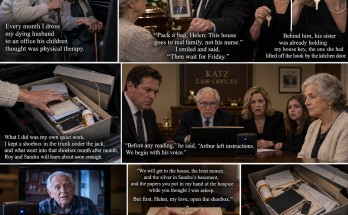
Cancer reduced Arthur’s world in stages. First he stopped driving at night. Then he stopped climbing the stairs unless necessary. Then the stairs became impossible altogether, and we moved a bed into the downstairs study. By the eighteenth first Tuesday, I could no longer pretend our trips downtown were merely inconvenient. Getting him into the car had become an operation involving oxygen tubing, a cushion, two medications, a thermos, and ten quiet minutes after he sat down so he could recover from crossing the driveway.
He still refused to miss the appointment.
“You can call Katz,” I told him that morning.
“No.”
“He can come here.”
“No.”
“You are exhausted.”
“I’ll be exhausted here too.”
“That is not an argument.”
“It has the advantage of being true.”
I crouched in front of him to tie his shoes. His ankles were swollen. His hands rested on his knees, thinner than they had been the previous month.
“Arthur.”
He touched my hair.
“I need to go.”
Something in his voice ended the debate.
During the drive, he watched familiar streets slide past the window. There was a particular stillness in terminal illness that had nothing to do with weakness. People imagine dying makes every moment profound. It does not. Sometimes Arthur complained about potholes. Sometimes he asked whether we had milk. Sometimes he slept.
That morning he counted intersections.
At the fourth traffic light, he said, “Margaret used to hate this road.”
I glanced at him.
He rarely introduced his first wife into conversation without context.
“Why?”
“She said the lights were deliberately timed to punish impatient people.”
“She may have been right.”
“She usually was.”
He smiled.
After a while he said, “I wish Sandra remembered more of her mother accurately.”
“What does she remember inaccurately?”
“That Margaret would approve of all this.”
I knew what all this meant.
The hostility.
The possessions.
The way Sandra spoke about me as if I had entered Arthur’s life before Margaret left it, when in fact Margaret had been dead for eleven years before I first met him.
“Grief edits people,” I said.
Arthur looked through the window.
“So does guilt.”
The word stayed with me.
Before I could ask what he meant, we reached Mr. Katz’s office.
The lawyer met us outside.
He and Arthur exchanged a look.
Not dramatic.
Not secretive in the childish sense.
But practiced.
That irritated me.
“Good morning, Helen,” Mr. Katz said.
“Apparently.”
Arthur almost smiled.
Mr. Katz helped him inside.
I followed.
On the waiting-room table sat a fresh stack of magazines and a plate with two oatmeal cookies beneath plastic wrap.
One cookie had a handwritten note beside it.
HELEN.
I looked toward the closed office door.
Arthur had arranged my snack.
Even while keeping half his life secret.
I ate the cookie anyway.
An hour passed.
Then another.
The office door remained closed.
At eleven forty, Mr. Katz’s assistant brought me more coffee.
“Is he all right?”
“Yes.”
“That answer is becoming suspicious.”
She smiled. “He’s stubborn.”
“That answer I trust.”
Twenty minutes later the door opened.
Arthur came out in a wheelchair.
I stood so fast my coffee spilled.
“What happened?”
“Nothing.”
“You entered walking.”
“I’m leaving more efficiently.”
His lips had almost no color.
I knelt beside him.
“We’re going to the hospital.”
“No.”
“Arthur.”
Mr. Katz touched my shoulder. “His oxygen dipped. It recovered.”
I looked at him sharply. “You are not his physician.”
“No.”
“Then don’t sound like one.”
“Helen.”
Arthur’s tone was soft.
I turned back to him.
“Take me home.”
I wanted to argue.
Instead I wheeled him outside.
In the car he slept with his head against the window.
Halfway home, he woke and said, “Glove compartment.”
“What?”
“There’s an envelope.”
I opened it at the next red light.
Arthur Mercer — Capacity Evaluation.
I looked at him.
He kept his eyes closed.
“What is this?”
“Medical opinion.”
“About what?”
“My mind.”
“You have an oncologist.”
“This doctor is independent.”
The light changed. A horn sounded behind us.
I drove.
“You’ve been getting competency evaluations.”
“Yes.”
“How many?”
“Several.”
“Why?”
He opened his eyes.
“So nobody can say later that I didn’t understand what I was doing.”
My hands tightened around the steering wheel.
“Doing what?”
“Making decisions.”
“About the will?”
“Among other things.”
The road noise suddenly seemed louder.
“Are Roy and Sandra threatening to challenge you?”
“No.”
“Then why are you preparing as if they will?”
Arthur turned toward me.
“Because I know my children.”
That answer hurt him.
I could hear it.
“Does Mr. Katz think they’ll challenge?”
“He thinks good records prevent bad arguments.”
“And the recordings?”
Arthur was silent.
I looked at him.
“I saw the recorder.”
“I know.”
“You record every appointment?”
“Yes.”
“Why?”
“Same reason.”
A strange coldness moved through me.
Twenty-two months was not housekeeping.
It was fortification.
“You think they’ll accuse me.”
Arthur’s face tightened.
“Helen.”
“They’ll say I pressured you.”
“I won’t let them.”
“They’ll say I isolated you.”
“You didn’t.”
“They’ll say you were medicated and I manipulated you.”
His silence told me I had reached the center.
I pulled into a grocery-store parking lot and stopped the car.
Arthur looked surprised.
I turned off the engine.
“For eighteen months, you have been walking into that office while I sit outside because you’re documenting that your wife isn’t influencing you.”
“I’m documenting my choices.”
“To protect me.”
“Yes.”
I looked away.
Anger arrived before gratitude.
“How dare you.”
“I expected that.”
“You should have told me.”
“If I told you, you would have spent eighteen months feeling watched.”
“I have spent eighteen months feeling lied to.”
“I know.”
“No, you don’t.”
I pressed my palms against my eyes.
The steering wheel blurred when I looked up again.
“You are dying, Arthur. Do you understand how little time we have left? And you’re spending it building legal walls around me.”
His voice was barely audible.
“Exactly.”
I stopped.
He looked exhausted and older than he had that morning.
“Exactly because I’m dying.”
Neither of us spoke for a while.
Cars moved through the parking lot.
A woman pushed a cart loaded with bottled water.
Someone honked near the pharmacy entrance.
Life continued with insulting normality.
Arthur reached for my hand.
“After I’m gone, they will come for the house.”
My throat closed.
He continued before I could answer.
“They will come for money. They will come for anything they believe Margaret left behind. And when you resist, they will not attack me. I’ll be dead.”
“Arthur—”
“They’ll attack you.”
I looked at him.
“I can survive being disliked.”
“It won’t stop at dislike.”
The certainty in his face frightened me.
“What do you know?”
He withdrew his hand.
“Not enough yet.”
“There’s that word.”
“What word?”
“Yet.”
He looked away.
I started the car.
At home I helped him into bed.
He slept until evening.
While he slept, I counted his medication.
Two tablets short.
This time I did not blame myself.
I photographed the bottle beside the prescription label.
Then I removed one tablet from the same batch, placed it in a small plastic bag, and wrote the date across the front.
When Arthur woke, I showed him.
His expression barely changed.
“You expected it.”
“I suspected.”
“Who visited while I was showering yesterday?”
He thought.
“Sandra.”
“Anyone else?”
“Roy came by after lunch.”
“They weren’t here together.”
“No.”
I sat beside him.
“What are they doing?”
“I don’t know.”
“Arthur.”
“I don’t.”
“Then what do you suspect?”
He closed his eyes.
“I suspect they want me easier to manage.”
The sentence made my skin crawl.
I remembered the hospice room.
The ink mark on the blanket.
The pen.
The leather folder.
“Those papers they brought before.”
“Yes.”
“What were they?”
“Power of attorney.”
I stared at him.
“They tried to get you to sign power of attorney while you were sedated?”
“And a property transfer.”
My stomach turned.
“Which property?”
“The house.”
I stood so abruptly the chair struck the wall.
“I’m calling the police.”
“No.”
“Yes.”
“Not yet.”
“There is no not yet.”
“Helen.”
“They tried to take your house while you were drugged.”
“They failed.”
“That doesn’t make it harmless.”
“I know.”
“Then why haven’t you reported them?”
He looked at me.
“I have.”
The room became very quiet.
“What?”
“Mr. Katz has copies.”
“That isn’t the police.”
“No.”
“Arthur.”
He reached toward the drawer beside his bed.
“Open it.”
Inside lay a business card.
Officer Daniel Bennett.
Financial Crimes and Vulnerable Adults Unit.
Beneath it was a report number.
I sat again.
“You filed a report.”
“Three weeks ago.”
“Without telling me.”
“Yes.”
My anger faltered.
Not because I approved.
Because I suddenly understood the scale of what Arthur had been doing.
The lawyer.
Capacity examinations.
Recorded statements.
Photographs.
Medication counts.
Police.
He had not been passively waiting for death.
He had been assembling a case.
“Why didn’t Officer Bennett contact me?”
“I asked him not to yet.”
“Why?”
“Because your records matter more if nobody can say I instructed you to make them.”
I thought of my shoebox.
He knew about it.
Of course he knew.
“You knew where I kept the evidence.”
“I knew you had evidence.”
“Not where?”
“No.”
A tired smile crossed his face.
“You were always better at hiding things than I was.”
Despite myself, I laughed once.
Then I cried.
Arthur looked away because he hated watching me cry.
“You should have told me.”
“Yes.”
“You should have trusted me.”
“I did.”
“This does not feel like trust.”
He took my hand.
“I trusted you enough to know you would stop me.”
“Stop you from what?”
“Spending the end of my life preparing for yours.”
I could not answer that.
Three days later, Sandra visited with soup she had bought from a restaurant and transferred into one of her own containers.
She found Arthur sleeping.
I was in the kitchen when she came downstairs.
“How is he?”
“Dying.”
She stiffened.
“You don’t have to say it like that.”
“How should I say it?”
She looked toward the study.
“Has Dad changed any financial documents recently?”
There was no lead-in.
No shame.
I dried a plate slowly.
“You should ask him.”
“He gets confused.”
“No, he doesn’t.”
“He’s on a lot of medication.”
“He knows exactly where he is.”
“You can’t know that every minute.”
“I can know it better than you.”
Her expression changed.
“The nurse speaks.”
There it was.
The old insult.
Normally I ignored it.
That day I placed the plate on the counter and faced her.
“Yes,” I said. “The nurse speaks.”
Sandra blinked.
“And the nurse knows every pill your father takes, every dosage, every prescribing doctor, every normal side effect, and every abnormal one.”
Color drained slightly from her face.
I continued.
“So if you’re worried about his medication, ask me.”
“I’m not worried.”
“You mentioned it.”
“I said he gets confused.”
“He doesn’t.”
She picked up her purse.
“You always think you know everything.”
“No.”
I looked toward the study door.
“But I know your father.”
Sandra left without saying goodbye.
I watched through the window as she sat in her car for several minutes before driving away.
That night Arthur asked what happened.
I told him.
He listened quietly.
Then he said something strange.
“Did she look frightened?”
“Angry.”
“Think again.”
I did.
The tight mouth.
The pale face.
The way she had left almost too quickly.
“Yes.”
Arthur nodded.
“Good.”
“Why is that good?”
“It means she knows we’re paying attention.”
“We?”
Arthur smiled.
“You and your shoebox.”
I stared at him.
“You said you didn’t know where it was.”
“I don’t.”
“Then how—”
“You have been married to me for nine years, Helen. You cannot sneak a shoebox through the laundry room without looking guilty.”
I laughed so hard I had to sit down.
Arthur laughed too.
It became a coughing fit.
I held his shoulders until it passed.
When he could breathe again, he leaned against me, exhausted.
“First Tuesday,” he whispered.
“The next one?”
“Yes.”
“We can skip it.”
“No.”
“You can barely cross the room.”
“One more.”
His voice had changed.
I looked at him.
“One more what?”
He rested his head against my shoulder.
“One more Tuesday.”
I knew then.
He did not mean one more before resting.
He meant one more before dying.
And suddenly the next appointment stopped feeling like part of a routine.
It felt like a deadline.
Click here to continue reading: PART 4: On Arthur’s Final First Tuesday, He Left the Lawyer Carrying Nothing, Then Asked Me to Promise I Would Show Up Friday
Before the Flowers Had Wilted, Arthur’s Children Were Measuring My House and Telling Me I Had Until Friday to Leave
Part 3 of 48