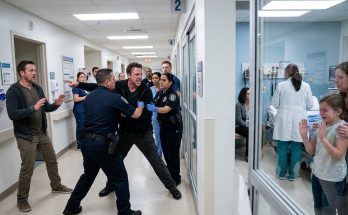
The investigator was already moving before we finished explaining.
Sarah gave Richard's address.
Daniel called local law enforcement.
Nobody used the word emergency until Maya did.
“He's going to destroy them.”
The attorney corrected her gently.
“We don't know that.”
Maya stared at him through the screen.
“I do.”
We were told not to go.
Again.
This time Maya did not argue.
She stood beside the window watching the street as if Richard's house might somehow appear at the end of it.
“What if Grandpa changes his mind?”
Sarah said, “Then the investigator documents that too.”
“What if Dad makes him?”
“He's an adult.”
“So am I almost.”
The bitterness in Maya's voice silenced everyone.
Twenty minutes passed.
Then forty.
The absence of information became its own kind of torture.
I imagined Mark in Richard's basement, lifting boxes into his car.
I imagined a shredder.
A fire.
A dumpster behind some office park.
Every crime drama scenario felt possible because ordinary life had already become implausible.
At last, Sarah's phone rang.
The investigator.
Richard was safe.
Mark had arrived, but law enforcement reached the property before any boxes were removed.
Maya closed her eyes.
Sarah asked, “Did he destroy anything?”
“Not that we know.”
“What happens now?”
“Mr. Bennett is voluntarily turning over several boxes he believes relevant. We'll inventory them.”
Maya leaned toward the speaker.
“Can Grandpa talk?”
A pause.
“He asked to speak with you.”
Richard came on.
His voice sounded wrecked.
“Maya?”
“I'm here.”
“He was furious.”
“What did he say?”
“He said I had no right.”
“To give them over?”
“To betray the family.”
Maya's mouth twisted.
“What did you say?”
Richard took a shaky breath.
“I said you were family too.”
Maya began crying.
Quietly.
Richard did too.
For a while, neither could speak.
Then he said something that changed the room again.
“There is one box I didn't tell him about.”
Maya wiped her face.
“What?”
“Your grandmother gave it to me two years ago.”
Barbara.
Sarah stood.
“What is in it?”
“I don't know everything.”
“Where is it?”
“Safe.”
The investigator interrupted.
“Mr. Bennett, don't disclose the location over this call.”
Richard agreed.
Maya asked, “Why did Grandma give you a box?”
“She said Mark was getting reckless.”
My skin prickled.
“Reckless how?” I asked.
Richard answered me for the first time.
“With money.”
The fundraising accounts.
Sarah sat down slowly.
Richard continued.
“Barbara noticed transfers.”
“Did she confront him?”
“Yes.”
“What did he say?”
“That the donations were for the family's needs, not only Maya's direct care.”
That explanation might have covered some expenses.
Not all.
Richard said Barbara started copying statements.
“She told me to keep them somewhere Mark couldn't find.”
Maya stared at the phone.
“But she still helped him.”
“I know.”
“Why?”
Richard had no good answer.
“She thought protecting him meant protecting everyone.”
Maya's expression hardened.
“That isn't protection.”
“No.”
The investigator ended the call.
By evening, officials had possession of eleven boxes.
The twelfth, Richard said, contained mostly duplicate tax records and remained at the house pending inventory.
The secret Barbara box was retrieved separately.
We did not see the contents that night.
We saw something else.
An email arrived from Daniel.
Urgent.
He had obtained additional records from the proposed guardianship lawyer after sending preservation notices.
One attachment was a draft statement attributed to Barbara.
Sarah opened it.
Maya read over her shoulder.
Barbara described her granddaughter as loving but severely impaired.
She claimed Maya had limited understanding of consequences.
Needed help bathing.
Could not prepare food safely.
Could become agitated when routines changed.
Required reminders to swallow medication.
Was susceptible to manipulation by outsiders.
Maya stopped reading.
“Outsiders.”
Sarah looked at her.
“That's probably aimed at me.”
“Maybe Claire too.”
I hated that she might be right.
The worst part came near the bottom.
Barbara stated that Maya's occasional attempts to stand or speak at greater length should not be mistaken for meaningful functional recovery.
Maya read that sentence three times.
“She knew.”
Nobody contradicted her.
“She knew enough to write this.”
The statement was unsigned.
A draft.
But the language suggested preparation long before this week.
Maya stood.
“I want to call her.”
Sarah shook her head.
“Not now.”
“I want to ask her.”
“You're angry.”
“I have a right to be angry.”
“Yes.”
“So let me call.”
Daniel, still connected by video, intervened.
“If you contact her, assume Mark may hear everything.”
Maya's jaw tightened.
“So he gets to hide behind everybody.”
“For tonight, maybe.”
Maya walked away from the table.
I followed her into the living room but kept my distance.
She stared at the framed photographs Sarah had preserved.
“My grandmother taught me to make pancakes.”
The sentence surprised me.
“She used to let me pour the batter even when I made a mess.”
I waited.
“She stayed with me in the hospital the first week.”
“I know.”
“She slept in a chair.”
I had heard the story.
Maya looked at me.
“How can somebody love you and do this?”
There was no answer that would satisfy her.
“People can love in selfish ways.”
She frowned.
“That sounds like an excuse.”
“It isn't.”
I thought about Mark.
“Love doesn't automatically make what someone does safe.”
She sat on the edge of the couch.
“I keep remembering good things.”
“Those happened too.”
“Then I feel stupid.”
“Why?”
“Because maybe I should hate them.”
“You don't owe anybody a simple emotion.”
Maya looked down.
“Do you hate Dad?”
The question struck deeper than I expected.
“I don't know what I feel yet.”
“You were married to him yesterday.”
“I'm still married to him.”
Technically.
The word felt absurd.
She looked at me.
“Did you love him?”
“Yes.”
“Do you still?”
I thought about the man at the porch telling me to come home.
The man who used tenderness like a key.
“I don't know what part of what I loved was real.”
Maya nodded as if that answer made sense.
Later that evening, the investigator called again.
She could not disclose every detail from the seized records, but one discovery required immediate action.
A physician's letter had been found among Richard's boxes.
It was dated eighteen months earlier.
The doctor had examined Maya during a short hospital admission for dehydration.
During that stay, without Mark present for several hours, nurses documented Maya walking independently to the bathroom.
Speaking normally.
Requesting privacy.
Using her own phone.
The physician wrote a formal concern about inconsistencies between the family's description of severe disability and Maya's observed function.
Sarah gripped the table.
“What happened to the letter?”
“It was sent to Mark and copied to another provider.”
Maya whispered, “I remember that hospital.”
The investigator continued.
“The records include a response from Mark.”
“What did he say?”
“He attributed the behavior to a temporary neurological fluctuation and warned that staff observations taken outside her established treatment context could be misleading.”
Of course he did.
But there was more.
Attached to his response was an email to Barbara.
The investigator read only the necessary portion.
We have to be consistent. If people start documenting isolated good days as recovery, everything becomes harder.
Maya closed her eyes.
Everything.
Not Maya's health.
Not safety.
Everything.
Sarah asked, “Does that prove he knew?”
“It is significant.”
Maya opened her eyes.
“What else was in the email?”
The investigator hesitated.
“There is a reference to upcoming fundraising commitments.”
Silence.
I felt sick.
Mark had not simply feared being misunderstood.
He had understood the financial implications of Maya appearing recovered.
The investigator explained that financial-crimes specialists might review the donation accounts if evidence supported misuse.
Maya looked overwhelmed.
“I don't care about the money.”
Sarah said, “I know.”
“I care that he made me sick.”
The words came out with sudden force.
“I got better.”
Her voice broke.
“I got better and nobody let me be better.”
Sarah crossed the room and held her.
This time Maya did not pull away.
The next morning, we met the investigator at a county office.
Richard arrived separately.
He looked ten years older than he had the day before.
When Maya saw him, she hesitated.
Then walked over.
He did not try to hug her.
“I don't expect forgiveness.”
“Good.”
He nodded.
“I'll answer everything.”
She studied him.
“Even if it hurts Dad?”
Richard's eyes filled.
“Yes.”
“Even if Grandma gets in trouble?”
His pause was longer.
“Yes.”
Maya turned away.
The interview lasted almost three hours.
Richard confirmed seeing Maya walk.
Confirmed hearing her speak normally.
Confirmed that Mark knew.
Confirmed that Barbara knew enough to question him.
Confirmed discussions about donations.
Confirmed concern about Sarah regaining custody if Maya's recovery became legally documented.
That last fact stunned everyone.
“What did he say?” Daniel asked.
Richard looked at Maya.
“He said if Sarah learned Maya was improving, she'd reopen custody.”
Sarah whispered, “I would have.”
“He knew.”
“Yes.”
Maya asked, “So keeping me sick kept Mom away.”
Richard lowered his head.
“Yes.”
The central machinery became clearer.
Illness justified control.
Control blocked Sarah.
Fundraising rewarded illness.
Medical records strengthened future guardianship.
Guardianship promised permanent control.
Every piece supported another.
After Richard's interview, an investigator placed a folder on the table.
“These are copies from Barbara's box.”
Maya opened it.
Bank records.
Emails.
Fundraising drafts.
A printed social-media post Mark had written but apparently never published.
At the bottom was something different.
A handwritten letter.
Barbara's handwriting.
Not addressed to Mark.
To Richard.
Maya read silently.
Then stopped.
“What?”
Sarah moved closer.
Maya handed her the page.
Sarah read the line aloud.
“If he ever goes through with making Maya legally incompetent after eighteen, I won't be able to pretend this is only about protecting her.”
The room went silent.
Maya took the letter back.
“She knew about guardianship.”
Richard stared at the floor.
“Yes.”
“And she knew it was wrong.”
He did not answer.
Maya folded the page carefully.
“Then I want to hear her say it.”
This time, nobody tried to stop her.
Click here to continue reading: PART 8: Barbara Finally Told Maya Why She Helped Mark Keep the Lie Alive, but Her Answer Exposed an Even Older Secret
The Morning My Husband Left Town, His Silent Daughter Stood Up and Asked Me Not to Call Him
Part 7 of 47