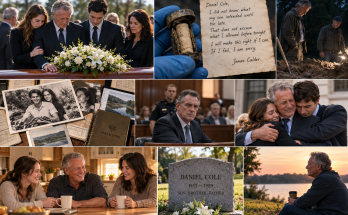
At sunrise, River Lot looked almost peaceful.
A low stretch of scrub near the water.
Cottonwoods.
Mud.
Old concrete foundations from structures demolished decades earlier.
Nothing about it suggested buried corporate history.
Dad watched remotely.
He had stopped insisting on being physically present at every discovery.
Not because he cared less.
Because he finally understood that witnessing truth did not require standing in every dangerous place.
Federal environmental specialists marked the coordinates.
Price had given them the likely location.
Mom’s old film labels supported it.
The red ledger referenced the parcel.
Ground-penetrating equipment found a long rectangular disturbance beneath a former loading platform.
No human remains signature.
Metal containers.
Large.
Uniform.
Excavation began carefully.
The first container surfaced by midmorning.
Stainless steel.
Welded seams.
Far more sophisticated than the improvised boxes used elsewhere.
James Calder had not buried garbage.
He had buried an archive.
The first case contained laboratory reports.
Original Halcyon letterhead.
Dates from the late 1970s and early 1980s.
Groundwater toxicity studies.
Chemical persistence reports.
Warnings.
One internal memorandum stated clearly that chlorinated solvents disposed in unlined pits could migrate into residential wells.
Dad stared at the scanned page.
“They knew before Walter hauled the first drum.”
Harold nodded.
No uncertainty there.
This was not merely reckless ignorance.
The company’s own scientists warned them.
Another report recommended specialized containment at a cost Halcyon executives considered prohibitive.
A handwritten note beside the estimate:
Alternate disposal through B.I.T. significantly cheaper.
Bell Industrial Transport.
Dad closed his eyes.
Money.
The beginning really was that simple.
Proper disposal cost more.
So executives chose secrecy.
Everything afterward existed to protect that choice.
The second container held executive correspondence.
James Calder signed some.
Others bore Stephen’s initials even though he had not yet reached senior leadership formally.
Dad frowned.
“He was already acting beyond his title.”
Harold nodded.
Family company.
Power did not always follow the organizational chart.
Stephen proposed using small transport contractors because they could absorb liability if regulators discovered illegal dumping.
Dad whispered, “Walter.”
Yes.
Use people with less power.
Let them carry the risk.
The architecture existed before murder.
Before threats.
Before forged deaths.
The violence later served an economic design built from the beginning around disposable people.
The third case contained medical information.
Dad looked away at first.
Worker exposure.
Illness reports.
Complaints from residents near disposal sites.
One name appeared multiple times.
A child with recurring neurological symptoms near School Road.
Another family with contaminated well water.
Dad’s face tightened.
“This is why the trust money isn't enough.”
No.
Money could repair some harm.
Not erase it.
Federal teams began cross-referencing affected communities.
Notifications would be required.
Public-health investigations.
Possibly decades of claims.
Dad sat quietly.
For years, Walter had worried about what exposure would do to the family.
But families outside his house had already paid.
The perspective mattered.
Daniel understood that.
Peter Lawson understood it.
Mom eventually did too.
The fourth case contained audio tapes.
Reel-to-reel and cassette.
Labels.
Board meetings.
Private conversations.
James had preserved more than anyone realized.
One tape was dated six months after Peter Lawson disappeared.
Participants:
James Calder.
Stephen Calder.
Thomas Vale.
Dad stared.
“Play it.”
After forensic copying, the recording began.
James sounded furious.
“Peter Lawson did not need to disappear.”
Stephen answered.
“He was stealing records.”
“He was an accountant.”
“He was a liability.”
James said, “You are not hearing me.”
Stephen replied, “I hear you perfectly.”
Thomas remained mostly silent.
James asked him directly.
“Did you kill Lawson?”
A pause.
Thomas answered.
“No.”
Dad leaned forward.
Stephen spoke.
“He fell.”
Harold almost laughed bitterly.
The same kind of story later used for Daniel.
James said, “Do not insult me.”
Stephen replied, “Then don't ask questions you cannot afford answered.”
The room went still.
Dad looked toward the screen.
Stephen was speaking to his own father the way Thomas later spoke to everyone else.
Power had already shifted.
James threatened to remove Stephen from Halcyon.
Stephen responded by mentioning Leonard.
Price.
James went silent.
The recording confirmed Marian Holt’s story.
Stephen knew Leonard was James’s secret son and used that secret as leverage.
Not because public scandal alone mattered.
Because Stephen threatened to expose Leonard’s parentage in a way that could jeopardize inheritance, marriage, and corporate governance.
James yielded.
Dad whispered, “That’s when Stephen took over.”
Harold nodded.
Not officially.
Practically.
The tape continued.
James ordered all illegal disposal stopped.
Stephen said stopping immediately would expose prior operations because contractors would talk.
James proposed controlled cleanup.
Thomas finally spoke.
“He’s right about one thing.”
Dad leaned closer.
Thomas supported cleanup.
But not disclosure.
He proposed buying contaminated parcels quietly.
That was the beginning of Vale Environmental’s later role.
James approved temporary containment.
Stephen interpreted temporary as permanent.
The final exchange mattered most.
James said:
“If one more person disappears, I go to the state myself.”
Stephen replied:
“You won't.”
James asked why.
Stephen answered:
“Because everything begins with your signature.”
Dad closed his eyes.
The founder trapped by his own guilt.
He could expose Stephen only by exposing himself.
He chose himself.
That choice allowed Daniel’s death three years later.
The next tape dated one week after Daniel’s murder.
Dad hesitated before asking to hear it.
Then nodded.
James.
Stephen.
Mercer.
Thomas.
No Walter.
No Robert.
James began:
“You told me no one would be hurt.”
Stephen answered:
“No one planned for Cole’s brother to steal records.”
Dad’s face tightened.
Daniel described only as relation to a contractor.
James demanded to know what happened.
Thomas said:
“He was shot.”
James:
“By who?”
Thomas:
“Me.”
No evasion.
James swore.
“Is he dead?”
A long pause.
Stephen answered instead.
“Yes.”
Dad stared.
Thomas did not say it.
Stephen did.
James asked whether an ambulance was called.
No.
“Why?”
Stephen said:
“Because then we lose everything.”
Dad’s jaw clenched.
James whispered something almost inaudible.
Then louder:
“You buried him?”
Thomas answered:
“Yes.”
Dad closed his eyes.
James became sick on the recording.
You could hear it.
A chair moved.
Mercer told him to calm down.
James said:
“This is murder.”
Stephen replied:
“This is containment.”
Dad’s fist hit the table once.
Not hard.
Enough.
That one word captured Stephen completely.
Containment.
People.
Bodies.
Families.
Truth.
Everything was a spill to manage.
James demanded the dumping stop immediately.
Stephen refused again.
James threatened to go public.
Stephen mentioned Leonard.
Then Evelyn.
Then Richard.
Then Walter’s permits.
Then Edward.
Every family pressure point.
James finally stopped arguing.
Dad whispered, “He listed them.”
“He already had everyone mapped.”
Stephen’s system of human leverage existed fully by 1989.
Then something surprising happened.
Thomas spoke against Stephen.
“He’s right. Shut the sites down.”
Stephen said:
“You don't get a conscience after pulling the trigger.”
Thomas answered:
“No. But I get survival instinct.”
Dad looked at Harold.
Thomas had begun diverging from Stephen after Daniel.
Not enough to confess.
Enough to see the system becoming uncontrollable.
Thomas wanted cleanup and reduced exposure.
Stephen wanted continuation.
That fracture widened over decades.
The last part of the tape captured James alone with Mercer after Stephen and Thomas left.
James said:
“I created him.”
Mercer replied:
“He created himself.”
James disagreed.
“I taught him results matter more than methods.”
Dad stared.
A father recognizing himself inside his son’s worst qualities.
James asked Mercer to help build an evidence archive.
Mercer agreed.
That was the origin of CM-7 and the hidden courthouse records.
James was not becoming innocent.
He was building insurance.
But insurance later became evidence.
The fifth buried case contained more.
One file was marked LAWSON.
Peter’s original audit.
Dad asked Christine to join remotely before it was reviewed.
She did.
Peter documented $3.8 million diverted from environmental reserves.
Who received it?
Not Walter.
Not Robert.
Not Thomas primarily.
The majority went to entities controlled by Stephen.
Christine stared.
“My father found theft.”
“Yes.”
Stephen was not merely concealing dumping.
He was stealing from the company while doing it.
That provided another motive for Peter’s disappearance.
Exposure threatened prison for fraud independent of environmental crimes.
Christine asked quietly.
“Did my father know?”
“Yes.”
She nodded.
No tears.
Just confirmation.
Then investigators opened a small inner container.
One cassette.
No label except:
J.C. / FINAL.
James Calder’s final recording.
Dad stared.
Date:
Three days before James died.
The recording began in James’s home.
He spoke alone.
“If this is found, Stephen has either ignored me or killed me.”
Everyone stopped.
James said he had decided to confess.
Not privately.
Publicly.
He planned to meet federal investigators.
He had finally accepted that preserving Halcyon was no longer possible or morally defensible.
Dad leaned forward.
James named Peter.
Daniel.
Illegal dumping.
Walter’s forged permits.
Robert’s coerced accounts.
Mercer’s legal work.
Thomas’s violence.
Stephen’s direction.
Everything.
He intended to surrender the archive.
Then he said:
“Leonard deserves the truth before I do this.”
Price, watching from custody, covered his face.
James planned to tell him privately.
He never got the chance.
The recording continued.
“If Stephen stops me, look at Malcolm.”
Dr. Malcolm Reese.
The physician who signed James’s death certificate.
Dad stared.
James suspected his doctor.
Why?
Because Stephen recently insisted Reese begin managing his medications.
The sheriff immediately contacted forensic toxicology experts regarding possible exhumation.
James’s final words were not about Halcyon.
They were about Leonard.
“I spent my life hiding one son to protect the other. In the end I protected neither.”
The tape stopped.
Price wept.
Dad looked toward the wall.
That sentence belonged to every parent in the story.
Hide truth to protect children.
Create worse danger.
Then an investigator brought news from Stephen’s custody.
After learning River Lot had been opened, Stephen requested a lawyer and refused further statements.
His attorney issued denials.
The recordings were old.
Interpretations contested.
Evidence needed authentication.
All legally predictable.
Dad did not react.
He no longer needed Stephen to admit anything.
Then toxicology authorities called.
James’s preserved medical samples still existed unexpectedly because of a research donation after death.
Testing could begin without exhumation first.
Results would take time.
Dad nodded.
No rush.
Thirty-seven years had taught him something else too.
Truth that survives decades does not need to be forced in an hour.
Then another River Lot case surfaced.
Smaller.
Marked:
COLE.
Dad stood.
Inside were copies of Walter’s forged permits.
Mom’s photographs.
Daniel’s letters.
And one sealed envelope.
To Edward.
From James Calder.
Dad almost laughed.
“Again?”
The letter was short.
James wrote that Walter asked him to send it if Stephen ever used Edward as a scapegoat.
He apologized without asking forgiveness.
Then wrote:
Your father did wrong things. Your brother tried to stop worse ones. Do not let my son make you carry either man’s guilt.
Dad stared at that sentence for a long time.
Then folded the copy.
For almost two days, everyone had tried to assign him inherited responsibility.
Walter’s crimes.
Daniel’s death.
Margaret’s silence.
Vanessa’s choices.
The trust.
The land.
James had named the boundary clearly.
Dad could answer for what he did next.
Not for everything before him.
Then the sheriff approached with an update.
The toxicology lab had found something preliminary in James’s preserved blood sample.
A compound inconsistent with his listed medications.
Dad’s face hardened.
“What compound?”
A cardiac drug.
Dangerous at elevated levels.
James Calder may not have died naturally.
The physician had called it a heart attack.
But someone may have induced one.
Dad looked toward Stephen’s custody photo.
If the lab confirmed poisoning, Daniel was not Stephen Calder’s only suspected murder.
And Peter Lawson may not have been the first either.
Click here to continue reading: PART 40: James Calder’s Toxicology Result Turned Stephen’s Family Dinner Into a Murder Scene, and Michael Remembered Who Handed Him the Glass
My Sister Called Before Sunrise to Say Dad Was Gone, but Someone Was Already Moving Around His Kitchen
Part 39 of 46