Six months later, the first public report on the Halcyon sites was released.
It was hundreds of pages.
Maps.
Groundwater testing.
Historical disposal records.
Corporate structures.
Health-risk assessments.
Recommendations for cleanup.
No family could reduce it to one villain anymore.
That mattered.
Stephen Calder had not poisoned land alone.
Thomas Vale had not built the financial system alone.
Mercer had not created the waste.
Walter and Robert had not designed Halcyon.
Mom did not cause Daniel’s murder by staying silent afterward.
The truth was larger than any convenient scapegoat.
That was what finally made it useful.
Eleven major historical disposal locations were confirmed.
Several smaller sites remained under review.
The old reservoir showed severe historical contamination but no connection to the current municipal water supply.
School Road required immediate soil remediation.
Two neighborhoods entered long-term groundwater monitoring.
Former employees and residents received access to health-screening programs funded initially by emergency corporate agreements and public resources.
The family trust contributed too.
Not privately.
Not through Dad slipping checks to people.
Not through Vanessa withdrawing money because Mom told her to.
Not through Walter’s notebook.
Court supervision.
Public accounting.
Independent trustees.
Affected-community representatives.
Every payment recorded.
Dad insisted on that.
“No more secret good deeds built on secret crimes.”
The trust balance turned out to be just over nine million dollars.
For several weeks, journalists described me as an “heir to a hidden fortune.”
I hated that phrase.
I signed documents formally directing the trust toward remediation and compensation consistent with Walter’s original restitution purpose.
Dad signed alongside me.
Then neither of us controlled it.
Vanessa asked whether I regretted giving up access to that kind of money.
“No.”
She nodded.
“Me neither.”
I looked at her.
“You didn't have access.”
“I know.”
We both laughed.
That was new.
Not forgetting.
Not pretending the previous year had not happened.
Just finding a place where laughter could exist without erasing anything.
Vanessa entered a plea agreement on several nonviolent fraud-related counts tied to the forged estate documents and unauthorized property activity.
The court considered her cooperation.
The restitution payments involving Dad’s $48,000 were verified as legitimate payments to affected families, though her unauthorized withdrawal remained part of the record.
She received probation, financial restrictions, and community-service obligations connected to legal-aid and elder-protection programs.
Dad attended sentencing.
He did not speak on her behalf unless asked.
When the judge asked whether he wished to address the court, he said:
“My daughter did things that harmed me. She also helped stop worse things once she understood what she had joined. I love her. I don’t need the court to confuse that with innocence.”
Vanessa cried.
The judge thanked him.
Dad sat down.
Grant’s outcome was harsher.
He had accepted substantial secret payments.
Moved property.
Participated knowingly in false-death and forged-document schemes.
Tried to deliver Dad to Stephen after the conspiracy began collapsing.
His cooperation eventually mattered, but it came later and under greater pressure.
He accepted a prison sentence.
Vanessa filed for divorce.
Dad did not celebrate.
Neither did I.
A marriage ending after betrayal is not a victory.
It is simply what remained.
Leonard Price entered a cooperation agreement in exchange for testimony concerning Stephen’s security operations, witness intimidation, surveillance, and the river shooting.
He faced prison too.
Learning James Calder was his biological father did not remove responsibility for his actions.
Price understood that eventually.
During testimony, he said something simple:
“I thought loyalty meant doing what Stephen asked. It took me sixty years to notice he never did anything for me that didn't buy him something.”
James Calder’s death was formally reclassified after toxicology review and the evidence surrounding Dr. Reese’s records.
Homicide.
Stephen became the principal suspect.
Reese’s old letter, the missing digoxin, call records, estate drafts, and witness testimony formed a separate case.
Peter Lawson’s death was also prosecuted as part of the broader conspiracy, though reconstructing the precise physical act remained more difficult.
Thomas denied killing Peter.
Stephen denied everything.
The state did not need every uncertainty resolved before moving forward on what could be proven.
That was another lesson.
Truth did not require pretending every blank space had been filled.
Thomas survived his injuries.
He eventually gave a formal statement.
Long.
Detailed.
Self-serving in places.
Useful in others.
Dad never visited him.
Thomas asked twice.
Dad refused twice.
When investigators asked if he wanted any message delivered, Dad said:
“No.”
Thomas had spent decades deciding what other people needed to hear.
Dad would not participate in one more controlled conversation.
Thomas ultimately pleaded guilty to Daniel’s murder, obstruction, evidence tampering, and additional charges tied to the environmental conspiracy.
His statement confirmed that Daniel was conscious when he was buried.
That fact appeared in every major article.
Dad stopped reading articles.
He already knew enough.
Charles Mercer survived too.
He cooperated extensively.
His legal career had once been built on turning dangerous reality into manageable paper.
In the end, his papers helped destroy the system he maintained.
He faced charges.
Age and health affected proceedings.
They did not erase them.
June testified.
Her testimony was difficult.
Stephen’s attorneys attacked her memory.
Her long silence.
Her marriage to him.
Her theft of company files.
Her shifting names.
She answered most questions the same way.
“Yes.”
Yes, she lied.
Yes, she stayed.
Yes, she was afraid.
Yes, she loved Daniel.
Yes, she married Stephen afterward.
Yes, she allowed Michael to believe Stephen was his father.
Yes, she waited too long.
Then prosecutors showed the burial photographs.
The room became quiet.
June identified Daniel.
Thomas.
Stephen.
She described Stephen saying Daniel could not leave.
The defense argued about exact wording.
The photographs remained.
The recording remained.
Mercer’s 1990 confession remained.
The board minutes remained.
The red ledger remained.
The evidence did not require June to be flawless.
That was perhaps the greatest difference from thirty-seven years earlier.
Back then, everyone believed a witness needed to be clean enough to survive attack.
Now the case was built from overlapping imperfect people.
Mom’s letter supported June.
Robert supported Mom.
Walter supported Robert.
Peter’s journals supported the financial trail.
James’s recordings supported the corporate history.
Price supported Stephen’s later operations.
Michael supplied the Wisconsin archive.
Rebecca carried Thomas’s key.
Elaine preserved the negatives.
Evelyn Shaw admitted the false morgue file.
Luis Morales preserved water tests.
Christine kept Peter’s journals.
Nobody had everything.
Together they had enough.
Stephen’s murder trial involving Daniel took place separately from some of the environmental proceedings.
Dad attended opening statements.
Then stopped going every day.
I asked why.
“I thought you wanted to see him convicted.”
“I do.”
“Then?”
Dad looked toward Daniel’s photograph at home.
“I spent enough years letting that family decide my schedule.”
He returned for critical testimony.
For June.
For Michael.
For Rebecca.
For the recordings.
And for the verdict.
Guilty on the charges submitted in Daniel’s case.
The courtroom reacted quietly.
Stephen did not.
He sat beside his attorneys and stared ahead.
Dad did not look triumphant.
Rebecca cried.
Michael closed his eyes.
June bowed her head.
Dad took both Daniel’s children by the hand.
Outside the courthouse, reporters shouted questions.
Dad said one sentence.
“My brother did not run away.”
Then walked past them.
That became the line repeated everywhere.
Not the millions.
Not the forged death.
Not the corporate scandal.
My brother did not run away.
Peter Lawson’s family received their own formal findings.
Christine had waited almost four decades for a death certificate bearing her father’s real name.
When she finally received it, she sent Dad a photograph.
PETER LAWSON.
Not missing.
Not voluntary departure.
Not unknown.
Dad printed the picture and kept it beside Daniel’s.
Environmental litigation continued.
It would continue for years.
Cleanup too.
Some damage could not be reversed neatly.
Some illnesses would never be linked with absolute certainty.
Some families would receive money and still wish they had clean water thirty years earlier.
No ending could make that fair.
Dad understood.
He stopped using words like closure.
“Doors close,” he said once. “People don't.”
Daniel’s children became part of our lives slowly.
Rebecca visited Dad first.
She brought no gifts.
Dad made chili.
They argued over whether Daniel would have liked it.
Neither had authority to know.
They argued anyway.
Michael came later.
He had spent months separating himself from Calder Holdings and cooperating with investigators.
The company name became toxic publicly.
He considered changing his surname.
Dad told him:
“Do it if you want. Don’t do it because you think a name is a confession.”
Michael kept Calder for the time being.
His childhood remained his childhood.
Stephen had raised him.
Daniel had fathered him.
June had protected and deceived him.
No single revelation canceled the rest.
Rebecca and Michael did not become instant siblings.
They texted occasionally.
Then more.
Then argued.
That seemed promising.
At Dad’s birthday, Rebecca brought a cake.
Michael arrived late.
Vanessa brought groceries.
I brought nothing.
Dad complained I had become cheap.
Normal life returned in uneven pieces.
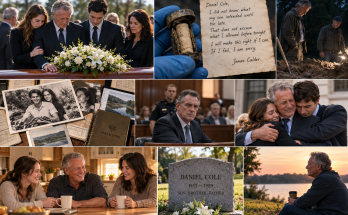
One Sunday afternoon, we drove to Daniel’s grave.
Dad carried no flowers.
Just coffee in a paper cup.
He sat on the grass.
“I think he’d make fun of this.”
I sat beside him.
“You're speaking for dead people again.”
Dad sighed.
“I think he might make fun of this.”
“Better.”
He looked toward the marker.
Daniel Cole.
Son, Brother, Father.
No explanation.
Dad said:
“For years, I thought the worst thing was not knowing where he went.”
“And now?”
“The worst thing was letting someone else tell me what his silence meant.”
I understood.
That was what Vanessa had done to me on the first morning.
Dad is dead.
He left you out.
He chose us.
She had filled his supposed silence with her own meaning.
Stephen did the same to everyone.
Daniel disappeared, so they called him unstable.
Peter disappeared, so they called him dishonest.
Mom stayed silent, so Stephen tried to call her complicit.
Dad’s forged permits were supposed to speak for him if he died.
My forced signature was supposed to become consent.
Documents were repeatedly used to make absent people say things they never chose.
The truth required restoring voices.
Dad looked at me.
“You believed Vanessa?”
“That you were dead?”
“At first.”
“Of course.”
“That I cut you out.”
I hesitated.
“For about thirty seconds.”
He winced.
“That long?”
“She sounded certain.”
Dad nodded.
Then smiled slightly.
“I’m glad you’re stubborn.”
“I got it from you.”
“No.”
“Mom?”
“No.”
“Daniel?”
Dad laughed.
“Unfortunately, maybe.”
The house remained Dad’s.
He did not transfer it immediately to anyone.
That surprised Vanessa.
Dad told both of us:
“I’m alive. I intend to remain inconveniently involved in my own property.”
Vanessa laughed harder than I expected.
He revised his estate plan again.
This time he invited both daughters to the attorney’s office.
Not to negotiate amounts.
To hear his wishes directly.
No secret interpretations.
No assumptions.
The house would eventually be sold unless one of us wished to buy the other’s interest under a clear arrangement.
Personal items were divided by specific written instructions.
Some land would be placed into conservation after remediation.
No ambiguous promises.
No whispered expectations.
Dad looked at Vanessa.
“If you hate something, tell me now.”
She said, “I hate that Natalie gets the fishing rods.”
I stared.
“You don't fish.”
“I might start.”
“You hate worms.”
“That can change.”
Dad rubbed his forehead.
“This is why people use lawyers.”
We laughed.
It was probably the first conversation about inheritance that did not feel like someone’s death was already in the room.
Before we left, Dad added one final instruction.
“No one is allowed to announce my death until a qualified medical professional confirms it.”
The attorney blinked.
Vanessa covered her face.
I laughed so hard I had to sit down.
Dad looked pleased with himself.
Later, Vanessa apologized again.
Not repeatedly.
Once more, differently.
She said:
“I thought staying near Dad made me the good daughter.”
I said:
“I thought leaving made me the bad one.”
We looked at each other.
Both stories had been useful to our resentment.
Neither was true.
She stayed.
I left.
Those were facts.
Everything else had been interpretation.
One evening, Dad found the original text Vanessa sent me.
Please don't make a scene. Dad made his decision.
He stared at it.
Then handed me the phone.
“I did make a decision.”
“What?”
He looked around the kitchen.
“Breakfast.”
I laughed.
“What are we eating?”
“Not eggs.”
“Good.”
He opened the refrigerator.
Vanessa had stocked it again.
Dad pulled out bacon.
For a moment, I was back in the doorway months earlier.
Expecting death.
Smelling breakfast.
Seeing my father alive.
That moment remained unbelievable.
So much had followed because one lie failed instantly.
Vanessa called me to say Dad was dead.
I drove home.
Dad was standing three feet away from the kitchen table making coffee.
Then he told us what she had done.
At first, I thought that was the story.
A greedy daughter.
A forged inheritance.
A father who caught her.
It was simpler.
Cleaner.
Wrong.
Vanessa had done real harm.
Grant had done worse.
But behind them stood Mercer.
Thomas.
Stephen.
Halcyon.
And behind those men stood decades of choices made by people who believed fear justified one more secret.
The actual story was not that my sister lied about Dad’s death.
It was that our family had spent generations allowing silence to speak for living people.
Daniel’s silence became abandonment.
Mom’s silence became complicity.
Dad’s supposed silence became disinheritance.
My silence was nearly going to become consent on a bank form.
Rebecca’s absence became rejection.
Michael’s surname became false proof of fatherhood.
James’s death became natural.
Peter’s disappearance became voluntary.
Every lie depended on somebody not being present to object.
That changed.
Daniel had a grave.
Peter had a grave.
Mom’s evidence was public.
Walter’s trust was accountable.
Rebecca and Michael knew each other.
June testified.
Vanessa faced what she did.
Grant faced what he did.
Thomas could no longer control Daniel’s last words.
Stephen could no longer make everyone carry separate versions of the truth.
And Dad—
Dad was alive.
One night, months after the verdict, I stayed at his house.
Rain tapped against the kitchen window.
He sat in his usual chair reading the newspaper.
I was making coffee.
He looked over the top of his glasses.
“You know your sister is coming tomorrow.”
“Yes.”
“She’s bringing lunch.”
“I know.”
“Rebecca too.”
“Yes.”
“Michael might come.”
“I know.”
Dad frowned.
“What am I forgetting?”
I smiled.
“Nothing.”
“That seems unlikely.”
I handed him coffee.
He tasted it.
“Too strong.”
“You make it stronger.”
“Not the point.”
I sat across from him.
For a while, neither of us spoke.
No need.
Then Dad looked toward the memory table we had finally made properly.
Mom.
Daniel.
Walter.
Family photographs.
Not perfect people.
Not purified versions.
Just ours.
Dad said:
“I wish Margaret could see this.”
I looked at the table.
“Me too.”
“She’d probably tell us we made a mess.”
“She'd be right.”
Dad smiled.
Then his expression softened.
“I spent years thinking protecting family meant keeping certain things from them.”
I waited.
He continued.
“Turns out sometimes protection means telling people the truth and trusting them with what they do next.”
That was as close to a philosophy as Dad ever got.
I raised my coffee mug.
“To inconvenient involvement.”
He laughed.
“To being alive enough to cause trouble.”
Outside, rain ran down the glass.
Inside, the house sounded ordinary.
Refrigerator humming.
Clock ticking.
Newspaper turning.
Dad clearing his throat.
Nothing hidden.
Nothing urgent.
No one waiting for him to die.
And when my sister came through the door the next morning, she did not tell me what Dad wanted.
She asked him.
He answered for himself.
The End
Read more original stories on Feel Every Story.
My Sister Called Before Sunrise to Say Dad Was Gone, but Someone Was Already Moving Around His Kitchen
Part 46 of 46