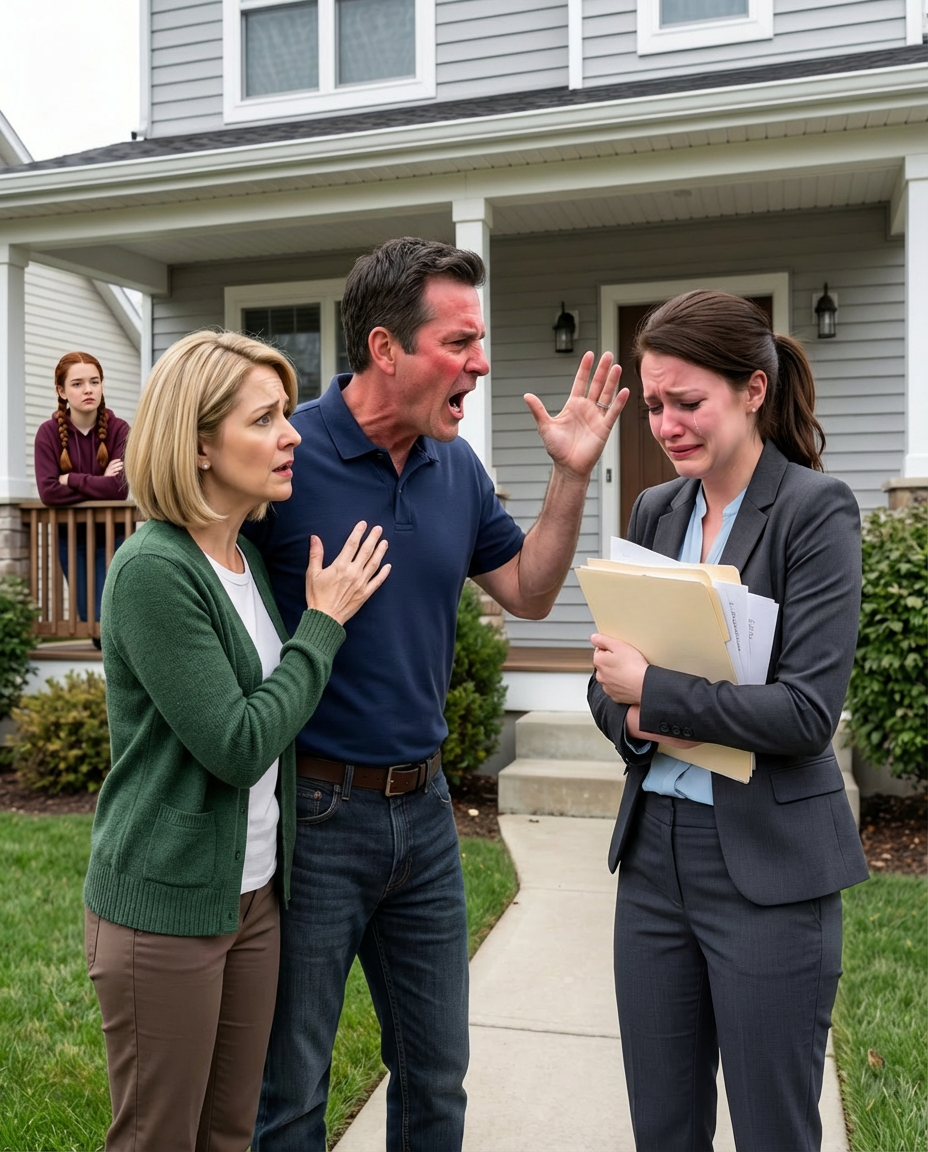
My parents sold their home and bought my sister an $860,000 house. Then they came after mine. I said “No!” — my father struck me across the face. Three months later… “Your parents are in big trouble.” I answered evenly: “I know.”
My parents sold their house, gave my sister an eight-hundred-and-sixty-thousand-dollar property, and then set their sights on mine.
Not figuratively. Not in that passive-aggressive family way where people hint, guilt, and circle your boundaries until you feel wrong for having them. I mean they drove to my house on a Tuesday afternoon, walked in like they already owned it, and told me I needed to “do the right thing” and sign it over.
My name is Claire Donnelly. I was thirty-six, divorced, living in a four-bedroom colonial outside Raleigh, North Carolina, and working sixty-hour weeks as a senior procurement manager for a medical manufacturing company. I had bought that house on my own after my divorce, every inch paid for with years of overtime, bonuses, and the kind of quiet discipline no one in my family ever celebrated because it wasn’t flashy enough to post.
My younger sister, Melanie, had enough flash for all of us. She was thirty-two, permanently dramatic, and always one crisis away from needing rescue. She married a man with charm and no stability, then spent six years talking about “building the dream” while my parents paid for furniture, vacations, legal bills, fertility treatments, and finally the grand finale: an eight-hundred-and-sixty-thousand-dollar house they bought outright after selling their own home and “downsizing temporarily.”
Temporarily, for them, meant moving into a luxury rental and acting like martyrs for choosing their daughter’s happiness over their own comfort.
I found out about the house on Facebook. My mother posted a photo of Melanie crying in front of a stone entryway with imported lanterns and a caption about “what parents do for children they believe in.” That sentence sat under my skin for three days straight.
On the fourth day, they showed up at my door.
My father, Thomas Donnelly, still carried the posture of authority long after reality had stopped matching it. Broad shoulders, a voice that sounded like a threat even when he was ordering coffee. My mother, Elaine, wore one of her church-lady cardigans and the expression she always used before saying something selfish in a tone meant to sound practical.
They sat in my living room, looked around at my furniture, my books, the framed school photos of my son in the hallway, and my father said, “This house makes the most sense.”
I honestly thought I’d missed part of the conversation. “What?”
My mother folded her hands. “Melanie’s new place has more land, but your layout works better for the children.”
Children. Hers. Not mine.
My father leaned forward. “We’re going to rearrange some things. You can rent for a while. It’s time to help your sister stabilize.”
I stared at him. No request. No embarrassment. No acknowledgment that I had watched them liquidate everything to lift Melanie into a life she couldn’t afford, only to decide weeks later that even that wasn’t enough.
“You gave her a house,” I said.
“And now she needs yours,” my mother replied, as if the sentence became reasonable if spoken calmly enough.
I stood so fast my coffee sloshed over the rim. “No.”
The room shifted.
My father stood immediately. “Watch your tone.”
“No,” I said again. “You sold your house, gave her eight hundred and sixty thousand dollars in property, and now you think you can take mine?”
My mother rose too, already offended that I wouldn’t disappear quietly. “Don’t be hysterical.”
That was when my father crossed the room.
I saw it happen and still almost didn’t believe it. His hand came up, fast and hard, and the slap cracked across my face so sharply my head snapped sideways and my shoulder hit the bookcase.
My son was upstairs.
That was my first thought. Not pain. Not shock. Just: He cannot hear this again.
I looked back at my father, my cheek burning, my whole body gone cold. And in that instant, while my mother gasped and my father said, “You made me do that,” something inside me stopped being their daughter.
Three months later, when the call came and a voice said, “Your parents are in big trouble,” I replied calmly: “I know.”