October arrived before I expected it.
The morning we flew to New Mexico, Dennis complained about airport security before we even reached the airport.
Sandra ignored him.
Emma met us at the terminal wearing headphones around her neck and carrying a backpack large enough for a month despite staying only three nights.
"You packed too much," I said.
"You sound ancient."
"I am ancient."
"Then carry my bag."
"No."
She smiled.
Growth.
On the plane, I had a window seat.
I hadn't flown anywhere since Eleanor's funeral arrangements for her sister years earlier.
Takeoff made my stomach drop.
Dennis slept before we reached cruising altitude.
Sandra read.
Emma watched something on her laptop.
I looked out the window.
Clouds.
Then land.
I thought of Eleanor.
Not painfully.
Not exactly.
She had wanted this.
Santa Fe.
Adobe walls.
Dry air.
Art galleries.
She had once torn a magazine page out and stuck it on our refrigerator.
Someday.
That was what she'd written.
Someday had arrived without her.
For years I had treated that as proof it shouldn't happen.
Now I wondered how many somedays vanished because people insisted on the original cast.
We landed under a bright blue sky.
The air felt thinner.
Cleaner.
Different enough that I understood immediately why Eleanor had wanted to come.
Our hotel had a small courtyard with red tile and a fountain.
Dennis inspected the room as if searching for structural flaws.
Sandra told him to stop.
Emma photographed everything.
The first afternoon we walked farther than my knee appreciated.
We ate too much.
Saw paintings I didn't understand.
Bought nothing.
At sunset, the buildings turned warmer.
I stood in a plaza listening to street musicians.
No one needed me.
That sensation was becoming less frightening.
Dinner was noisy.
Dennis ordered something too spicy and blamed the waiter.
Sandra pointed out the menu had literally said hot.
Emma laughed until she choked.
I watched all three of them.
This trip did not resemble the life Eleanor and I might have lived here.
Good.
It wasn't supposed to.
That night Emma and I sat in the courtyard after Dennis and Sandra went upstairs.
The temperature had dropped.
She wrapped herself in a hotel blanket.
"Grandpa."
"Yes?"
"Are you happy?"
The question irritated me immediately.
"That's broad."
"I know."
"Ask something answerable."
"Fine."
She thought.
"Are you happier than last year?"
That I could answer.
"Yes."
"Because Dad stopped taking your money?"
I laughed.
"Among other things."
"Because you found the cabin?"
"Yes."
"Because of therapy?"
"Unfortunately."
She smiled.
"Because Grandma isn't in everything anymore?"
The question landed differently.
"What does that mean?"
Emma looked toward the fountain.
"Last year every decision was Grandma."
"How?"
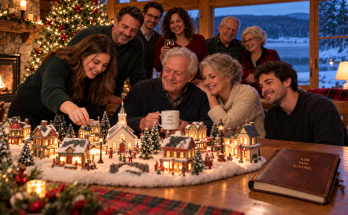
"What Grandma would've wanted. What Grandma said. Her chair. Her jewelry. Her Christmas village. Her letters."
She touched the pendant at her neck.
She wore Eleanor's necklace often now.
Not ceremonially.
With sweaters.
Jeans.
Once with a sweatshirt.
I liked that.
"It's not bad," Emma continued. "I just wondered."
"Wondered what?"
"If thinking about her less makes you feel guilty."
I became quiet.
There it was.
The question I had not known I was avoiding.
Did I think about Eleanor less?
Yes.
Some days.
At first, every room contained her.
Every meal.
Every song.
Every decision.
Now entire mornings passed before she entered my mind.
Once, during woodworking class, I realized at lunch that I had not thought of her since waking.
The discovery felt like betrayal.
Then relief.
Then guilt about the relief.
"Sometimes."
Emma nodded.
"I thought so."
"Why?"
"Because when people say Grandma's name now, you don't get that face as much."
"What face?"
"The face where you leave without moving."
I looked at her.
"That's disturbingly specific."
She shrugged.
"I had three years."
I thought of Eleanor's letter.
Don't make being loyal to me the same thing as being lonely.
Maybe loyalty could become smaller too.
Not weaker.
Less consuming.
"Do you think about her every day?" I asked.
Emma shook her head.
"No."
"Does that bother you?"
"Sometimes."
"Why?"
"I'm scared I'll forget."
"What?"
"Her voice."
I understood.
That fear had visited me too.
"Do you?"
"Some parts."
Her eyes filled.
"That's awful."
"No."
"It is."
"Memory isn't a recording."
"Then what is it?"
I considered.
"Pieces."
"That sounds worse."
"Maybe. But pieces can still be enough."
She touched the necklace.
"I remember her hands."
"Good."
"And how she smelled."
"She used too much perfume."
Emma smiled.
"And the way she said my name when I was in trouble."
I laughed.
"That survived?"
"Very clearly."
"What don't you remember?"
Emma thought.
"Ordinary stuff."
"Like?"
"What she did when nobody was talking."
That answer hurt.
Because ordinary memory was exactly what disappeared first.
The person walking from one room to another.
Opening a drawer.
Looking for keys.
Sitting quietly.
Death preserved highlights and erased filler.
But filler had been most of marriage.
"Want to know something ordinary?"
Emma nodded.
"Your grandmother hummed while reading."
"Seriously?"
"Constantly."
"What song?"
"No song."
"Then how?"
"Just noise."
Emma laughed.
"That's weird."
"Very."
"Anything else?"
"She checked locks twice."
"So do you."
"I know."
"She left half-finished cups of tea everywhere."
"I remember that."
"She hated putting gas in the car."
"Why?"
"No idea."
Emma smiled.
Then said, "Tell me more."
So I did.
Not stories with lessons.
Nothing dramatic.
Eleanor hated folding fitted sheets.
She always forgot where she left scissors.
She liked burnt toast.
She claimed not to snore.
She cried at animal-rescue commercials but not sad movies.
She sometimes read the final page of a mystery first.
Emma was horrified by that.
"That's cheating."
"I told her."
"Did she care?"
"No."
"Classic Grandma."
We sat until the courtyard emptied.
Before going upstairs, Emma said, "I think that's better."
"What?"
"Remembering weird little stuff."
"Better than what?"
"Making her perfect."
I looked at her.
That was exactly what had happened after Eleanor died.
We polished her.
Preston used idealized Eleanor to justify money.
Marissa used her to justify family trips.
I used her to justify staying frozen.
Perfection made the dead easier to weaponize.
Ordinary memory made them human again.
The next morning, we visited a museum Eleanor had wanted to see.
I expected sadness.
Instead I kept thinking how loudly she would have complained about the admission price.
I laughed beside one exhibit.
Sandra looked at me.
"What?"
"Ellie would've said twenty-two dollars was robbery."
Sandra smiled.
"She would've paid anyway."
"Then talked about it for a week."
Dennis said, "Month."
We laughed.
No ache afterward.
Just warmth.
That afternoon Emma flew back for classes.
At the airport, she hugged me.
"Thanks for inviting me."
"Thanks for coming."
"Take pictures."
"I hate pictures."
"Exactly why."
She left.
The remaining days with Dennis and Sandra were different.
Quieter.
We drove north.
Saw mountains.
Ate badly in one town and excellently in another.
Dennis found a lake despite the desert and insisted on fishing for two hours.
He caught nothing.
I considered it justice.
On our last night, Sandra went upstairs early.
Dennis and I sat outside.
He had been drinking one beer for nearly an hour.
"Ray."
"What?"
"You dating?"
I almost spit my coffee.
"What?"
"Just asking."
"Why?"
"Because you're leaving the house now."
"That is not dating."
"You met that fisherman."
"Martin?"
"You remember his name."
"He is a seventy-two-year-old man."
Dennis frowned.
"I wasn't suggesting Martin."
I laughed so hard the couple at the next table looked over.
"Shut up."
"I'm serious."
"Why?"
"Ellie told me you'd never date again."
I stopped laughing.
"She did?"
"Once."
"When?"
"Before she died."
"What exactly?"
Dennis looked uncomfortable.
"She said you'd act like dating was cheating."
That sounded accurate.
"What did you say?"
"That you'd probably become unbearable and no woman would want you."
"Supportive."
"She laughed."
I looked toward the dark courtyard.
"Did she want me to?"
"Date?"
"Eventually."
"She wanted you to do whatever kept you from turning into a ghost."
That phrase felt like Eleanor.
"Did she name anyone?"
Dennis laughed.
"No."
"Good."
"Why? Someone in mind?"
"No."
"Martin?"
"Go to bed."
He laughed for several minutes.
I went upstairs annoyed.
Not because dating interested me.
Because the question existed.
Another future choice.
Another piece of life I had treated as permanently closed.
I did not reopen it that night.
I simply stopped guarding the door.
Back in Cleveland, autumn deepened.
Preston's repayments continued.
Marissa's too.
Emma settled into college.
Caleb's sentencing approached.
Kessler began his license suspension.
Thomas recovered fully and complained about Janet monitoring his driving.
The family became boring.
I loved it.
Then Maya called.
"Caleb wants to speak to Preston before sentencing."
"Why are you telling me?"
"Preston asked whether you thought he should."
I closed my eyes.
"Why is he asking me?"
"Because he values your opinion."
"That's suspicious."
Maya laughed.
"What do you think?"
I considered.
"Does his therapist know?"
"Yes."
"His attorney?"
"Me."
"Right."
"Do you think he should meet Caleb?"
"No idea."
"Useful."
"Tell Preston the decision is his."
"I already did."
"Then why call me?"
"Because he's afraid he's still outsourcing moral decisions."
That stopped me.
He was aware of it.
Good.
"What did you tell him?"
"That seeking advice isn't the same as surrendering choice."
I smiled.
"I like you less every month."
"Mutual."
Later Preston called.
"I think I'm going."
"To see Caleb."
"Yes."
"Why?"
"I want to ask why."
"That answer may disappoint you."
"I know."
"Go anyway if you want."
"You're not worried?"
"Yes."
"About?"
"You expecting his explanation to make you feel better."
Preston became quiet.
"That's fair."
"When?"
"Tomorrow."
"Then tomorrow."
He hesitated.
"Dad."
"Yes?"
"Would you come?"
Every instinct said yes.
Protect.
Witness.
Support.
Then I stopped.
"Do you want me because you're scared or because you think I should hear it?"
He took a long time.
"Because I'm scared."
I respected that answer.
"Then yes."
The meeting took place in a courthouse conference room.
Caleb entered wearing county-issued clothing.
Thinner than I remembered.
No beard.
He looked at Preston first.
Then me.
"Mr. Hale."
I almost told him not to call me that.
Old habit.
I didn't.
Preston sat across from him.
Maya remained near the door.
For several seconds nobody spoke.
Then Preston asked the question.
"Why?"
Caleb looked down.
"I needed money."
Preston laughed once.
Not kindly.
"That's it?"
"At first."
"For what?"
"Gambling."
The word changed the room.
"How much?"
"A lot."
"Did you steal because you owed people?"
"Sometimes."
"Why alter my reports?"
"To hide missing cash."
"The guarantee?"
Caleb closed his eyes.
"Shaw was pushing. If he started digging, he'd find things."
"So you made him think I had more backing."
"Yes."
"You used my father."
Caleb looked at me.
"I used what you already told people."
Preston flinched.
There it was.
Not absolution.
Shared machinery.
"You knew Dad never agreed."
"Yes."
"And you did it anyway."
"Yes."
Preston sat back.
I watched recognition move through him.
Same words.
Same structure.
Different seat.
He asked, "Did you plan to repay it?"
Caleb laughed bitterly.
"Of course."
Preston's face changed.
Because there it was.
The sentence everybody used.
Borrow.
Fix it.
Replace it.
Before anyone knows.
"What happened?" Preston asked.
Caleb stared at the table.
"It got bigger."
Preston nodded slowly.
"Yeah."
The conversation lasted forty minutes.
Caleb apologized.
Preston did not accept or reject it.
He asked questions.
Caleb answered some.
Not all.
At the end, Preston stood.
"I hope you get help."
Caleb looked surprised.
"For gambling?"
"For whatever makes you believe the next lie fixes the last one."
Preston walked out.
In the hallway, he leaned against the wall.
"You okay?" I asked.
"No."
"Good."
He laughed despite himself.
"I knew you'd say that."
"What did you expect?"
"Anger."
"Got some?"
"A lot."
"Anything else?"
He thought.
"Pity."
"That's inconvenient."
"Very."
"And?"
He looked toward the closed conference-room door.
"I don't feel better."
"I warned you."
"I know."
He stopped.
Then smiled faintly.
"But I understand something."
"What?"
"He wasn't me."
I waited.
"And I'm not him."
Simple.
Important.
He looked at me.
"We did similar things."
"Yes."
"But understanding him doesn't mean I have to make our stories identical."
"Correct."
"I think I've been doing that with Mom too."
"What do you mean?"
"Using her mistakes to make mine feel less unique."
I understood.
Eleanor took from Emma's account once.
Preston could use that as evidence his behavior was hereditary.
Marissa opened credit.
He could call them both desperate.
Caleb stole.
He could collapse all wrongdoing into one category.
But accountability required specificity.
"Your story belongs to you."
"Yeah."
He breathed out.
"I think I'm finally starting to want that."
We left the courthouse.
Outside, cold wind came off the lake.
Winter approaching again.
One year since Telluride was coming.
I realized it suddenly.
Christmas.
The first anniversary of the decision that had exposed everything.
I wondered what we would do.
Then my phone buzzed.
Family group message.
Emma.
Christmas this year. Nobody plans anything without everybody agreeing.
Then another:
And Grandpa does NOT automatically pay.
I looked at Preston.
His phone buzzed too.
He read the message.
Then laughed.
"Sounds like a threat."
"It is."
Another message appeared.
Marissa:
Agreed.
Then Dennis:
Who is cooking?
Sandra:
Not Raymond.
I stared at the screen.
Preston smiled.
"Well?"
"What?"
"What do you want for Christmas?"
I thought of last year.
The card charge.
The motel.
The silence.
Then this year.
Choice.
Ordinary dinner.
Maybe chaos.
"I don't know yet."
Preston nodded.
"Good answer."
Click here to continue reading: PART 32: One Year After Telluride, We Planned Christmas Without Using Money as Proof That Anyone Belonged
Nine Days Before Christmas, a Thirty-Thousand-Dollar Charge Revealed What My Son Thought I Would Always Forgive
Part 31 of 46