
The Christmas that changed everything became a family reference point.
Not a legend.
Not something we discussed every year.
Just a line.
Before Telluride.
After Telluride.
There were no photographs of me there because I never went.
For a long time, that absence bothered Preston.
Eventually it didn't.
Some pictures were valuable because someone was missing.
They showed the truth too.
Years passed.
Not dramatically.
Which was the outcome I had once failed to imagine.
Preston stayed with the distribution company.
The regional job became permanent.
He eventually moved into another role with less travel because, in his words, hotel breakfast had convinced him ambition needed limits.
He finished every repayment agreement.
Not early.
Not ceremonially.
Simply according to schedule.
His credit recovered.
His savings grew.
He never asked me for account access again.
That sentence sounds absurd.
Once, it would not have.
Emma graduated.
Public policy, as threatened.
She worked first in Columbus, then Washington.
She called often.
Not every day.
Good.
She had her own money.
Her own accounts.
Her own mistakes.
Once she bought a car I considered ridiculous.
She did not ask.
I hated it.
Then remembered my role.
Grandfather.
Not lender.
She paid for it herself.
It lasted six years.
Longer than I predicted.
She reminded me repeatedly.
Marissa built a life I would never have predicted for her either.
The accounting-office job became permanent, then part-time again after her paintings began selling steadily.
Not enough to make her famous.
Enough to matter.
She paid every dollar related to the credit account she'd opened in Emma's name.
She also repaid Thomas for the portion he had secretly covered.
Not because Thomas demanded it.
Because she chose to.
At one of her gallery shows, she displayed the painting called Inheritance again.
This time it sold.
I asked whether that bothered her.
"No."
"Why?"
"It was never the house."
I understood.
Thomas stopped trying to rescue her.
Mostly.
Janet enforced the rest.
Dennis eventually gave up the electric bicycle after a third fall.
He insisted the bicycle had design flaws.
Sandra sold it before he could change his mind.
Helen and I never married.
We discussed it.
Repeatedly.
Eventually decided we did not need to.
The legal arrangements were clear.
The emotional arrangements were clearer.
She had her family.
I had mine.
Then gradually those pronouns became inaccurate.
Emma sent Helen birthday cards.
Preston called her when I ignored medical advice.
Marissa discussed painting with her.
Dennis annoyed her directly instead of through me.
Family changed shape without needing a vote.
The cabin remained.
Longer than I expected.
I repaired the roof.
Preston rebuilt the dock with me.
Emma brought friends.
Then coworkers.
Later someone serious.
The oak table collected stains.
Scratches.
One burn mark whose origin nobody admitted.
I stopped caring.
The rebuilt workbench stayed in the garage.
Above it hung the strip of wood from the old house.
Preston — 12.
Emma — 7.
Emma — 18.
Three marks from a building that no longer existed.
Enough.
The Christmas village changed too.
Pieces broke.
One disappeared.
Dennis claimed innocence regarding the missing bakery.
No one believed him.
The repaired church always showed its crack.
The lamppost moved every year.
Sometimes middle.
Sometimes edge.
Once Emma placed it behind the church just to irritate me.
Eleanor would have objected.
That became part of the pleasure.
The blue mug lasted longer than anyone expected.
Then one spring morning, I dropped it.
No drama.
It slipped from my hand while I unloaded the dishwasher.
It hit tile.
Shattered.
I stared at the pieces.
Helen came in.
"Oh."
That was all.
I expected grief.
It came.
Sharp.
Small.
Then passed.
I collected every piece.
Not to repair.
The handle had broken into fragments too small.
I threw the mug away.
Not immediately.
I took a photograph first.
Then threw it away.
Objects are not loyalty.
I'd written that.
Apparently I had to prove I believed it.
A week later Emma mailed me a new mug.
White.
Plain.
On the side she had printed:
ASK THE LIVING.
I laughed so hard Helen came in to check on me.
I used that mug for years.
My relationship with Preston never returned to what it had been before everything came out.
Good.
The old relationship had contained assumptions that nearly destroyed us.
He assumed access.
I assumed obedience.
He assumed rescue.
I assumed paying meant helping.
Both of us confused silence with stability.
The new relationship was less automatic.
More deliberate.
He called.
I called.
We disagreed.
Sometimes badly.
Then talked again.
One Thanksgiving he accused me of favoring Emma in my estate plan.
For ten minutes I was furious.
Then I asked what made him think that.
He had misunderstood a trust document.
We called Julian.
Resolved it.
No secret resentment for three years.
Remarkable.
Another time I accused him of pressuring Emma about where she should work.
Emma told both of us to mind our own business.
We did.
Eventually.
Boundaries did not become instinct simply because we learned the vocabulary.
They remained practice.
Like physical therapy.
Tedious.
Necessary.
Sometimes repetitive.
The most important clue from the beginning had never been the thirty-thousand-dollar charge.
Not really.
It was the phrase underneath everything.
You always do this.
Preston had said it when I questioned the card.
At the time, he meant I always turned things into discussions about money.
What he did not understand was that money had become the language our family used when we didn't know how to talk about fear.
Preston feared failure.
Marissa feared humiliation.
Thomas feared his daughter suffering.
Eleanor feared leaving me alone.
I feared becoming useless.
We translated all of it into transactions.
Pay.
Borrow.
Save.
Give.
Inherit.
Protect.
Rescue.
The central conflict was never whether money mattered.
It did.
Money could pay a mortgage.
Cover school.
Save a house.
Hire care.
Fund travel.
Destroy trust.
Create choices.
What it could not do was answer questions we kept asking it to answer.
Do you love me?
Will you stay?
Am I successful?
Am I forgiven?
Will I be okay after you die?
Money answered every one badly.
The year I turned seventy-six, my knee finally required replacement.
This time there was no garage fall.
No emergency.
Just a doctor showing me an X-ray and saying, "You've postponed this impressively."
Helen looked at me.
"Told you."
I ignored her.
Surgery was scheduled.
Preston asked whether I wanted him there.
I said yes.
Emma flew in.
I told her not to.
She came anyway.
Different category.
I accepted it.
The evening before surgery, all three sat in our living room.
Helen.
Preston.
Emma.
No paperwork.
No secret authority.
My medical directive was filed.
Julian had copies.
Everyone knew roles.
Clear systems gave emotion room.
Emma looked at me.
"You nervous?"
"Yes."
Preston smiled.
"You admitted that quickly."
"Therapy ruined me."
"Good."
I pointed at him.
"Enough."
Helen laughed.
The surgery went well.
Recovery hurt.
Everyone helped.
Nobody took over.
That distinction remained one of my proudest accomplishments.
At eighty, I stopped driving to the cabin alone.
My choice.
Mostly.
Helen had opinions.
So did my doctor.
Preston offered to drive.
Sometimes I let him.
Sometimes Emma did.
Sometimes Martin, until he moved to Arizona.
The cabin became less solitary.
I didn't mind.
One autumn afternoon, Preston and I sat at the oak table.
He was grayer.
I was much grayer.
He had brought lunch.
No occasion.
He looked around.
"What happens to this place?"
"After what?"
"You."
"Cheerful."
"You've become difficult to kill."
"Genetics."
He smiled.
Then waited.
"The plan hasn't changed much."
"Emma and I choose."
"Yes."
"What if neither wants it?"
"Sell."
"You're really okay with that?"
"Yes."
He ran his hand across the table.
"Mom bought this place for you."
"Yes."
"You built the table."
"Yes."
"Workbench."
"Yes."
"Height marks."
"Yes."
"You'd be okay if someone else owned all of it?"
I looked toward the lake.
"Do you remember the lodge?"
Telluride.
His face changed.
"Yes."
"You spent thirty thousand dollars of my money trying to create a perfect Christmas."
He winced.
"Hard to forget."
"I spent years trying to preserve a perfect version of your mother."
He looked at me.
"Neither worked."
"No."
I touched the table.
"This place did what it was supposed to do."
"What?"
"Helped me live."
That was enough.
Objects did not need to outlive their purpose forever.
Preston became quiet.
Then:
"I might want it."
"Then buy Emma's half."
He laughed.
"Still making me pay?"
"Especially you."
He smiled.
"Fair."
Years earlier that joke would have cut.
Now it was only a joke.
That mattered.
The final Christmas I will describe happened at the cabin.
Not because it was the last Christmas.
Because it was the one where the story finally stopped feeling unfinished.
Snow had fallen overnight.
Emma arrived first with her partner, Daniel, whom I liked mostly because he challenged her.
Preston came with a woman named Rebecca he'd been seeing for two years.
Marissa arrived with Thomas and Janet.
Dennis and Sandra came late.
Helen was beside me.
Too many coats.
Too much food.
The usual.
Nobody asked what Eleanor would have wanted.
That absence no longer needed noticing.
It was simply normal.
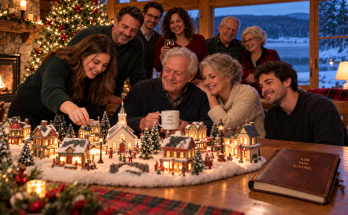
Emma arranged the village.
I did not supervise.
When she finished, the church stood near the center.
Crack visible.
The bakery had been replaced by a completely different piece she bought at a flea market.
The children faced the wrong direction.
The lamppost stood near the edge.
I looked.
"Terrible."
"Perfect."
"Those are not synonyms."
"Today they are."
Dinner happened.
Stories.
Arguments.
Laughter.
Dennis still believed he made superior potatoes.
No evidence supported him.
After dessert, Emma handed me a small wrapped package.
"We said no expensive gifts," I said.
"It's not."
I opened it.
A book.
Blank pages.
Leather cover.
On the front:
ASK THE LIVING.
I stared.
"What am I supposed to do with this?"
"Write."
"What?"
"Anything."
"I don't journal."
"Then start."
Preston leaned over.
"Maybe write down every time you were right."
"Too many volumes."
Everyone groaned.
Emma smiled.
"Write the real stories."
"Which ones?"
"The stupid ones."
I understood.
Not instructions.
Not moral lessons.
Not documents designed to survive us.
Ordinary memory.
I opened to the first page.
Everyone watched.
"I am not writing in front of you."
"Why?" Emma asked.
"Pressure."
"Boundary?"
"Yes."
She laughed.
Later, after everyone left or went to bed, Helen sat beside me.
Fire low.
Snow outside.
The village still lit.
I opened the book.
"What are you writing?" she asked.
"I don't know."
"Good."
I glared.
She smiled.
Then went upstairs.
I sat alone at the oak table.
The same table I'd built after Eleanor's secret cabin taught me that my life could contain places she had never shared.
I thought of where to begin.
Not Telluride.
Too dramatic.
Not Eleanor's death.
Too obvious.
Not money.
I wrote:
Your grandmother burned toast because she liked it that way and lied that she forgot.
I laughed.
Then another.
Preston once blamed a broken window on wind.
Emma thought inheritance meant jewelry until she learned it could also mean bad habits.
Dennis has never made good mashed potatoes.
Helen still believes sixty-eight degrees is reasonable.
I kept going.
Small things.
Living things.
Nothing sacred.
Nothing arranged for an ending.
Sometime after midnight, Preston came downstairs for water.
He saw me writing.
"What is that?"
"Nothing."
"Looks like something."
"Go back to bed."
He filled a glass.
Then stopped near the village.
"Dad."
"What?"
"You know that first Christmas?"
"Telluride."
"Yeah."
"What about it?"
"I really thought you ruined it."
I looked at him.
"I know."
He smiled sadly.
"I think about that sometimes."
"So do I."
"I blamed you because you stopped paying."
"Yes."
He leaned against the counter.
"But if you'd paid…"
I waited.
"We would've had a nice week."
"Possibly."
"Then come home."
"Yes."
"Then try to sell your house."
"Yes."
"And keep going."
"Probably."
He stared at the floor.
"You saying no changed everything."
I considered.
"No."
He looked up.
"Didn't it?"
"It exposed everything."
"Difference?"
"Yes."
I closed the book.
"The problems were already there."
He nodded.
"Fair."
"What changed things was what happened after."
"The lawyers."
"Some."
"Therapy."
"Unfortunately."
He smiled.
"Emma."
"Yes."
"Mom's letters."
"Some."
"Repayment."
"Some."
He waited.
"What then?"
I looked at my son.
"The fact that we kept choosing differently."
He became quiet.
That was the true outcome.
Not that I stayed home one Christmas.
Not that a card was cancelled.
Not that secret accounts were found.
Not even that money came back.
Choices repeated long enough became a life.
Preston nodded.
"I like that."
"Good."
He turned toward the stairs.
"Night."
"Goodnight."
"Dad."
"What?"
"Love you."
Simple.
No debt behind it.
No request.
No emergency.
"Love you too."
He went upstairs.
I sat alone again.
The village glowed.
The repaired church showed its crack.
The replacement bakery stood where the old one used to.
The lamppost remained near the edge.
Not everything survived.
Not everything needed to.
I opened Emma's book again.
On the next page, I wrote:
One Christmas, I thought staying home meant I had lost my family.
I stopped.
Then continued.
It turned out I had only stopped paying to pretend we were one.
That sentence looked harsher on paper than it felt.
So I added:
After that, we had to learn how to become one on purpose.
Better.
True.
Outside, snow covered the lake road.
Inside, everyone I loved was either sleeping upstairs, living somewhere else, or gone beyond asking.
No one needed me to solve anything.
No one was waiting for a check.
No one had made plans for my house.
No one had used Eleanor's name to win an argument.
And I no longer needed any of those absences to prove we had changed.
Tomorrow would produce new problems.
Emma would make decisions I disliked.
Preston would disappoint me again somehow.
I would irritate Helen.
Dennis would remain Dennis.
There would be bills.
Illness.
Arguments.
Loss.
Nothing we had learned made us safe from being human.
It only gave us a better way to be human together.
I closed the book.
Turned off the village lights.
The room went dark except for snowlight through the windows.
I stood.
My knee hurt.
My back hurt.
I was old.
Alive.
Loved.
Still capable of choosing.
That was enough.
I went upstairs.
The End
Read more original stories on Feel Every Story.
Nine Days Before Christmas, a Thirty-Thousand-Dollar Charge Revealed What My Son Thought I Would Always Forgive
Part 46 of 46

One Comment on “PART 46 – Years After the Christmas I Refused to Finance, Our Family Finally Understood What Staying Together Was Supposed to Cost”