Five years after my mother’s card declined at a grocery store, Olivia stood in the kitchen of a house outside Seattle and asked whether I wanted the blue bowl on the top shelf.
I looked up from a box labeled GARAGE — DO NOT LET DEREK ORGANIZE.
“I own a repair shop.”
“You alphabetized extension cords.”
“That is called civilization.”
“Do you want the bowl?”
I looked at it.
Same chipped blue ceramic bowl from our first apartment.
It had somehow survived Phoenix.
Divorce.
Seattle.
Two separate moves.
Three years of long-distance dating.
A second attempt at living in the same city.
And, eventually, our decision to buy a house together.
“Yes.”
Olivia handed it down carefully.
We never remarried.
Not because marriage had become frightening or meaningless.
Because neither of us needed the legal form to prove the relationship.
Maybe someday.
Maybe never.
We discussed it openly.
No hidden hope.
No symbolic refusal.
Just choice.
After three years long distance, I sold a minority share of Hale Automotive to Carlos.
He had earned it.
More than earned it.
I kept ownership.
Split my time initially.
Then eventually hired a general manager and moved to Washington.
Carlos called that abandonment.
Then sent me monthly numbers even though I could view them online.
Hale Automotive survived without me standing inside it every day.
Another lesson.
Being needed was not the same as being valuable.
I had feared leaving meant becoming irrelevant.
That was Marjorie’s fear.
I did not want to inherit it.
The restitution program continued for years.
Most direct Hale-linked claims were resolved.
Some funds went unclaimed because victims died without identifiable heirs.
Those amounts transferred through approved victim-assistance channels.
No money returned to me.
Good.
Arthur died in federal custody three years after trial.
Natural causes.
The notice arrived by mail.
I read it once.
Felt less than expected.
Not satisfaction.
Not grief.
An ending to a man whose influence had already stopped organizing my life.
Marjorie remained incarcerated.
I visited twice a year.
Not monthly anymore.
Her letters became infrequent.
Better.
We had a relationship with boundaries strong enough to survive silence.
She aged quickly.
Prison does that.
She worked in the library.
Helped women fill out basic financial forms through an approved program.
The irony was not lost on either of us.
During one visit she said:
“I spend half my time telling people not to sign things they don’t understand.”
I laughed.
She did too.
Then became serious.
“I wish someone had told me that.”
“Someone probably did.”
She nodded.
“Yes.”
Good.
No rewritten childhood.
No pretending Arthur erased every choice.
We talked about books.
Carlos.
Weather.
Occasionally Dad.
Rarely Olivia unless I brought her up.
That boundary held.
The last time I visited, Marjorie asked:
“Is she happy?”
“Yes.”
“And you?”
“Yes.”
She smiled.
“That’s enough.”
It was.
Rachel rebuilt a quiet life in Nevada.
She never created a relationship with Leonard.
He died in prison.
She attended no funeral.
No guilt.
Diane’s record was corrected where possible.
Her cooperation in fraud remained documented.
So did her victimization.
History did not need simple saints.
Rebecca’s father Charles finished his sentence and lived quietly afterward.
Rebecca saw him occasionally.
Their relationship remained cautious.
She once told Olivia:
“Forgiveness is not restoration.”
That sentence entered our household vocabulary.
If one of us broke something emotionally, we could apologize.
Forgiveness might happen.
Trust still needed rebuilding.
Different processes.
Thomas Porter’s remains were returned to Elaine’s family after the case concluded.
They held a small burial.
Olivia and I attended.
Elaine placed the Saint Christopher medal beside his photograph.
Dad had taken it from Westbridge intending to return it.
Thirty years late.
Finally home.
Elaine stood beside me afterward.
“Robert should’ve told me.”
“Yes.”
“He was trying.”
“Yes.”
“That doesn’t make it okay.”
“No.”
She smiled sadly.
“You’re easier to talk to than you used to be.”
“I’ve received feedback.”
Dad’s grave remained in Phoenix.
Whenever I visited the shop, I stopped there.
Sometimes with coffee.
Sometimes not.
I no longer reported every development.
Dead people did not need progress updates.
I told him ordinary things.
Carlos bought another alignment machine.
Seattle rain annoyed me.
Olivia still hated carburetor stories.
Once I said:
“You were right about her.”
Then corrected myself.
“You were wrong to think introducing us would fix me.”
I laughed.
Dad would have appreciated that distinction.
Margaret Elaine Hale’s photograph remained inside the blue notebook.
Her brother died peacefully two years after the records were corrected.
His daughter sent me a copy of the obituary.
Margaret was mentioned.
Aunt Margaret, who died young.
Her name belonged to her family again.
Small repair.
Real.
The case itself became something law students and investigators occasionally wrote about.
I declined interviews.
Olivia declined too.
Rebecca gave one professional lecture about identity fraud and coercive family systems without naming personal clients beyond public records.
Carlos told everyone who asked that documentaries were “for people who don’t have work.”
I agreed.
Hale Automotive’s new sign faded slightly in the Arizona sun.
Still there.
Teresa Wynn became a regular customer.
She refused discounts.
She once sent Carlos a Christmas card:
Brakes still good. Don’t get sentimental.
He framed it.
The house Olivia and I bought outside Seattle was ordinary.
That was its greatest virtue.
Two bedrooms.
Small garage.
Backyard.
No hidden walls.
I checked.
Olivia watched me.
“You know how weird that looked.”
“Professional inspection.”
“You knocked on every wall.”
“Due diligence.”
We installed a safe for important documents.
Both had access.
Separate personal accounts.
One shared household account.
Clear authorizations.
No family members added by default.
No spare keys distributed without agreement.
Rules that might sound excessive to other people.
To us they felt peaceful.
One evening after moving, Olivia left her purse on the kitchen counter.
I noticed.
Not because I wanted anything inside.
Because of how unremarkable it looked.
A purse.
A bank card.
Keys.
Ordinary objects.
No threat.
No claim.
No one entitled to touch them simply because they could.
That image stayed with me.
The entire catastrophe began, at least for me, with my mother calling because Olivia’s card would not work.
At the time I thought the problem was the decline.
Then the theft.
Then fraud.
Then murder.
Then family history.
Then Arthur.
Eventually I understood the deepest problem was older and simpler.
Access had been mistaken for permission.
Need for love.
Silence for peace.
Fear for loyalty.
Control for care.
Those mistakes scaled from a stolen bank card to an entire criminal network.
The scale changed.
The logic did not.
We unpacked the kitchen slowly.
Olivia held up another box.
“Wedding stuff.”
Our first wedding.
I stopped.
We had kept very little.
Photographs.
A dried invitation.
One small silver frame.
The rest had been discarded during divorce.
Olivia opened the box.
Inside was a napkin.
Faded.
A carburetor drawing.
I laughed.
“You kept that?”
“I told you I was polite.”
“For eight years?”
“Extremely polite.”
She flattened it on the counter.
Our first night.
Rachel’s party.
Dad’s nudge.
Arthur’s surveillance.
Marjorie’s plans.
All the hidden machinery surrounding a ridiculous drawing neither of us understood at the time.
Olivia looked at it.
“Does knowing how we met ruin it?”
Years ago the question would have terrified me.
Now:
“No.”
“Why?”
“Because they arranged proximity.”
I pointed to the napkin.
“We made this.”
She smiled.
“That’s a terrible carburetor.”
“It is technically excellent.”
“It has six impossible hoses.”
“Artistic license.”
She laughed.
Then asked:
“Do you ever wish none of it happened?”
The case?
Our marriage?
The crimes?
Dad’s failures?
Her leaving?
All of it.
I thought carefully.
“I wish nobody had been hurt.”
“That’s not the same question.”
“No.”
I leaned against the counter.
“I don’t wish our marriage had failed.”
She raised an eyebrow.
“Interesting.”
“I wish I had treated you differently inside it.”
“Yes.”
“But if I wish the divorce away, I’m wishing away the consequence that finally forced me to see what I was doing.”
Olivia nodded.
“And us now?”
“I’m not calling this reward.”
“Good.”
“We’re not together because suffering earned us something.”
“Very good.”
“We’re together because we chose it again.”
She smiled.
“Better.”
I looked at her.
“What about you?”
“Do I wish none of it happened?”
“Yes.”
She thought longer.
“I wish your mother never touched my purse.”
Fair.
“I wish your father went to police before Thomas died.”
“Yes.”
“I wish Diane told Rachel.”
“Yes.”
“I wish Arthur never existed.”
Understandable.
Then:
“But I don’t wish I never loved you.”
My throat tightened.
“Even the bad version?”
Olivia looked offended.
“I had excellent taste. You had poor maintenance.”
I laughed.
Then she became serious.
“I don’t divide you into old Derek and new Derek.”
That surprised me.
“You changed. But the person who changed is the same person who hurt me.”
I nodded.
“That matters.”
“Yes.”
“And?”
“And I chose to build something with that whole person after I saw the change last long enough to trust.”
That meant more than forgiveness.
Because it had never been owed.
It had been evaluated.
Chosen.
Our relationship now existed because Olivia was free to leave and stayed anyway.
Marjorie had spent her life trying to eliminate that freedom.
Arthur too.
They believed love became safer when choices narrowed.
The opposite was true.
Love mattered because leaving remained possible.
We put the napkin in a frame.
Not beside wedding pictures.
In the kitchen.
A ridiculous drawing.
Ours.
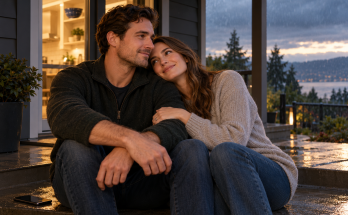
Later that night, we sat on the back steps while rain tapped the patio roof.
I had eventually learned not to complain about Seattle weather every time.
Mostly.
Olivia leaned against me.
“I have a question.”
“Dangerous opening.”
“If your mother had called that day and said, ‘I stole Olivia’s card and it got declined,’ what would you have done?”
I laughed softly.
“Then?”
“Yes.”
The whole five-year journey compressed into one ordinary question.
What would I have done differently if truth arrived without disguise?
“I want to say I would’ve defended you.”
“Would you?”
I thought about the man I was.
“No.”
Olivia nodded.
“I probably would’ve asked why you canceled it.”
“Correct.”
“I would’ve looked for a reason Mom wasn’t really stealing.”
“Correct.”
“I might’ve gotten angry at you anyway.”
“Also correct.”
“That’s hard to admit.”
“I know.”
Then she asked:
“What would you do now?”
Easy.
“I’d ask whether you were safe.”
She waited.
“Then I’d tell her the card wasn’t hers.”
“And?”
“I’d cancel access.”
“And?”
“I’d believe that your boundary didn’t require my approval.”
Olivia smiled.
“That’s the answer.”
Not that I would magically know every fact.
Not that I would always choose perfectly.
That I would begin in the right place.
The person whose boundary was crossed.
Not the person demanding access.
We sat in silence.
Rain.
Warm light from the kitchen.
Blue bowl visible through the window.
No hidden camera.
No missing key.
No one watching.
My phone buzzed on the step.
A prison voicemail notification.
Marjorie.
I looked at it.
Olivia did too.
“You going to answer?”
“Tomorrow.”
She smiled.
“Good.”
I left the phone facedown.
Not rejection.
Not fear.
Choice.
Olivia rested her head against my shoulder.
Some endings look like court verdicts.
Some like graves.
Some like airports.
Ours looked like a wet backyard and a phone I did not need to answer immediately.
I had spent most of my life believing family survived when nobody left, nobody exposed too much, and everyone forgave fast enough to keep the structure standing.
I was wrong.
The structures built that way eventually became prisons.
What survived instead was smaller.
Truth.
Boundaries.
Repair when possible.
Consequences when necessary.
Love without ownership.
Memory without worship.
And the freedom to choose again.
The next morning I listened to Marjorie’s voicemail over coffee.
She said only:
“Hi, Derek. No emergency. Call whenever you want. I hope you and Olivia are well.”
Twenty seconds.
No guilt.
No demand.
No question.
I smiled.
Then finished breakfast before calling her back.
The End
Read more original stories on Feel Every Story.
My Mother’s Furious Phone Call Forced Me to Notice the Question I Had Spent Three Years Refusing to Ask
Part 47 of 47