
We arrived at school twenty minutes before the first bell. The parking lot was still relatively quiet, and the morning sun had barely reached the windows on the upper floor. Hailey sat beside me with her backpack on her knees. She had asked to arrive early so she could enter before the hallways filled with students. Now that we were there, she seemed uncertain whether she could move. I turned off the engine and waited. She looked at the front doors, then down at her hands. I asked whether she wanted me to walk inside with her. She nodded. I picked up my bag and stepped out of the car.
The air was cool enough that Hailey pulled the sleeves of her shirt over her wrists. We walked toward the entrance together, our footsteps sounding unusually loud against the pavement. A few students passed us, talking about homework and weekend plans. None of them seemed to notice Hailey. She watched them carefully anyway. At the doors, she stopped and looked at me. I asked whether she wanted another minute. She shook her head. Then she opened the door and stepped inside. I followed her toward the counselor's office, where we had arranged to meet before classes began.
The counselor greeted us warmly but without making a spectacle of Hailey's return. She reviewed the morning schedule and reminded my daughter that she could come to the office if she needed a break. Hailey asked whether Lily would be in her first class. The counselor confirmed that they shared the same class and that Lily had been informed only that Hailey was returning on a reduced schedule. My daughter looked relieved. She had worried about walking into a room alone. Knowing a familiar face would be there seemed to make the next step manageable. I asked whether she wanted me to wait nearby for a while. She said yes, but she wanted to enter the classroom herself.
We walked down the hallway together. The building smelled faintly of floor cleaner and paper. Lockers lined the walls, and a few students were gathering near classroom doors. Hailey slowed when we approached the corner where she had become anxious during our earlier visit. I noticed her breathing change. She stopped beside a display of student artwork and looked at one of the photographs. I waited without speaking. After a moment, she took a slow breath and continued. When we reached her classroom, she turned toward me. I told her I would be in the counselor's office for a while and that she could contact me if needed. She nodded, then stepped through the doorway.
I watched her disappear into the room. For several seconds, I remained in the hallway, feeling an urge to follow. I wanted to see whether she found a seat, whether Lily greeted her, and whether the teacher treated her gently. But Hailey had asked to enter alone. I turned and walked back toward the counselor's office. Each step felt strangely difficult. I had spent weeks keeping her close because I was afraid of what might happen when she was out of sight. Now I was being asked to trust the arrangements we had made and allow her a small measure of independence. I knew that was part of helping her recover, but knowing did not make it easy.
The counselor offered me a chair and asked whether I wanted coffee. I declined. I sat near the window and opened my notebook, though I could barely focus on the page. I thought about the first morning Hailey had told me she felt sick. Mark had insisted she go to school, and I had allowed his certainty to outweigh her discomfort. Now I was sitting in the same building, hoping she could remain in class because she wanted to be there. The difference mattered. I had learned that attendance, grades, and routines could not be separated from safety. A child could appear responsible while suffering terribly, and a child who needed time away from school was not necessarily avoiding responsibility.
After about forty minutes, the counselor received a brief message confirming that Hailey was still in class and appeared settled. She shared the update with me, and I felt my shoulders loosen. I knew it was only one small part of the morning, but I was grateful. I asked whether I should remain until the scheduled end of the reduced day. The counselor said I could, though Hailey also had the option of contacting me if she needed support. I decided to stay. I did not want her to feel trapped if the day became overwhelming. At the same time, I reminded myself that I did not need to hover outside every classroom. The school had agreed to help.
When the first class ended, Hailey sent me a short message. She said Lily had saved her a seat and that the teacher had treated her normally. I read the words twice. Then I replied that I was glad and would see her when she was ready. I resisted adding a long paragraph about how proud I was. Hailey had asked me not to turn every ordinary accomplishment into a speech about courage. I wanted to respect that. I placed the phone on my lap and looked out the window. A group of students crossed the courtyard, laughing about something I could not hear. For the first time in weeks, I imagined Hailey among them without immediately picturing danger.
The second class was more difficult. Hailey sent a message saying she felt anxious and wanted to visit the counselor's office. A few minutes later, she appeared in the doorway. Her face was pale, and she held her backpack tightly against her side. I stood, but she raised a hand and asked me not to make a fuss. I sat back down. The counselor invited her to take a chair and offered water. Hailey accepted. She explained that a sudden noise in the hallway had startled her and made it difficult to concentrate. The counselor listened, then asked whether she wanted to rest before deciding what to do next.
Hailey sat quietly for several minutes. I watched her breathing settle. She looked at the clock, then at the schedule in her notebook. She said she had planned to attend one more class, but she was not sure she could manage it. I told her she could leave if she needed to. The counselor agreed that the schedule was flexible. Hailey looked relieved, then disappointed. She said she had wanted to complete the whole morning. I reminded her that she had already attended classes and practiced asking for support when she needed it. She nodded, but I could see she was frustrated. I did not try to remove that feeling. It belonged to her, and she was allowed to have it.
After a few minutes, Hailey asked whether she could stay for a shorter portion of the final class. The counselor discussed the option with her and confirmed that it could be arranged. My daughter considered it, then decided to try. She looked at me and asked whether I would still be there afterward. I said yes. She stood, adjusted her backpack, and walked toward the door. Before leaving, she turned and said she was not trying to prove anything. She simply wanted to see whether she could do it. I told her I understood. She nodded and disappeared down the hallway.
I remained in the counselor's office, thinking about the difference between determination and pressure. I had once encouraged Hailey to push through discomfort because I believed persistence was always good. Mark had used similar language to dismiss her illness, and I had accepted it. Now I was learning that persistence mattered only when it belonged to the person making the choice. Hailey had decided to try another class, but she had also been given permission to stop. That freedom changed the meaning of the effort. She was not being forced to prove she was well. She was exploring what felt possible.
When Hailey returned, she looked tired but pleased. She had stayed for part of the final class and completed a short assignment. Lily had walked with her between rooms, and the teacher had quietly checked whether she needed anything. Hailey said she wanted to go home now. I agreed. We thanked the counselor and walked toward the entrance. The hallway was busier than when we arrived, but Hailey moved steadily beside me. She kept her eyes forward, occasionally glancing at passing students. Nobody stopped us. A few classmates smiled or waved. Hailey returned the gestures without pausing.
Outside, she took a long breath and looked toward the parking lot. I asked whether she wanted lunch before we went home. She said she would rather eat at Amanda's house. We drove in silence for several minutes. Then she began telling me about her first class. The teacher had started a discussion about a book they were reading, and Lily had whispered a joke about one of the characters. Hailey laughed as she repeated it. I smiled, listening to the familiar rhythm of her school stories. For years, she had come home complaining about assignments and describing small classroom dramas. Hearing her do that again felt unexpectedly precious.
At Amanda's house, Hailey went upstairs to change. I prepared soup and sandwiches while Amanda finished a phone call for work. When my daughter returned, she sat at the table and began eating. She looked exhausted, but her appetite was better than I expected. Amanda asked how school had gone. Hailey said it was strange, but not as terrible as she had imagined. She described Lily saving her a seat and the counselor helping when she became anxious. Amanda listened without interrupting. Then she asked whether Hailey wanted to return for another reduced morning. My daughter said she thought so, though she wanted to discuss the timing with Lauren first.
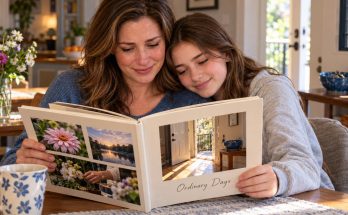
That afternoon, Hailey slept for nearly two hours. I checked on her once, quietly opening the door enough to see that she was resting. She did not stir. I closed it again and returned downstairs. Amanda was sorting photographs on the kitchen table. She had printed several images from Hailey's Ordinary Days collection and placed them in a folder. I looked through them slowly. There was the flower from the garden, the pond at the park, the library steps, and the sneakers beside the bench where she had met Lily. Each image represented a moment when Hailey had chosen to notice something beyond her fear. I felt grateful for the collection, not because it proved she was healed, but because it showed she was still curious about the world.
When Hailey woke, she came downstairs carrying her camera. She asked whether I wanted to see a picture she had taken at school. I was surprised. I had not realized she had used the camera during the visit. She showed me an image of sunlight falling across an empty desk near the classroom window. The photograph was simple, almost abstract. She said she had taken it during a quiet moment before class began. I asked why she liked it. She said the desk looked ordinary, and that was exactly what she had wanted to capture. For months, school had seemed like a frightening place she might never return to. Now she had a photograph of a desk she had sat beside.
Later that evening, Lauren called to check on the school visit. Hailey spoke with her privately for a while, then invited me to join the conversation. She explained that the day had been difficult but manageable. Lauren asked what had helped most. Hailey said knowing she could leave if she needed to had made it easier to stay. She also said Lily's presence mattered. Lauren helped her think about how to approach future visits without expecting every day to feel the same. I listened carefully. I wanted to plan the next week immediately, but Hailey needed time to rest and decide what she wanted.
After the call, Hailey asked whether we could watch a movie together. Amanda joined us, and we chose a comedy none of us had seen. Hailey curled up on the couch with a blanket while I sat beside her. She laughed at several scenes, then became quiet during a tense moment. I noticed but did not ask whether she was all right. She shifted closer to me and continued watching. When the movie ended, she said it had been fun. I told her I enjoyed it too. She looked at Amanda and asked whether we could make movie night a regular thing. Amanda said she would be happy to, provided Hailey helped choose films that were not three hours long.
The following morning, Hailey asked whether Lily could come over during the weekend. I said we could arrange it with Amanda. My sister agreed immediately. Hailey sent a message, and Lily replied that she would love to visit. They planned to work on photographs and perhaps bake something if Amanda did not mind using the kitchen. I watched Hailey discuss the plans with a seriousness usually reserved for major events. She wanted to choose snacks, clear a space on the table, and make sure her camera batteries were charged. I realized she was planning something ordinary without first asking whether Mark would be home. That freedom still felt new to her.
As the weekend approached, I continued attending my own counseling appointments. I spoke about the school visit and the anxiety I had felt while waiting. My counselor helped me recognize that I was still trying to prevent every possible discomfort Hailey might experience. I wanted to protect her, but I could not build a life for her in which nothing unexpected ever happened. She needed reliable support and reasonable safety, not constant supervision. I left the appointment thinking about how difficult it was to distinguish between care and control when fear had shaped so many recent decisions. I knew I would have to keep learning.
Lily arrived on Saturday afternoon carrying a bag of cookies and a small notebook of photography ideas. Hailey met her at the door. The girls went into the kitchen and spread their photographs across the table. Amanda helped them find colored paper for arranging prints, then returned to her own work. I stayed nearby but did not hover. They talked about school, music, and a teacher who had assigned an unexpectedly difficult project. Their laughter drifted through the house. At one point, Hailey came to ask whether they could go into the garden to take pictures. I said yes. She smiled and hurried back to Lily.
I watched them through the kitchen window. They moved around the flower beds, occasionally kneeling to photograph leaves or shadows. Lily said something that made Hailey laugh so hard she had to lower the camera. I felt tears rise, but I turned away before she could notice. The moment was not proof that everything was fine. It was simply two friends enjoying an afternoon. I was beginning to understand that such moments did not need to carry the weight of recovery. They were valuable because they belonged to Hailey's life, not because they represented a milestone.
After Lily left, Hailey helped clear the kitchen table. She looked tired but content. I asked whether she had enjoyed the visit. She said yes. Then she told me Lily had not asked any more questions about her absence. They had talked about photography and school instead. Hailey said she appreciated that. I told her I was glad she had a friend who respected her boundaries. She nodded, then said she wanted to return to school again the following week. I asked whether she had a particular day in mind. She said she would check with Lauren and the counselor, but she thought she was ready to try another reduced morning.
That night, Hailey came to my doorway before bed. She asked whether I thought she had changed too much to have a normal life. I looked at her, surprised by the question after such a pleasant afternoon. She said sometimes she felt happy and then remembered what had happened, and the happiness seemed fragile. I told her that difficult memories did not cancel good moments. She could feel joy and fear on the same day without either feeling being false. She considered that, then asked whether I believed she could still become the person she wanted to be. I said I believed she could continue discovering who she wanted to become, and that Mark did not get to decide that for her.
Hailey nodded slowly. Then she said she wanted to enter the photography competition the school had mentioned. She had been thinking about it since visiting the art room, but she had been afraid to commit. I asked whether she knew the deadline. She said there were several weeks left. I told her we could help her prepare if she wanted. She smiled and said she already had ideas. She wanted to submit a photograph from her Ordinary Days collection, though she had not chosen which one. I told her I looked forward to seeing what she decided.
After she went to bed, I sat at the kitchen table and looked through the photographs she had printed. The images were quiet and precise, full of details most people would overlook. I thought about the morning she had returned to school and the way she had chosen to stay for part of another class after becoming frightened. I also remembered how she had asked me not to turn every effort into a speech about courage. I smiled to myself. She was teaching me how to support her without making her life a constant response to what Mark had done. The competition would be another choice that belonged to her, and I intended to let her make it.
Click here to continue reading: PART 12: As the Case Against Mark Moved Forward, My Daughter Made a Decision About Her Photographs That Showed Me What She Refused to Surrender
My Daughter Kept Saying Something Was Wrong, but the Way My Husband Reacted Made Me Question Everything I Believed About Our Family
Part 11 of 34

One Comment on “PART 11 – My Daughter Walked Back Into School Expecting Everyone to Stare, but One Ordinary Conversation Helped Her Remember Who She Had Been Before”