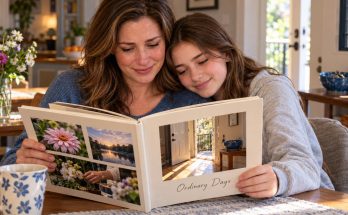
The first time I realized my daughter might be frightened of her own home, she was standing at the kitchen sink with a glass of water trembling between her fingers. Hailey was fifteen, old enough to insist she could handle most things herself, yet that morning she looked younger than she had in years. Her face was pale, and the dark circles beneath her eyes had deepened. I asked whether she wanted to stay home from school. Before she could answer, my husband, Mark, walked into the kitchen. Hailey immediately set down the glass. Her shoulders tightened. Whatever she had been about to tell me disappeared behind a quiet, practiced expression.
Mark noticed her hesitation. He noticed almost everything that happened in our house, or so I believed. He pulled open a cabinet, took out his coffee mug, and asked why she was still wearing her pajamas. Hailey said her stomach hurt. He sighed as though she had announced an inconvenience rather than an illness. He reminded her that she had missed enough classes and that teachers would eventually stop accepting excuses. His voice was not especially loud. That was one of the things I would remember afterward. He rarely needed to raise it. Hailey lowered her eyes, murmured that she would get dressed, and left the room without finishing her water.
I watched her disappear down the hallway. Something about the exchange troubled me, although I could not have explained exactly what. For several weeks, Hailey had complained of nausea, headaches, and an exhaustion that sleep never seemed to improve. She had stopped asking to visit friends. Her camera, once practically attached to her hand, remained untouched on her bedroom shelf. At dinner she pushed food around her plate and claimed she had eaten earlier. I had attributed the changes to school pressure, adolescence, or some lingering illness. Mark had an explanation for every symptom. He was so certain that I had begun to borrow his certainty.
That morning, however, I found myself listening to the sound of Hailey's bedroom door closing. I asked Mark whether he thought we should make a doctor's appointment. He turned toward me with an expression of mild disbelief. He said we had discussed this already and that Hailey needed consistency, not another opportunity to avoid her responsibilities. According to him, she was going through a difficult phase and had discovered that saying she felt sick brought her attention. I disliked hearing him describe our daughter that way. Still, I had spent years trusting his judgment. I told myself that two parents could interpret the same behavior differently without either being cruel.
We had been married long enough that our household operated through familiar routines. Mark left for work at predictable hours. I managed most of Hailey's school arrangements, meals, and appointments. We paid bills, discussed groceries, and occasionally argued about ordinary things that seemed important until something truly terrible happened. From the outside, we looked like a stable family. Friends described Mark as dependable. Neighbors saw him mowing the lawn, carrying shopping bags, and greeting people across the driveway. I had never imagined that the appearance of ordinary domestic life could make me less willing to examine what happened inside it.
Hailey had once filled that house with noise. She sang while making breakfast, left shoes in inconvenient places, and photographed everything from rainwater on the windows to the shadows of tree branches across the porch. She could spend twenty minutes explaining why a particular patch of evening light made an otherwise unremarkable photograph beautiful. Mark sometimes teased her about the hundreds of pictures stored on her phone. She would roll her eyes and continue taking them. Their relationship had never seemed especially affectionate, but I believed they understood each other. When she became withdrawn, I assumed the distance was another ordinary part of growing older.
By the second week of her illness, I began waking at night and checking whether her bedroom light was still on. Often it was. I would find her sitting against the headboard, knees drawn beneath a blanket, staring at a book she had not turned a page of. She said she could not sleep. Sometimes she complained that her stomach hurt. Other times she insisted she was fine and asked me to leave. I tried not to crowd her. I remembered being fifteen and wanting privacy. Yet every morning she looked more exhausted, and I could no longer remember the last time I had heard her laugh without first checking who was nearby.
One afternoon, I came home earlier than expected and found Hailey sitting on the back steps. Her camera rested beside her, but its lens cap was still attached. She was looking toward the garden, where a few late flowers leaned against the fence. I sat beside her and asked why she had stopped taking pictures. She shrugged. I asked whether someone at school had been bothering her. She shook her head. After a long silence, she said she did not feel like herself anymore. The words were simple, but the way she said them frightened me. I asked what she meant. She pressed her palms together and stared at her hands.
I waited. She seemed to be searching for a way to begin. Twice she opened her mouth without speaking. Finally, she asked whether I would be angry if she told me something difficult. I said there was nothing she could say that would make me stop loving her. She looked at me for a moment, and I thought she might cry. Then the back door opened. Mark stepped outside, glanced from me to Hailey, and asked what we were discussing. My daughter stood so quickly that her camera slipped from the step. I caught it before it struck the concrete. She said she had homework and hurried inside.
Mark watched her go. He shook his head and remarked that she had become unusually sensitive. I asked why she seemed nervous whenever he entered a room. He looked surprised, then irritated. He said I was imagining things because I had become too worried about her. According to him, Hailey was uncomfortable because she knew he expected her to attend school and complete her responsibilities. I wanted to challenge that explanation. Instead, I looked down at the camera in my hands. The strap had twisted around my wrist. I realized I was gripping it hard enough to leave a mark.
That evening, Hailey barely touched her dinner. Mark asked whether she had finished an assignment. She nodded. He questioned her about a missed class, and she gave a short answer I could hardly hear. I watched the exchange more closely than usual. She did not simply avoid eye contact. She seemed to calculate every word before speaking. When Mark reached across the table for the salt, she flinched. The movement was small, almost invisible, but I saw it. Mark continued eating. I wondered whether he had noticed and chosen to ignore it, or whether I was finally seeing something that had been happening for longer than I understood.
After dinner, I went upstairs and knocked on Hailey's door. She was sitting on the floor beside her bed, surrounded by notebooks she had not opened. I asked whether she wanted to talk about what had happened outside. She said there was nothing to discuss. I told her I was concerned about her health. Her expression changed when I mentioned a doctor. For a moment she looked relieved. She asked whether I could take her somewhere soon. I said I would arrange an appointment. Then she asked a question that caught me off guard: would I go with her alone?
I told her of course I would. She studied my face as though checking whether I meant it. Then she asked whether Mark needed to know. I felt an uneasy pressure beneath my ribs. Parents usually shared information about their children, and I had never considered keeping a medical appointment from my husband. I asked why she did not want him involved. Hailey looked toward her closed door. She said she simply preferred that he not come. I could have asked more questions. I could have sat down beside her and waited until she felt ready to explain. Instead, I reassured her that everything would be fine, not understanding how little that promise meant without action.
The following morning, Mark found me looking up local medical offices. He asked what I was doing, and I told him I intended to have Hailey examined. His reaction was immediate. He said I was encouraging her behavior and that the last thing she needed was another reason to believe she could avoid school. I replied that several weeks of feeling ill justified a professional opinion. He reminded me that we had expenses coming up and asked whether I really wanted to spend money confirming that a teenager was stressed. His tone carried the familiar confidence that had settled so many disagreements between us.
For the first time, I refused to end the conversation there. I said I would rather pay for an unnecessary appointment than overlook something serious. Mark looked at me for several seconds. Then he gave a short laugh and told me to do whatever would make me feel better. He left the kitchen without finishing his coffee. I stood there feeling both relieved and strangely ashamed, as though taking my sick daughter to a doctor had become an accusation against my husband. It was an absurd feeling. I recognized that even then. What I did not recognize was how carefully I had learned to avoid upsetting him.
When I told Hailey about the appointment, she asked when we could go. I said I was trying to find the earliest available time. She nodded, but her eyes filled with tears. I reached toward her, and she allowed me to hold her for a moment before stepping away. I asked whether the pain had become worse. She said she did not know. Then she added that she was tired of being afraid. I felt the words settle between us. I asked what frightened her. She looked past me toward the hallway and said she was worried something was terribly wrong with her.
I assumed she meant an illness. I began talking about how many conditions could cause fatigue and stomach pain, how doctors could run tests, and how worrying often made physical symptoms feel worse. Hailey listened without interrupting. Only later would I understand that she had not been asking for a medical explanation. She had been trying to tell me that fear itself had become part of her daily life. I was so determined to comfort her that I answered a question she had never asked.
Over the next several days, I noticed things that made me increasingly uncomfortable. Hailey stayed in her room whenever Mark was home. If he called her name, she responded immediately, even when she had been asleep. She avoided the living room unless I was there. Once, when I mentioned that I needed to stop at the grocery store, she asked whether she could come along despite having complained of a headache all afternoon. I suggested she rest. Her face changed. She asked how long I would be gone. I said perhaps forty minutes. She put on her shoes and came with me.
At the store, she followed closely as I moved between aisles. I bought soup, crackers, and the ginger tea she sometimes drank when she felt nauseated. Near the checkout, I asked whether she wanted anything else. She shook her head. Then she quietly thanked me for bringing her. I almost laughed because the errand had been so ordinary. Instead, I asked why it mattered. She looked at the shoppers around us and said she liked being away from the house. I felt a sudden chill despite the warmth of the store. I asked whether something at home was upsetting her. She said she was tired and wanted to leave.
That night, I lay awake beside Mark while he slept. I listened to the ceiling fan and thought about the questions Hailey had asked, the way she watched doors, and the relief she showed whenever we left the house together. None of it formed a complete explanation. I had no evidence of anything beyond a frightened, unwell teenager and a husband who responded harshly to her complaints. Yet the uneasiness would not leave me. I remembered the camera falling from the back step and the way Hailey had rushed inside. I remembered her asking whether Mark had to know about the appointment. Those details no longer seemed unrelated.
The next morning, I called the medical office again and explained that my daughter's symptoms had persisted and appeared to be worsening. The receptionist offered an earlier appointment. I accepted before checking Mark's schedule. When I told Hailey, she closed her eyes and released a breath I had not realized she was holding. I said we would go together and that she could speak privately with the doctor if she wanted. She asked whether I would believe her if the doctor found something serious. I told her yes. She nodded, but the expression on her face suggested that believing her was not the only thing she feared.
Later that afternoon, Mark asked when the appointment was scheduled. I told him. He looked annoyed and said he could not understand why I was making such a production of ordinary teenage complaints. I said Hailey was clearly suffering. He answered that she had always known how to make people worry about her. The remark struck me differently than it had before. I asked why he was so determined to dismiss her symptoms. His face hardened. He said I was turning a simple disagreement into something ugly. Then he walked away, leaving me with a question I could no longer push aside: why did he seem more concerned about preventing the appointment than discovering whether our daughter was well?
On the morning of the visit, Hailey came downstairs dressed before I called her. She carried a small bag and wore the gray sweatshirt she often pulled around herself when she felt anxious. Mark was already in the kitchen. He asked whether she intended to miss another day of school. I said she had a medical appointment. He looked at Hailey, then at me, and told us not to let a doctor frighten us with unnecessary tests. Hailey did not answer. She stood near the door, clutching the strap of her bag. I picked up my keys and told her we were leaving.
As we drove, she watched the houses pass without speaking. I kept the radio off. At a red light, I asked whether there was anything she wanted me to tell the doctor before we arrived. She shook her head. I said she could tell the doctor herself. After another silence, she asked whether the doctor would have to tell Mark everything. I explained that we could ask about privacy and that her safety and health came first. She turned toward the window again. I could see her reflection in the glass. Her lips were pressed together, and her eyes were wet.
At the medical office, the receptionist handed me paperwork while Hailey sat in a chair near the wall. I filled in her name, age, symptoms, and emergency contact information. When I reached the section asking about family circumstances, I hesitated with the pen above the page. Nothing in our official information reflected what I had been observing. We were a married couple raising our daughter in a comfortable home. We had insurance, employment, and an address we had occupied for years. I wondered how much suffering could exist behind ordinary answers on an ordinary form.
A nurse called Hailey's name. My daughter rose slowly, and I followed her down the hallway. As we approached the examination room, she reached for my hand. It was the first time she had done that in public for years. I held it without comment. Inside, the nurse asked about her symptoms, and Hailey answered in short phrases. When asked whether she felt safe at home, she stopped speaking. I felt her fingers tighten around mine. The nurse waited. Hailey glanced at me, then toward the closed door. She opened her mouth, but no words came.
I had brought her there expecting someone to explain her illness. Instead, I sat beside my daughter and watched her struggle to answer a question that should have been simple. The nurse gently offered to speak with her privately. Hailey looked at me once more, and this time I understood that she needed me to do something difficult. I stood, told her I would be just outside, and walked into the hallway. The door closed behind me. For the first time, I stopped trying to supply an explanation for her silence and allowed someone else to hear what she might finally be ready to say.
Click here to continue reading: PART 2: The Doctor Asked My Daughter One Question in Private, and Everything I Had Dismissed Began to Take on a Terrifying Meaning
My Daughter Kept Saying Something Was Wrong, but the Way My Husband Reacted Made Me Question Everything I Believed About Our Family
Part 1 of 34