The first anniversary of the day Hailey told the doctor she did not feel safe at home arrived on a Thursday.
I knew the date before I looked at the calendar.
For weeks, I had been aware of it approaching, even when I tried not to count the days. I remembered the medical office, the examination room, the doctor's careful questions, and the moment my daughter finally spoke about Mark.
I remembered how frightened she had been.
I remembered how long it took me to understand that the danger was not something happening outside our family.
It had been living inside our home.
On the anniversary morning, I woke early and went into the kitchen. The apartment was quiet. Sunlight reached across the counter, touching the uneven blue ceramic bowl beside the door.
Our keys rested inside it.
I filled the kettle and stood by the window while the water heated.
I had expected the date to feel unbearable.
Instead, I felt a complicated mixture of sadness, gratitude, and ordinary morning tiredness.
There were bills to pay. The refrigerator needed groceries. Hailey had a photography club meeting after school, and I had promised to pick her up afterward.
Life had continued.
Not neatly.
Not without difficult days.
But it had continued.
Hailey came downstairs shortly after seven, wearing jeans and a pale gray sweatshirt. She poured cereal into a bowl and sat at the kitchen table.
“Morning,” she said.
“Morning.”
She ate quietly for a few minutes, then looked toward the calendar on the refrigerator.
“I know what today is.”
I set down my cup.
“Okay.”
She looked at me.
“Are you going to ask how I feel?”
“Would you like me to?”
She considered that.
“Not right now.”
“All right.”
She returned to her breakfast.
After a moment, she added, “I talked about it with Lauren yesterday.”
I nodded.
“Was that helpful?”
“Yeah.”
She stirred the cereal with her spoon.
“I told her I didn't want today to be some kind of ceremony.”
I smiled faintly.
“That sounds like you.”
She looked up.
“I want to go to school. I want to see Lily and Sophie. And I want to finish the pictures for the club.”
“Then that's what we'll do.”
She nodded, satisfied.
The anniversary passed through the morning like an ordinary date carrying an extraordinary memory.
I drove Hailey to school. She climbed out of the car, adjusted her backpack, and waved before walking toward the entrance.
She no longer paused at the doors every morning.
Sometimes she still felt anxious. Sometimes she used the counselor's office or needed a shorter day. But the school had become a place where she could study, work with friends, and participate in activities she enjoyed.
Her attendance had gradually become more consistent.
She had not been required to prove her recovery through perfect performance.
The flexibility had helped her return.
I watched her disappear inside the building, then drove to work.
The criminal case had concluded several months earlier, after the court accepted Mark's agreement. The final orders remained in effect, including restrictions intended to protect Hailey from unwanted contact.
We had received no prohibited contact from him.
The divorce proceedings had also advanced. Through my attorney, I had completed the remaining financial disclosures and worked through the necessary arrangements. Eventually, the court entered the final divorce judgment.
The marriage was legally over.
When my attorney called to tell me, I had been standing in the grocery store beside a display of oranges.
I remembered holding the phone in one hand and a shopping basket in the other.
There had been no dramatic music, no sudden feeling of freedom.
Just the quiet knowledge that the legal tie to Mark had ended.
I bought the oranges, drove home, and told Hailey at dinner.
She listened, then asked whether that meant we would have to move again.
“No,” I said.
She looked relieved.
“Good. I like my room.”
I smiled.
“So do I.”
Then she asked for another serving of pasta.
That was how the news entered our lives.
A legal ending, followed by dinner.
In the months after the criminal case concluded, Hailey continued seeing Lauren. Some appointments were easier than others. She still had occasional nightmares, and sudden anger sometimes frightened her before she could identify why.
But she had become better at asking for help.
She no longer apologized every time she needed a break.
When she felt overwhelmed, she sometimes came into the kitchen and said, “I need you to listen, not fix it.”
I had learned to understand the difference.
Other times, she wanted advice.
Sometimes she wanted nothing more than a sandwich and an hour alone with her photographs.
I was learning to let those needs change from day to day.
Her friendship with Lily and Sophie had deepened, and Nora had become part of their small circle. The four girls spent weekends exploring local parks, comparing photographs, and arguing about which cafés served the best hot chocolate.
They were not always together.
They had ordinary disagreements, changed plans, and occasionally irritated one another.
I was grateful for that too.
Their friendships were not fragile arrangements built entirely around Hailey's needs.
They were relationships in which she could be funny, stubborn, generous, impatient, and occasionally wrong.
She was allowed to be fifteen.
The gallery exhibition had closed after its scheduled run. Claire sent the participating students photographs of the display and invited them to attend future workshops.
Hailey kept a copy of the gallery program in her blue memory box.
Beside it, she placed Nora's photograph of the two of them at the arts center, the picture Lily had taken during the school presentation, and a small print from the opening reception.
The box had become crowded.
One afternoon, Hailey brought it into the living room and announced that she needed another one.
I laughed.
“What happened to the girl who said she wanted to keep only a few things?”
“She took too many pictures.”
We went shopping for a second box.
She chose a plain wooden one with a sliding lid.
At home, she labeled it New Memories.
The blue box with white stars remained on her shelf.
She did not throw it away.
She said she liked having both.
On the anniversary afternoon, I picked Hailey up after her photography club meeting. She climbed into the car carrying a large folder and a paper bag.
“Don't look in the bag,” she said immediately.
I glanced at it.
“Should I be concerned?”
“No.”
“Is it alive?”
She laughed.
“Mom.”
I smiled and started the car.
She spent the drive telling me about a new club project. The students were creating a small collection of photographs showing familiar places through different perspectives. Hailey had volunteered to help organize the final display.
She sounded excited.
At a traffic light, she looked toward me.
“Can we stop at Amanda's?”
“Of course.”
My sister was home, working in the garden. She greeted us at the gate, wiping soil from her hands.
Hailey carried the paper bag inside without explanation.
Amanda looked at me.
“What's that?”
“I've been told not to ask.”
My sister smiled.
“That sounds promising.”
We spent the afternoon in the garden. Hailey photographed the flower bed where she had taken one of her earliest pictures after leaving Mark.
The flowers had changed again.
Some of the plants were taller, and others had been replaced. The soil was darker after recent rain. A small wooden marker stood near the edge of the bed, identifying a variety Amanda had planted that spring.
Hailey knelt beside the path and adjusted her camera.
I watched her from the porch.
A year earlier, she had stood in this same garden, frightened by sudden noises and uncertain whether she would ever feel safe.
Now she was carefully adjusting the angle of a photograph because she disliked the way a garden hose appeared in the background.
“Can you move that?” she called.
I looked behind me.
“The hose?”
“Yes, please.”
I moved it.
She raised the camera again.
“Perfect.”
Amanda laughed from the porch.
“She's becoming demanding.”
Hailey looked up.
“It's called artistic direction.”
We all laughed.
Later, while Amanda prepared tea, Hailey asked me to sit beside her at the garden table.
She placed the paper bag between us.
“I made something,” she said.
I looked at her.
“For me?”
She nodded.
“Open it.”
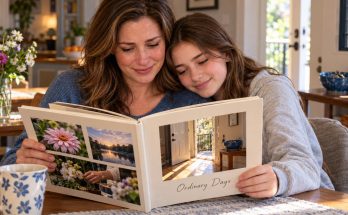
Inside was a small handmade photo book.
The cover was simple, with thick cream-colored paper and a photograph of morning light falling across our apartment window.
Beneath the image, Hailey had written two words.
Ordinary Days.
I ran my fingers over the cover.
“Hailey.”
“Look inside.”
I opened the book.
The first photograph was the flower from Amanda's garden, its petals covered in dew.
I remembered the morning she had taken it.
She had been frightened and exhausted, but she had wanted to go outside with her camera.
The next photograph showed the pond reflections.
Then came the library steps, the sneakers beside the park bench, and the empty classroom desk filled with sunlight.
There were photographs from our apartment: the first morning light across her desk, three mugs on the kitchen table, and the narrow balcony overlooking the courtyard.
I turned another page.
The botanical garden appeared, with fern shadows stretching across the stone floor.
Then the paired photographs of Amanda's flower bed, taken in different seasons.
Seasons in the Same Garden.
I paused over them.
The changes were subtle.
The shape of the bed remained recognizable, but the light, flowers, and shadows had shifted.
I remembered the conversation we had shared when Hailey first placed the images side by side.
She had said she liked how they belonged together without being identical.
I turned the page.
There was the river at sunrise.
The passage between buildings.
The flower seller's hands.
A photograph of Lily and Sophie laughing at the kitchen table.
Another showed Nora standing in the arts center courtyard, holding her camera and squinting toward the sun.
The book moved gradually from the familiar spaces where Hailey had first begun to feel safe toward the wider world she had chosen to explore.
Then I reached a photograph I had never seen.
It showed me standing at the kitchen sink in our apartment, looking out the window.
Morning sunlight fell across my shoulder.
The blue ceramic bowl was visible on the counter behind me.
I stared at the image.
“When did you take this?”
“Last month.”
“I didn't know.”
“I know.”
I looked at her.
“Why this one?”
She considered the question.
“Because you looked peaceful.”
I swallowed.
She looked down at the book.
“And because I wanted a picture of you doing something ordinary.”
I could not speak for a moment.
Hailey waited patiently.
Then she turned to the final page.
The photograph showed our apartment door standing open.
Sunlight stretched across the floor toward the hallway. The ceramic bowl rested on the small table beside the entrance, and our keys lay inside it.
There were no people in the image.
No dramatic gesture.
Just an open door, familiar objects, and light.
Beneath the photograph, Hailey had written:
Home.
I looked at the picture for a long time.
Then I turned toward her.
“This is beautiful.”
She smiled.
“I wanted you to have it.”
I closed the book carefully.
“Thank you.”
She watched me for a moment.
Then she said, “I know what today is.”
I nodded.
“I know.”
“And I know you're probably remembering the doctor's office.”
I looked down at the book.
“Yes.”
She took a breath.
“I remember it too.”
I waited.
“But I don't want that to be the only thing we remember about this year.”
I looked at her.
She touched the cover of the photo book.
“This is the life I want you to remember.”
I felt tears gathering in my eyes.
Hailey continued.
“I don't mean I want you to forget what happened. I don't want to forget it either. Sometimes I'm still angry. Sometimes I'm scared. And sometimes I wish none of it had happened.”
She looked toward the garden.
“But there were good things too. Real things.”
I nodded.
“Lily came back. I met Sophie and Nora. We got our apartment. I joined the club. I had pictures in a gallery.”
She smiled faintly.
“And you finally learned not to ask me seventeen questions every time I looked tired.”
I laughed through my tears.
“I'm still working on that.”
“I know.”
She reached across the table and took my hand.
“I wanted you to see that the whole year wasn't only about him.”
I looked at the photographs again.
She was right.
Mark had caused terrible harm, and the consequences would remain part of our history. The criminal case had brought legal accountability, but it had not erased what Hailey experienced.
Our family had changed.
Our marriage had ended.
There were memories we would never be able to make harmless.
But there were also moments Mark had not controlled.
The flower in Amanda's garden.
The first morning in our apartment.
The laughter around the kitchen table.
The school exhibition.
The river at sunrise.
The gallery opening.
The ordinary afternoons when Hailey had picked up her camera because something caught her eye.
Those moments belonged to her.
I squeezed her hand.
“I'll remember all of it,” I said.
She looked relieved.
Then she smiled.
“Good.”
Amanda came outside carrying tea and a plate of cookies. Hailey showed her the book, and my sister immediately began crying over the photograph of the garden.
“Don't start,” Hailey said, laughing.
Amanda wiped her eyes.
“I'm allowed. It's my garden.”
We sat together until the sun moved behind the trees.
Hailey took a few more photographs, then put her camera away.
On the drive home, she asked whether we could order pizza for dinner.
I agreed.
She chose the toppings, argued with me about whether mushrooms belonged on pizza, and sent Nora a photograph of the new photo book.
At home, she placed the second memory box on her shelf and began arranging the newest prints inside.
I set the book on the living-room table.
For a while, I sat alone and turned through its pages again.
I thought about the mother I had been before that appointment.
I had believed that keeping a family together meant preserving the marriage, smoothing over disagreements, and finding explanations for behavior that made me uncomfortable.
I had mistaken silence for peace.
I had mistaken my daughter's withdrawal for adolescence.
And when she tried to tell me something was wrong, I had been too slow to understand.
I would always regret that.
But regret was not the same as repair.
Repair had required action.
It had required believing Hailey when the truth threatened the life I thought I knew. It had required leaving Mark, cooperating with the investigation, accepting professional help, and rebuilding a home where my daughter could speak without fear of being dismissed.
It had required learning that an apology did not become more meaningful through repetition.
It became meaningful through changed behavior.
I had not become a perfect mother.
I still made mistakes.
Sometimes I asked too many questions. Sometimes I became frightened and tried to solve problems before Hailey had finished explaining them.
When that happened, she told me.
And I listened.
That was the difference I wanted to preserve.
Later that evening, Hailey came into the living room wearing her pajamas.
She looked at the book on the table.
“Are you still reading it?”
“Yes.”
She smiled.
“You're going to wear it out.”
“Probably.”
She sat beside me.
For a while, we looked through the photographs together.
Then she stopped at the picture of the open apartment door.
“I think I want to take another one next year,” she said.
“Of the door?”
“Maybe. Or somewhere else.”
I looked at her.
“Where?”
She shrugged.
“I don't know yet.”
There was no fear in the answer.
Only curiosity.
I smiled.
“You have time to decide.”
She nodded.
Then she leaned against my shoulder.
Outside, the courtyard lights came on one by one. Somewhere below us, a neighbor laughed, and a car door closed.
Hailey noticed the sound.
For a moment, her body stiffened.
I felt it.
I did not ask whether she was all right.
I waited.
After a few seconds, she relaxed against me again.
Then she turned another page of the book.
“That's still my favorite,” she said, pointing to the flower seller's hands.
I studied the image.
The woman was arranging pale blossoms, her fingers caught in the middle of a small, careful movement.
“Why that one?” I asked.
“Because she's making something.”
I looked at my daughter.
She smiled.
“And you can tell she's done it a thousand times.”
I nodded.
We sat together until she became sleepy.
Then she closed the book and placed it gently on the table.
“Goodnight, Mom.”
“Goodnight, sweetheart.”
She walked down the hallway toward her room.
I watched her go.
A year earlier, I had been terrified that I might never regain my daughter's trust.
Now I understood that trust was not something I could win once and keep forever.
It lived in the ordinary choices we made.
In listening.
In respecting boundaries.
In telling the truth.
In allowing difficult feelings without turning them into emergencies.
In making room for joy without pretending the past had disappeared.
I turned off the living-room lamp and carried the photo book to the shelf beside the window.
The final image faced upward.
Our open apartment door.
The sunlight on the floor.
The blue bowl holding our keys.
A home that belonged to us.
And somewhere down the hallway, my daughter was preparing for another ordinary morning.
Not because everything had been fixed.
Not because the past had stopped mattering.
But because she had a life beyond what happened to her.
And this time, I was listening closely enough to see it.
The End
Read more original stories on Feel Every Story.
My Daughter Kept Saying Something Was Wrong, but the Way My Husband Reacted Made Me Question Everything I Believed About Our Family
Part 34 of 34