The invitation came from Hailey's art teacher near the end of the school term. The school photography club was accepting new members for a project that would continue into the following year. Students would meet after classes, share work, visit local places for supervised photography outings, and prepare a small exhibition. Hailey brought the information home in a folded sheet of paper. She placed it on the kitchen table and waited while I finished washing a dish. When I turned toward her, she asked whether I thought joining would be too much. I dried my hands and sat down. I asked what she wanted to do.
She looked at the paper and said she wanted to join. Then she began listing reasons it might be difficult. The meetings would take place after school, when she was often tired. Some outings would involve unfamiliar places and groups of students. She worried about becoming overwhelmed and needing to leave early. I listened until she finished. Then I asked what appealed to her about the club. Her expression changed. She said she wanted to learn from other students, try new techniques, and work on projects that were not connected to the case. She also liked the idea of having something to look forward to each week.
I told her those sounded like good reasons to consider joining. She looked surprised. “You don't think it's too soon?” she asked. I said I could not decide that based only on the calendar. We could discuss the schedule with Lauren and the school counselor, learn about the club's arrangements, and see whether participation could be flexible. Hailey nodded. Then she said she did not want the decision to become a major family discussion. I smiled and told her we could keep it practical. She looked relieved and began reading the club information aloud.
The next day, Hailey spoke with her art teacher. She learned that the club met once a week and that students could miss sessions when necessary. The teacher was aware of the accommodations already in place and said the counselor could help coordinate support. Hailey came home looking pleased. She had also spoken with Lily and Sophie, who were considering joining. The three girls had already begun discussing possible projects. I watched her talk, struck by how quickly her anxiety gave way to enthusiasm when the practical questions were answered.
At her next appointment, Lauren helped Hailey think through the decision. My daughter explained that she wanted to participate but worried about committing to something she might not always manage. Lauren asked whether the club required perfect attendance. Hailey said no. Then Lauren asked what would happen if she needed to miss a meeting. Hailey considered the question and admitted that she would probably be disappointed, but nothing serious would happen. The conversation helped her separate realistic concerns from the fear of failing. When I joined them near the end, Hailey said she had decided to try the club for a few weeks and then reassess.
I told her I supported the plan. She smiled, then asked whether I could help her find a better camera strap. The one she used had become uncomfortable during longer outings. I agreed to look at options with her. We spent the evening comparing straps and discussing what would work with her camera. The conversation was practical and pleasant. I appreciated that she was planning for the activity itself rather than only for the possibility of becoming anxious. She was beginning to approach new experiences with preparation and curiosity.
The first club meeting took place on a Wednesday afternoon. Hailey stayed at school after her regular classes and joined a small group of students in the art room. I had arranged to pick her up afterward. When I arrived, she was standing near the entrance with Lily and Sophie, talking animatedly. She waved goodbye to them and climbed into the car. I asked how the meeting had gone. She smiled and said it was better than she expected. The club had discussed a project about everyday life in the community, and students were invited to propose themes. Hailey had suggested photographing ordinary spaces at different times of day.
She told me the teacher had liked the idea and encouraged her to develop it. Several students had asked questions, and she had enjoyed explaining her approach. I listened as she described the discussion. She seemed tired, but the tiredness was different from the exhaustion that followed difficult legal meetings. It came from concentration, conversation, and an afternoon spent doing something she loved. I asked whether she wanted to continue attending. She nodded immediately. Then she said she hoped the club would organize a visit to the botanical garden. I smiled and told her she already knew a good place to photograph.
Over the following weeks, the club became part of Hailey's routine. She attended when she could and missed a meeting when she needed rest. The teacher and counselor supported the flexible arrangement. Hailey began bringing home photographs taken by other students and discussing what she admired about them. She learned new editing techniques and experimented with different compositions. I watched her confidence grow through the work itself. She was not simply recovering something she had lost. She was developing new skills and interests.
One afternoon, she came home with a photograph of an elderly couple sitting on a bench near the river. The image had been taken during a supervised club outing, with the subjects' permission. Hailey said she had been nervous about asking whether she could photograph them, but the couple had agreed and seemed pleased. She showed me the picture. The man held a paper cup while the woman leaned slightly toward him, smiling at something outside the frame. The photograph was quiet and intimate without revealing anything private. I told Hailey I liked the way she had captured the gesture between them. She smiled and said she was beginning to enjoy photographing people as well as places.
The change interested me. For months, Hailey had focused on flowers, shadows, empty desks, and objects. Those images had allowed her to create without needing to interact with strangers. Now she was beginning to photograph people, carefully and respectfully. She said she liked noticing small gestures: hands resting on a table, someone laughing, or two friends walking together. I asked what drew her to those moments. She considered the question. Then she said photographs could preserve things people might otherwise forget. I nodded, thinking about the blue box and the old pictures she had saved from childhood.
The club planned a small exhibition for the end of the school year. Hailey was invited to submit several photographs from her new work. She chose the elderly couple by the river, the bridge reflection, and a photograph of Lily and Sophie walking along a path with their backs to the camera. She asked for their permission before including the image, and both agreed. I watched her arrange the prints on the kitchen table. She was thinking about how the photographs worked together, not only as individual pictures. She wanted them to show different kinds of connection: between people, places, and moments.
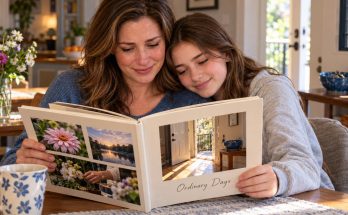
One evening, while reviewing the images, Hailey asked whether I thought she should include a photograph from the Ordinary Days collection. I asked what she wanted the exhibition to communicate. She said she wanted it to be about the community project, not about her personal recovery. Then she answered her own question. She would keep the collections separate. I smiled and told her that seemed reasonable. She looked relieved. The distinction mattered to her. She wanted to decide which parts of her work belonged in public spaces and which remained private.
The legal case continued through its scheduled stages. Denise contacted us with updates, and Rachel's team remained available for questions. There was still no final resolution, and the possibility of future testimony remained. Hailey continued meeting with Lauren to prepare emotionally for whatever might be required. Some appointments were difficult, and she occasionally returned home quiet and withdrawn. But she had become more comfortable asking for time before discussing them. I respected that. The photography club provided a part of her week that was not organized around the case.
One afternoon, after a particularly difficult appointment, Hailey came home and went straight to her room. I prepared dinner and left her alone for a while. Later, she came downstairs and asked whether she could talk. We sat at the kitchen table. She said she was frightened about the possibility of having to speak in court. She understood that the legal team would prepare her, but the idea still made her anxious. I listened and reminded her that she could continue asking questions and using the support available. She nodded. Then she said she did not want to quit the photography club because of the case. I told her there was no reason to make that decision now.
She looked relieved. Then she asked whether I thought it was selfish to care about photographs while serious legal matters were happening. I told her no. She was allowed to care about her interests, friendships, and future. Those things did not diminish the seriousness of what Mark had done. She nodded slowly. Then she said she sometimes felt guilty when she enjoyed herself, as though happiness meant she had forgotten. I told her she did not have to remain unhappy to prove that the harm mattered. She looked at me for a long moment, then returned to her photographs.
The school exhibition took place on a Friday afternoon. Amanda joined us, and Lily's parents came to see the students' work. The room was filled with photographs of parks, streets, buildings, and people. Hailey stood beside her three images, explaining the project to visitors. She looked nervous at first, but she gradually became more comfortable. I watched her speak with a teacher about the elderly couple photograph, describing how she had waited for a natural gesture rather than asking them to pose. Her voice was thoughtful and confident. She seemed pleased when the teacher complimented the composition.
Near the end of the exhibition, a younger student approached Hailey and asked whether she had any advice for someone just starting photography. My daughter looked surprised. Then she smiled and said the best thing was to take pictures of whatever caught their attention, even if it seemed ordinary. She explained that interesting photographs did not always require dramatic subjects. Sometimes the way light fell across a table or the expression on someone's face could be enough. The younger student listened carefully and thanked her. Hailey watched them walk away, looking slightly astonished.
On the drive home, she told us about the conversation. She said she had never imagined someone would ask her for advice. Amanda smiled and said she had clearly learned a great deal. Hailey looked thoughtful. Then she said she wanted to keep improving, perhaps by taking a photography course during the summer. I told her we could look into options. She smiled and began discussing what she wanted to learn next. I listened, struck by how naturally she was planning beyond the school year.
That evening, we celebrated with dinner at the apartment. Amanda brought dessert, and Hailey showed us photographs from the exhibition. She laughed about a picture Sophie had taken of a pigeon that looked unusually serious. We talked about the club, the summer, and the possibility of visiting another botanical garden. The conversation was ordinary and full of small plans. I noticed that Mark's name did not come up once. The absence did not mean we had forgotten the case. It meant we were allowing other things to matter.
Later, after Amanda left, Hailey asked whether I thought she could eventually study photography professionally. I told her she had time to explore that possibility and that I would support her in learning more. She nodded. Then she said she liked the idea of doing work that helped people notice things they might otherwise overlook. I smiled and told her that seemed consistent with the photographs she had been taking for years. She looked pleased. Then she asked whether we could start looking at summer courses the next day. I agreed.
Before bed, Hailey stood in front of her Ordinary Days collection. The wall was nearly full now, with photographs from Amanda's garden, the park, school, the botanical garden, and our apartment. She studied the images for a while, then asked whether I thought she should begin a second collection. I asked what it would be about. She said she wanted to photograph people and places beyond our immediate routines. She was thinking of calling it The World Outside. I smiled at the title. She looked at me and said she wanted the new collection to be about curiosity, not fear.
I told her I liked that distinction. She nodded, then said she was still afraid of many things. She did not want to pretend otherwise. But she was beginning to understand that fear did not have to be the reason she made every decision. I listened, remembering the first weeks after leaving Mark, when she had been frightened even to step into Amanda's garden. Now she was planning photography projects, joining clubs, and considering future courses. The changes had come slowly, through support, setbacks, and ordinary choices.
After she went to bed, I stood in the hallway and looked at the photographs on her wall. The apartment was quiet, and the ceramic bowl near the door held our keys. The legal folder remained in its drawer, waiting for the next update. I knew the case would continue and that difficult days lay ahead. But I also knew something had changed. Hailey was no longer asking whether she would ever have a future. She was beginning to decide what she wanted that future to contain. I could not make every path easy for her, and I could not undo the harm she had endured. What I could do was listen, believe her, and support the choices that belonged to her. That was the promise I had made when she finally told the truth, and it was the promise I intended to keep.
Click here to continue reading: PART 25: The Summer Photography Course Gave My Daughter Something to Look Forward To, Until a Call From the Prosecutor Reminded Us That the Case Was Still Waiting
My Daughter Kept Saying Something Was Wrong, but the Way My Husband Reacted Made Me Question Everything I Believed About Our Family
Part 24 of 34