Three days before the gallery opening, Hailey asked me to stop referring to it as her big night. We were standing in her bedroom, deciding whether the pale blue shirt she had worn for her school presentation would look better than a dark green blouse Amanda had given her. The invitation was pinned above her desk, and the three selected photographs had already been delivered to Claire. Hailey held the green blouse against herself, examined her reflection, and frowned.
“Everybody keeps saying it's my big night,” she said. “It's making me feel like something terrible will happen if I don't enjoy every second.”
I put down the shirt I was holding.
“What would you rather call it?”
“The opening.”
“All right. The opening.”
She studied me in the mirror, then smiled.
“And please don't make a speech about how far I've come.”
“I wasn't planning one.”
She raised an eyebrow.
I admitted that I had been considering saying a few words at dinner afterward. Hailey laughed and told me I could congratulate her, but she wanted the evening to be about photographs, not an assessment of her recovery.
I agreed.
By then, I had learned that respecting her wishes sometimes required setting aside the version of a moment I had imagined for myself. I wanted to celebrate her. I wanted to tell everyone how proud I was. But Hailey did not want to stand in a room full of strangers feeling as though her mother were presenting her as an inspirational story.
She wanted to be one of the photographers.
The distinction mattered.
On the afternoon of the opening, Lily and Sophie arrived at our apartment carrying a small paper bag from a bakery. Nora came a few minutes later, wearing a navy dress and holding a photograph she had printed for Hailey. It showed the two of them working together at the arts center, their cameras pointed toward opposite sides of the courtyard.
“I thought you should have proof that you sometimes take pictures of things other than shadows,” Nora said.
Hailey laughed and accepted the print.
The girls spent nearly an hour getting ready. They compared clothes, borrowed hair clips, and argued about whether comfortable shoes were more important than appearance. I stayed in the kitchen with Amanda, preparing sandwiches and checking the gallery address.
Through the open doorway, I heard Hailey laughing.
It was a sound I had once feared I might never hear so freely again.
When the girls emerged, Hailey had chosen the green blouse with dark trousers and simple shoes. Her hair was tied loosely behind her head. She carried a small bag containing her phone, notebook, and the folded plan she had prepared with Lauren.
The plan was straightforward. She could step outside if the room became crowded. She did not have to answer personal questions. She could leave whenever she chose. Amanda and I would remain nearby without following her through the gallery.
Hailey checked the contents of her bag, then looked at us.
“Everybody ready?”
We left together.
The gallery windows glowed against the early evening street. Inside, visitors moved slowly between the photographs, holding paper programs and speaking in low voices. Claire greeted us at the entrance and directed Hailey toward her display.
My daughter stopped when she saw it.
Passage hung on the left, the flower seller's hands in the center, and the river at sunrise on the right. Beneath the photographs was the short statement she had written herself, describing her interest in familiar places, changing light, and the details people often overlooked.
She stood very still.
Then she whispered, “They look different here.”
I stepped beside her.
The prints were larger than the versions we had examined at home. The dark passage seemed deeper, and the morning light over the river had a softness I had not noticed on the laptop screen.
“They look beautiful,” I said.
Hailey glanced at me.
“Tell me what you actually think.”
I smiled.
“I think the middle photograph is the strongest. The hands make me want to know what happens just outside the frame.”
She looked back at the image.
“That's my favorite too.”
Claire approached and asked whether Hailey was comfortable with the display. My daughter said she was. Then she asked a question about the spacing between the prints. Claire explained the arrangement and offered to adjust it if Hailey preferred.
After considering it, Hailey decided to leave everything as it was.
I watched her make the decision without looking toward me for approval.
For the first twenty minutes, the evening went smoothly. Lily, Sophie, and Nora wandered between the displays, comparing photographs and quietly teasing one another about which subjects they would have chosen. Amanda spoke with Claire about the youth program. I stayed near the entrance, close enough for Hailey to find me but far enough away to let her manage her own conversations.
Several visitors stopped to ask about her work.
An older woman admired the flower seller photograph and asked whether Hailey had arranged the scene.
“No,” Hailey replied. “I asked permission to photograph her, but I didn't ask her to pose. I wanted to capture the movement while she was working.”
The woman studied the print again.
“That explains why it feels so natural.”
Hailey smiled.
A man carrying a gallery program asked about Passage. My daughter explained that she had noticed sunlight reaching through a narrow space between buildings during her first week at the arts center.
He asked whether the image was meant to symbolize something.
Hailey thought for a moment.
“It can, if that's what you see,” she said. “But I took it because of the light.”
The man laughed softly and thanked her for the answer.
I was smiling when I noticed her expression change.
A new visitor had entered the gallery.
He was tall, broad-shouldered, and wearing a charcoal jacket. His hair was cut short, and he moved with a quick, deliberate stride. From where I stood, he did not look especially like Mark.
But Hailey had seen him from another angle.
She stopped speaking in the middle of a sentence. Her face drained of color, and her hand tightened around the gallery program.
I moved toward her, but she had already turned to Lily.
“I need a minute,” she said.
Lily nodded immediately.
Hailey walked toward the side exit, and I followed at a distance. Amanda noticed us moving and quietly positioned herself near the gallery entrance.
Outside, the evening air was cooler. Hailey stood beside the brick wall, breathing carefully. I stopped several feet away.
“Do you want me to come closer?” I asked.
She nodded.
I moved beside her.
“That man,” she said.
“I saw him.”
“For a second, I thought—”
She stopped.
I waited.
“I thought it was Mark.”
I looked through the window. The man was standing beside another display, speaking with a woman who appeared to know him. I could not establish who he was from where we stood, but I had no reason to believe he was Mark.
“I don't think it's him,” I said. “But we can ask Claire to check if that would help.”
Hailey closed her eyes.
“I know it's probably not him.”
Her hands were trembling.
“I just saw the jacket and the way he turned his head.”
I nodded.
She took another breath, then looked toward the gallery.
“I hate this.”
“I know.”
“I was doing fine.”
“You were.”
“Now I'm standing outside shaking.”
I resisted the urge to tell her the reaction did not matter. It mattered to her. She had been enjoying the evening, and suddenly her body had reminded her of something she wanted to leave behind.
She looked at me.
“Do you think I should go home?”
I could hear how badly she wanted me to decide.
Instead, I asked, “What do you want?”
“I don't know.”
“Then we don't have to decide this minute.”
We stood quietly while people walked along the sidewalk. A bus passed, its windows reflecting the gallery lights. Hailey watched it disappear around the corner.
After a while, she said, “I want to know who he is.”
I asked whether she wanted me to speak with Claire.
She nodded.
I went inside and quietly explained the concern. Claire checked with the gallery staff and confirmed that the visitor was attending with another participating student's family. There was no indication he had any connection to Mark.
When I returned, Hailey listened carefully.
“Okay,” she said.
She looked through the window again.
The man was laughing at something his companion had said.
My daughter watched him for a few seconds, then lowered her eyes.
“I know he isn't Mark,” she said. “But I still feel scared.”
“You don't have to make the feeling disappear before deciding what to do.”
She considered that.
Then she asked whether we could stay outside for another five minutes.
We did.
When she was ready, she looked toward the gallery door.
“I want to go back.”
I nodded.
“We can.”
She stopped me before I reached for the handle.
“Mom?”
“Yes?”
“Please don't tell everybody what happened.”
“I won't.”
She looked relieved.
We returned to the gallery together.
Lily was waiting near the side wall. She gave Hailey a small smile and asked whether she wanted water. My daughter accepted the bottle and stood beside her for a moment. Nobody demanded an explanation.
Then Nora appeared, holding two gallery programs.
“Someone just asked me if you photographed the river from a boat,” she told Hailey. “I said I didn't know, but that you probably would have mentioned it.”
Hailey laughed.
“No boat. Just cold feet and an early alarm.”
The conversation moved on.
I stepped away.
For the remainder of the opening, Hailey stayed near her photographs. She took breaks when she needed them and answered questions when she wanted to. She did not return to the carefree excitement of the first twenty minutes, but neither did she leave.
I watched her speak with a younger student who wanted to know how she had begun photography. Hailey told her about the first camera she had owned and the way she liked photographing small things around the house.
She did not mention Mark.
She did not mention the case.
She spoke about cameras, light, and practice.
Near the end of the evening, Claire gathered the participating photographers for a group photograph. Hailey hesitated when she heard the request. Then she asked whether the image would be used publicly.
Claire explained the intended use and reminded her that participation was optional.
Hailey considered the answer.
“I'll be in it,” she said, “but I'd like to review it before it's posted.”
Claire agreed to the arrangement.
My daughter joined the group.
I watched her stand beside Nora and the other young photographers, smiling slightly as the camera clicked.
Afterward, we went to dinner with Amanda and the girls. The restaurant was small and noisy, with a long table near the back. Hailey ordered pasta and spent most of the meal discussing the exhibition.
Sophie said the flower seller photograph should have been twice as large.
Nora disagreed. She thought Passage was the strongest image.
Lily said she liked the river because it reminded her of the morning they had walked there together.
Hailey listened, laughing when the girls began arguing about composition.
At one point, she caught my eye across the table.
I smiled.
She smiled back.
Later, after everyone had gone home, Hailey came into the kitchen while I was putting away the remaining cake Amanda had brought.
“Can I tell you something?” she asked.
“Of course.”
She leaned against the counter.
“When I saw that man, I thought the whole night was ruined.”
I set down the container.
“And now?”
She considered the question.
“I still wish it hadn't happened.”
I nodded.
“But I remember other things too. The woman who liked the flower picture. Nora arguing about Passage. Claire putting my name on the wall.”
She looked toward her bedroom.
“I think I want to remember all of it.”
I smiled.
“That sounds fair.”
She stood quietly for a moment.
Then she said, “I'm glad you didn't tell me I had to stay.”
“I wouldn't have.”
“I know.”
She looked at me.
“That's why I could choose.”
The words stayed with me after she went to bed.
I had spent so much of my life believing protection meant anticipating danger and making decisions before anyone else could be hurt. With Mark, that instinct had become tangled with appeasement and denial. Since leaving him, I had sometimes swung toward the opposite extreme, wanting to control every circumstance around Hailey.
But that evening, she had needed something different.
She had needed information, support, and the freedom to decide what she could manage.
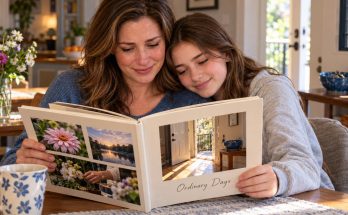
The next morning, she printed a small photograph from the gallery opening. It showed her standing beside the three displayed images, speaking to a visitor whose face was turned away from the camera.
She placed it in a new album.
On the first page, she wrote the date and the words First Gallery Opening.
Nothing about the photograph revealed the frightening moment outside.
But Hailey knew it had happened.
She kept the picture anyway.
Click here to continue reading: PART 32: When the Prosecutor Presented a Possible Agreement, My Daughter Asked One Final Question That Changed How I Understood the Ending We Had Been Waiting For
My Daughter Kept Saying Something Was Wrong, but the Way My Husband Reacted Made Me Question Everything I Believed About Our Family
Part 31 of 34