The approval came on a Wednesday morning. I was standing in Amanda's kitchen, waiting for the kettle to boil, when the property manager called to confirm that the apartment application had been accepted and the final arrangements could proceed. I listened carefully, wrote down the remaining steps, and thanked her. When I ended the call, I stood for a moment with the phone in my hand. The apartment was modest, and there would be practical challenges ahead, but it offered something I had been afraid to imagine during the first weeks after leaving Mark: a place where Hailey and I could begin building a life of our own.
I told Amanda first. She was sorting laundry at the kitchen table and looked up when I entered. I said the application had been approved. She smiled broadly, then set down the towel she was folding. “Well,” she said, “I suppose we should start finding boxes.” I laughed, feeling a sudden mixture of relief and sadness. Amanda had opened her home to us without hesitation, and leaving would be difficult. She seemed to understand. She said she would miss having us there, but she was glad we had found a place nearby. I thanked her, though the words felt too small for everything she had done.
Hailey came downstairs a few minutes later, carrying her laptop and a stack of school papers. She noticed our expressions and stopped. “What happened?” she asked. I told her the apartment application had been approved. For a moment, she simply stared at me. Then she asked whether we were really going to live there. I said we still had paperwork and moving arrangements to complete, but yes, we were moving forward. She looked toward Amanda, then back at me. A smile spread across her face. “The room with the window?” she asked. I nodded. She laughed softly and set her papers on the table.
She wanted to know when we could move, whether she could measure the walls, and whether the courtyard would look different in winter. I answered what I could and admitted what I did not yet know. She began making a list of things she wanted to bring from Amanda's house. Her camera equipment came first, followed by the blue box, her photographs, and the green sweater. I smiled when I saw the sweater on the list. It had become one of her favorite things to wear, even though the sleeves were short. She said it reminded her of the old house without making her feel frightened. I told her she could bring whatever helped the new place feel like home.
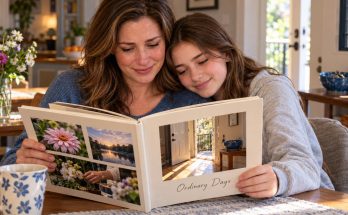
Over the next several days, we packed gradually. Amanda found boxes in the garage, and Hailey labeled them with a thick black marker. She wrote CAMERA EQUIPMENT on one, BOOKS on another, and ORDINARY DAYS on the box containing her photographs. I watched her work carefully, wrapping each print in tissue paper. She had decided to display the collection in her new bedroom, beginning with the flower from Amanda's garden. The photograph of the empty desk would go beside it, followed by the pond, the library steps, and the sneakers near the park bench. She wanted the arrangement to show how ordinary moments had helped her begin moving forward.
The legal case continued in the background. Denise called with updates when necessary, and I kept the information organized in a separate folder. There was still no final resolution, and I knew further proceedings could be difficult. I also continued working with my attorney on the practical steps of ending the marriage. Those responsibilities did not disappear because we were moving. But I was determined not to let them consume every conversation. Hailey needed to know that our new home was not simply a place to hide from Mark. It was a place where we could make choices about how we wanted to live.
The day we received the keys, Hailey asked whether she could be the first to open the apartment door. I handed them to her in the hallway. She studied the small metal key for a moment, then inserted it into the lock. The door opened onto the empty living room, where afternoon sunlight stretched across the floor. She stepped inside slowly. The apartment smelled faintly of fresh paint and clean wood. There were no photographs on the walls, no furniture, and no familiar objects. Yet the emptiness did not seem to frighten her. She looked around with a curious expression, then walked toward the smaller bedroom.
I followed her down the short hallway. She stopped in the doorway and looked at the window. Morning light would fall across the floor from that direction, just as she had hoped. She moved toward the wall where she planned to place her desk and measured the space with a tape measure. Then she turned toward me and smiled. “It fits,” she said. I asked what fit. She held up the sketch she had drawn weeks earlier. The desk, bookshelf, and chair would all fit if we arranged them carefully. I laughed and told her she had planned well. She looked pleased, then asked whether she could choose where the photographs would hang.
We spent the afternoon measuring rooms and discussing furniture. Amanda joined us with a notebook and helped make a list of practical needs. We would have to buy a few things, but much of our furniture could be reused or obtained gradually. Hailey was particularly interested in finding a desk that would fit beneath the window. She wanted enough space for her laptop, camera equipment, and notebooks. I told her we would look for something sturdy and affordable. She nodded, then asked whether she could paint one wall a pale color. I said we would need to check the rental agreement first. She smiled and said she had already expected that answer.
Moving day arrived the following weekend. Amanda helped coordinate the boxes, and a few trusted friends assisted with the heavier furniture. Hailey stayed close to her belongings, checking that the camera equipment and photographs were handled carefully. I watched her move through the apartment with a sense of purpose. She directed where boxes should go and helped arrange books on a shelf. Occasionally, she became overwhelmed by the noise and activity. When that happened, she stepped into her room for a break. I did not interpret those pauses as setbacks. She was managing a busy, unfamiliar day in a way that respected her needs.
By late afternoon, the apartment was filled with boxes and half-assembled furniture. Amanda brought sandwiches, and we sat on the living-room floor to eat. Hailey looked around at the clutter and laughed. “It looks like a warehouse,” she said. I agreed. She asked whether we could leave the boxes until the next day. I said we could unpack gradually. She seemed relieved. Then she looked toward the window and said the light was even better than she remembered. I followed her gaze. The late afternoon sun had turned the walls a warm pale gold. For a moment, the apartment felt peaceful despite the mess.
After Amanda and our friends left, Hailey and I stood in the living room alone. The quiet felt unfamiliar. For months, Amanda's house had been full of small sounds: the kettle, her footsteps, the radio in the kitchen, and the occasional creak of the back door. Now we were in a new place with different noises. Hailey looked toward the hallway and asked whether I was nervous. I admitted that I was. She nodded. Then she said she was nervous too, but she liked knowing we had chosen this place together. I smiled and told her I felt the same way.
We unpacked only what we needed that evening. Hailey arranged her bedding, placed the blue box on a shelf, and set her camera beside the window. I helped her hang a curtain and made sure the room felt comfortable. She asked whether the bedroom door had a privacy lock. We checked it together. It worked properly, and she could open it easily from inside. She nodded, satisfied. Then she asked whether I would be able to hear her if she called from her room. I told her I would. She looked relieved. We had discussed safety arrangements before moving, but she still needed to experience the new space for herself.
That night, we ate pasta at the small kitchen table. The chairs did not match, and half our dishes were still packed. Hailey looked around and smiled. She said the apartment felt strange, but not in a bad way. I asked what she meant. She considered the question. Then she said she was used to listening for Mark's footsteps in the old house. At Amanda's, she had learned to recognize her aunt's movements. Here, she did not yet know the sounds. I told her we would learn them together. She nodded and returned to her pasta. The conversation was simple, but I understood how much it mattered.
Later, Hailey asked whether we could watch a movie on my laptop because the television had not been set up. We sat on the couch beneath a blanket, balancing the computer on a small table. She chose a comedy, and we laughed at several scenes. Halfway through, a noise sounded in the hallway outside the apartment. Hailey stiffened. I paused the movie and waited. She looked toward the door, then took a slow breath. After a moment, she said it was probably a neighbor. I agreed. She asked whether we could check the lock. We did, then returned to the couch. She settled beside me and asked me to restart the movie.
The first night was difficult. Hailey woke twice and came to my doorway, asking whether I was awake. I invited her in and sat with her until she felt calmer. She said the unfamiliar sounds made it hard to sleep. I told her we could take time to adjust and discuss any continuing concerns with Lauren. She nodded. During the second visit, she asked whether moving had been a mistake. I told her we did not have to decide that after one difficult night. The apartment was new, and learning its sounds would take time. She looked relieved. Then she returned to her room, leaving the door slightly open.
The following morning, sunlight filled her bedroom. I found her sitting at the desk we had assembled the previous evening, looking through her camera. She had already taken several photographs of the window, the courtyard, and the shadows across the floor. I stood in the doorway and asked whether she had slept any better after our conversation. She said a little. Then she showed me a photograph of the morning light falling across her empty desk. I smiled at the resemblance to the competition image. She noticed and laughed softly. “I guess I like desks,” she said. I told her she seemed to like the way light changed ordinary places.
Over the next week, we settled into small routines. I learned which floorboards creaked and how the kitchen window caught the afternoon sun. Hailey discovered that the courtyard was quiet early in the morning and that a neighbor watered the plants near the entrance every evening. She began taking photographs from her window, documenting the changing light. We arranged her books, hung curtains, and found a place for the ceramic bowl she had made years earlier. It sat near the front door, holding our keys. Every time I saw it, I remembered the old house and the years before Mark. The bowl had become part of our new home without losing its history.
Hailey continued attending school on a reduced schedule. Some mornings were difficult, and she occasionally needed support from the counselor. But she was gradually spending more time in classes and working on assignments with greater confidence. Lily visited the apartment one afternoon and helped her arrange photographs on the bedroom wall. The girls measured the spaces carefully, stepping back to judge the composition. I heard them laughing when one print hung crookedly. Hailey insisted on fixing it herself. I stayed in the kitchen, listening to their conversation and feeling grateful for the ordinary sounds of friendship.
When I entered the room later, the photographs were arranged in a neat sequence. The flower from Amanda's garden hung first, followed by the pond, the library steps, the sneakers beside the bench, and the empty classroom desk. Hailey stood beside the wall, studying the arrangement. She asked whether I liked it. I told her I did. Then I asked why she had placed the desk photograph last. She said it reminded her of returning to school and beginning to imagine a future beyond the house we had left. She wanted the collection to end with an image that suggested possibility rather than a conclusion.
I looked at the photographs again. They were not dramatic images. There were no faces filled with grief, no scenes of confrontation, and no direct references to Mark. They showed light, objects, and quiet spaces. Yet I knew how much each picture meant to Hailey. She had taken them while learning to feel safe, while attending appointments, and while finding her way back to school. The collection did not explain her experience to strangers. It belonged to her. I told her the arrangement was thoughtful. She smiled and said she wanted to keep adding photographs as life changed.
That evening, Denise called with another update. The legal process was continuing, and the prosecution team would provide further information about upcoming proceedings. I listened carefully and took notes. There was still no final outcome. I thanked her and placed the folder in the drawer we had chosen for case documents. Later, at our agreed time, I told Hailey what I had learned. She asked a few questions, then said she wanted to return to her photography project. I agreed. She did not seem indifferent to the case. She simply understood that it was one part of her life, not the whole of it.
Before bed, Hailey came into the living room carrying her camera. She asked whether I wanted to see the newest photograph. It showed the morning light across her desk, with the courtyard visible through the window. I studied the image and told her I liked the way the shadows created a pattern on the floor. She smiled. Then she said she had decided to call the photograph First Morning. I asked why. She looked toward the hallway and said it reminded her that the apartment was ours, even if she was still learning to feel comfortable in it. I nodded, understanding that the title carried more meaning than the image alone could reveal.
We sat together for a while, looking at the photograph. Hailey asked whether I thought we would ever stop feeling like we were starting over. I considered the question. I said I hoped the apartment would gradually become familiar and that our routines would begin to feel ordinary. But I also thought starting over might mean different things at different times. She nodded. Then she said she did not want to spend her whole life thinking about what Mark had taken from us. She wanted to think about what we were building. I told her I wanted that too.
After she went to bed, I walked through the apartment, turning off lights and checking the doors. I paused outside Hailey's room. Her photographs were visible through the open doorway, illuminated by the small lamp on her desk. I could hear her moving quietly inside, arranging something on the shelf. I did not knock. I continued down the hallway and placed my keys in the blue ceramic bowl. The apartment was still unfamiliar, and the legal case remained unresolved. But the rooms were beginning to hold our own routines, choices, and memories. For the first time since leaving Mark, I felt that we were not merely staying somewhere safe. We were beginning to live in a home that belonged to us.
Click here to continue reading: PART 17: The First Time My Daughter Invited Her Friends Into Our New Home, I Realized How Much She Had Been Afraid to Ask For
My Daughter Kept Saying Something Was Wrong, but the Way My Husband Reacted Made Me Question Everything I Believed About Our Family
Part 16 of 34