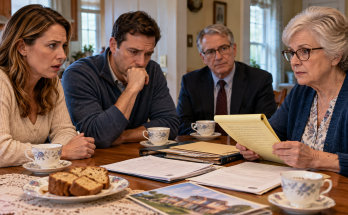
Alicia looked tired.
The confidence she had brought into my kitchen was no longer as easy to see.
Her handbag remained beside her chair.
The brochure lay closed.
The folder was still in front of me.
And the records of my house rested on the table where Raymond and I had once counted mortgage payments.
I looked at everything.
The cups.
The papers.
The untouched bread.
My son's lowered head.
It was strange how ordinary the room remained.
Nothing had broken.
Nobody had shouted.
The table hadn't moved.
But the family I thought I understood had changed in front of me.
Or perhaps I was finally seeing it clearly.
My guest had finished explaining the important facts about the house.
I was still the person responsible for deciding what happened to it.
I knew that before he arrived.
But hearing it confirmed helped.
Alicia looked at the records.
Then she looked at me.
“Dorothy, nobody wanted you to feel pushed.”
I kept my eyes on her.
I had heard that kind of reassurance several times already.
Every time, I had tried to decide whether she meant it.
Now I was less interested in her intentions.
I was interested in what she had done.
“You brought papers for me to sign,” I said.
She nodded.
“Yes, but—”
“You discussed where I should live.”
She stopped.
I continued.
“And you asked Bruce about my house.”
She looked toward Mark.
He didn't speak.
I held her gaze.
“Those are decisions that involve me.”
Alicia looked down.
I didn't need her to agree.
The truth remained the truth whether she liked it or not.
I turned toward Mark.
He was sitting in Raymond's old chair.
His hands rested on his knees.
I wondered whether he could feel his father's absence as strongly as I did.
I wondered whether he remembered how Raymond handled difficult conversations.
My husband had not been a perfect man.
Neither had I.
We had arguments.
We made mistakes.
We sometimes said things we regretted.
But when it came to important decisions, he believed both people affected should understand what was happening.
That was one reason our marriage had lasted.
We didn't always agree.
But we tried not to hide the truth from each other.
I looked at Mark.
“Your father would have wanted me to read those papers.”
He nodded.
“I know.”
“He would have wanted me to understand what I was signing.”
“Yes.”
“And he would have wanted you to speak to me honestly.”
Mark looked away.
The silence hurt.
I wanted him to argue.
I wanted him to tell me I had misunderstood everything.
But I had heard too much for that to be possible.
I remembered Alicia's voice coming through the phone.
The road noise.
The radio.
The little click of the turn signal.
I remembered holding the phone against my ear while she discussed how easily I signed things.
I remembered the moment she mentioned my glasses.
That detail stayed with me more than I expected.
It was such a small thing.
A pair of scratched reading glasses.
Nothing valuable.
Nothing impressive.
But she had treated them as an obstacle to be removed.
As though my ability to read were something inconvenient.
I touched the frame.
Alicia noticed.
I saw her eyes move toward my hand.
For a moment, I almost told her what I knew.
I nearly said that she had called me at 7:15.
That I had heard everything.
That I knew about the plan for Christmas.
But I stopped.
I wanted to be certain I could speak without losing control of myself.
I wanted the words to be clear.
Not shouted.
Not thrown across the table in anger.
I had spent the morning preparing for that moment.
I wasn't going to rush it now.
My guest looked at the folder.
He asked whether I wanted to keep examining the papers or set them aside until I had more time.
I thought about it.
Then I looked at Mark and Alicia.
“I won't sign anything today.”
Mark nodded.
Alicia said nothing.
I continued.
“And I won't make decisions about Silver Meadows until I've had time to consider whether it's something I want.”
My guest nodded.
That was enough.
He didn't need to persuade me.
He was there to help me understand.
I appreciated the difference.
For years, I had confused helping with deciding.
I had allowed people to make suggestions and then treated those suggestions as obligations.
Sometimes I agreed simply because I didn't want anyone disappointed.
Now I understood how easily that habit could be used against me.
I looked at Alicia.
“I know you think you're helping.”
She opened her mouth.
Then closed it.
I continued.
“But I need you to understand that my life isn't something you can arrange without asking me.”
She looked uncomfortable.
I felt no pleasure in it.
I didn't want her humiliated.
I wanted her to stop.
Mark leaned forward.
“Mom, maybe we should just leave it for now.”
I looked at him.
He seemed tired.
Perhaps he wanted the morning to end.
Perhaps he hoped we could all pretend nothing serious had happened.
That would have been easier.
I knew because I had spent years choosing easy endings.
A smile.
A change of subject.
A promise to talk later.
Then silence.
I wasn't going to do that again.
“There's something else we need to discuss,” I said.
Mark raised his eyes.
Alicia looked at me.
My guest remained seated.
I glanced toward the hallway.
The yellow notepad was still where I had placed it.
I remembered writing the first words.
7:15.
Alicia.
Mark.
Folder.
Brochure.
The times that followed.
7:19.
7:26.
7:31.
7:34.
I had written as accurately as I could.
I hadn't wanted to trust my memory alone.
Now those notes mattered.
I stood.
Mark watched me.
“Mom?”
I looked at him.
“I'll be right back.”
I walked toward the hallway.
My steps were slower than usual.
Not because I was frightened of falling.
Because I was thinking.
I had wanted my son to tell me the truth on his own.
I had given him opportunities.
I had asked direct questions.
I had listened to the answers.
Some had been honest.
Others had been incomplete.
And some had avoided the point entirely.
I couldn't make him confess something he wasn't ready to admit.
But I could tell him what I had heard.
I reached the place where I had put the notepad.
I picked it up.
The yellow pages looked ordinary.
A grocery list.
A few hurried notes.
Nothing that would attract attention.
Yet those pages held the conversation that had changed my understanding of my family.
I looked at the first line.
The time was written clearly.
I remembered the cold tea.
The pen.
The sound of Alicia laughing.
I remembered thinking of Raymond.
Write it down when it matters.
I had.
And now I was ready to bring those words back into the room.
I returned to the kitchen.
Mark looked at the notepad in my hand.
Alicia glanced at it.
Neither seemed to understand why I was carrying it.
I sat down.
I placed the pages beside the folder.
For a moment, I simply looked at them.
Then I looked at my son.
He was watching me carefully.
Alicia leaned forward.
“Dorothy, what's that?”
I touched the top page.
“Something I wrote this morning.”
She glanced at Mark.
I could see her curiosity.
Perhaps a little concern.
I didn't know.
I wasn't going to guess.
I looked at my guest.
He remained quiet.
I appreciated that.
This was my conversation.
My family.
My home.
And my decision about what to say.
I looked back at Alicia.
“There are some things I'd like to clear up.”
She nodded cautiously.
“Of course.”
I looked at the time written at the top of the page.
7:15.
Then I remembered the moment her name appeared on my phone.
I had answered because I thought somebody might need help.
I had answered because she was family.
I had answered because I still believed that a call from my daughter-in-law meant something ordinary.
Now I knew better.
I raised my eyes.
And for the first time that morning, I no longer felt the need to protect Mark and Alicia from hearing what they themselves had said.
Click here to continue reading: PART 17: I Read the First Line From My Yellow Notepad, and My Daughter-in-Law Finally Understood Why Her Carefully Prepared Visit Had Gone Wrong
When My Daughter-in-Law Called Before Breakfast, I Answered Without Knowing I Was About to Hear My Own Future Being Decided
Part 16 of 20