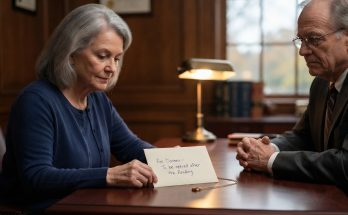
Bernard Skiles began the will reading by asking everyone to turn off their phones. Melissa placed hers face down beside a leather folder. Kevin silenced his but kept it in his hand. I left mine inside my purse with Ruth Ann’s damp business card tucked behind the case.
Bernard’s office occupied the second floor of a brick building above a dentist. The windows faced the county courthouse, and the radiator clicked beneath a shelf of law books. Harold had trusted Bernard for thirty-two years. He claimed the man charged too much and spoke too slowly, which was Harold’s way of describing friendship.
Melissa sat nearest Bernard’s desk. Kevin chose the chair beside her, forcing me toward the end of the conference table. Neither offered to move. Bernard noticed. His eyes rested briefly on the empty space between them, then on me.
“Mrs. Vance,” he said, “would you prefer to sit here?”
“I can hear from where I am.”
Melissa opened her folder. “Can we begin? I have an appointment with the realtor at one.”
Bernard removed his glasses and wiped them with a square of blue cloth. “Your father has been dead nine days.”
“I’m aware.”
“Then the realtor can survive until afternoon.”
A faint red patch rose along Melissa’s throat. Kevin pretended to study the rain outside.
Bernard explained probate, debts, taxes, and the difference between property passing under the will and property transferred through other instruments. Kevin interrupted twice. Melissa asked whether the estate could reimburse the funeral expenses, although she had not paid them. I listened to the radiator tick and pictured Harold in the chair beside me.
The first specific bequest was the house on Ashwood Lane. Harold left it to Kevin and Melissa in equal shares, subject to its mortgage and other recorded obligations. Melissa released a breath through her nose. Kevin tapped something into his phone.
They had expected the house. I had expected it too, though hearing the words still hurt. Fourteen years of my life had been converted into a legal description and divided between two people who had called before Harold’s funeral to ask whether I had found somewhere else to stay.
“The residence includes its ordinary furnishings,” Bernard continued, “except personal items separately identified in the attached memorandum.”
Melissa turned a page in her folder. “What personal items?”
“Those belonging to Doreen. Harold’s Bible. His brown field jacket. Several tools. Photographs from their marriage. The porch swing.”
“The porch swing is attached,” Kevin said.
“It hangs from chains,” I said.
He looked at me. “You know what I mean.”
“I know what a chain is.”
Bernard’s mouth twitched, but his eyes remained on the document.
The boat went to Kevin. Harold’s twenty-three-foot fishing boat had spent more time on a trailer than in water during the last four years. Kevin sat straighter when Bernard named it. He had argued repeatedly that the boat would deteriorate unless Harold transferred it to him. Harold always answered that deterioration was the boat’s principal talent.
Melissa received the antique furniture that had belonged to her mother, along with her jewelry and silver. Those things had never felt like mine, and I was relieved to hear them named. Melissa, however, examined the appraisal attached to her papers before she looked at the photographs.
The brokerage account was divided equally between the two children after taxes, medical expenses, administrative costs, and several outstanding obligations. At the phrase “outstanding obligations,” Kevin stopped tapping his screen.
“How much is in the account?” he asked.
Bernard folded his hands. “The value changes with the market.”
“What was yesterday’s closing balance?”
“Approximately six hundred and forty thousand dollars before deductions.”
Melissa’s pencil froze above the page. “What deductions?”
“Harold’s hospital bills, tax liabilities, a line of credit secured against securities, and estate expenses.”
“How large is the line of credit?”
“Just under two hundred thousand.”
Kevin stared. “Dad never borrowed against that account.”
“He did.”
“For what?”
“That transaction will be addressed when the accounting is complete.”
Melissa leaned back, the leather chair creaking beneath her. The house had a mortgage. The boat needed repairs. The brokerage account contained less than their private arithmetic had promised. Neither looked at me, but something in the room had shifted. Their inheritance still glittered; it simply had invoices attached.
Bernard continued through smaller gifts. Harold left money to the volunteer fire department and a kidney-care charity. He gave his woodworking equipment to a neighbor who had helped repair our porch. He left his old truck to the young mechanic who had driven him home after dialysis when I had pneumonia.
Kevin whispered, “Unbelievable.”
“What is?” Bernard asked.
“Nothing.”
“Your father did not consider those people nothing.”
Kevin’s jaw worked, but he stayed quiet.
At last Bernard reached the residuary clause. I felt Melissa glance toward me. During Harold’s illness, she had suggested more than once that he establish a “reasonable allowance” for me. She meant enough money for rent, groceries, and silence. Harold had answered by asking why his wife required an allowance from anyone.
“To my wife, Doreen Vance,” Bernard read, “I leave all my interest in the real property identified as county parcel 44-118, together with all improvements, appurtenant rights, and interests not previously severed or conveyed.”
For a moment, nobody reacted. The description sounded too formal for the place it named. Then Kevin frowned.
“Is that Route 9?”
“Yes,” Bernard said.
“The burned trailer?”
“The parcel containing the trailer remains.”
Melissa’s laugh came before she could stop it. She pressed two fingers to her lips, but amusement had already escaped. Kevin looked down at the table. His shoulders shook once.
I kept my hands folded.
Bernard’s expression did not change. “Is there a question?”
Melissa drew a breath. “I’m sorry. It’s just—Dad left Doreen that?”
“He did.”
“How many acres?” Kevin asked.
“The tax card lists approximately ten.”
Kevin whistled softly. “Ten acres of weeds and a condemned singlewide.”
“It is land,” I said.
“It’s a dumping ground,” Melissa replied. “The trailer burned before you even married Dad.”
“Then you won’t miss it.”
Her smile vanished.
Bernard read the property’s estimated tax value, which was low enough to revive Kevin’s amusement. He calculated aloud that the annual taxes would become my responsibility. Melissa tilted her head toward me with theatrical sympathy.
“At least it’s something,” she said.
The words landed with the neat precision of a pin. I thought of sitting behind her at Harold’s funeral while she called me companionship. I thought of fourteen years of dialysis bags, porch coffee, winter grocery lists, and Harold’s hand reaching for mine beneath the hospital blanket.
“Yes,” I said. “It is.”
Bernard closed the will but did not dismiss us. He explained that the beneficiaries would receive formal notices and that no one was to remove estate property before the inventory. Melissa asked when she could list the house. Kevin asked whether he could tow the boat that afternoon.
“You will wait,” Bernard said, “until title and insurance matters are resolved.”
“Dad wanted us to have those things,” Kevin replied.
“He also wanted you to follow the law.”
Melissa snapped her folder shut. “Doreen has already moved out. There’s no reason to leave the house sitting empty.”
I had moved into the small bungalow I owned before marrying Harold because Melissa had arrived at the hospital with a typed list of estate concerns while her father was still alive. Harold had overheard her asking whether I intended to claim the residence. That evening, he told me to keep the bungalow and never put it in anyone else’s name.
“I’ll collect the rest of my belongings when Bernard arranges it,” I said.
“You should do that soon,” Melissa replied. “We need photographs before the market changes.”
Bernard’s voice cooled. “Mrs. Vance will be given reasonable access.”
Kevin stood and slipped his phone into his pocket. “Well, I suppose everybody got what Dad thought they deserved.”
Melissa gathered her coat. “Some of us received responsibilities.”
I looked at her. “And some of us received weeds.”
She mistook my calm for surrender. Her smile returned.
In the hallway, Kevin caught up with me near the stairs. “If the taxes become a problem, I know a fellow who buys distressed lots. You might get fifteen or twenty thousand before the county starts bothering you.”
“Generous.”
“I’m being practical.”
“Were you practical when you priced the boat during your father’s last week?”
His face tightened. “Dad told you about that?”
“Your father told me many things.”
That answer followed him down the stairs.
I waited until Melissa’s heels had faded along the corridor, then returned to Bernard’s conference room. He was standing beside the window with one hand in his pocket. On the table in front of my chair lay a sealed cream-colored envelope.
“Harold left instructions,” he said.
“For me?”
“For after his children had gone.”
I touched the envelope. Harold’s block handwriting crossed the front: DOREEN—ONLY AFTER THE WILL IS ACCEPTED. The letters were firm, not the wavering marks of his final hospital days.
Bernard sat opposite me. “Before you open that, I need to ask whether anyone has contacted you about Route 9.”
I took Ruth Ann’s business card from my purse and placed it between us.
For the first time that morning, Bernard lost control of his expression.
“Who gave you this?”
“She said Harold told her to wait until after the funeral.”
He read the card without touching it. “Did she offer you money?”
“No.”
“Did you agree to anything?”
“No.”
“Did you sign anything?”
“No.”
His shoulders lowered a fraction. Then he pushed the sealed envelope closer.
“Good,” he said. “Because the ten acres they laughed about do not exist.”
I stared at him.
Bernard placed a thick survey folder beside Harold’s letter.
“The property Harold left you,” he said, “is not ten acres.”
Click here to continue reading: PART 3: The Burned Trailer Was Still There, but Fresh Survey Stakes Proved Someone Had Been Measuring Far More Than We Knew
Before Harold Was Buried, His Children Had Already Decided Which Parts of Our Life Belonged to Them
Part 2 of 20