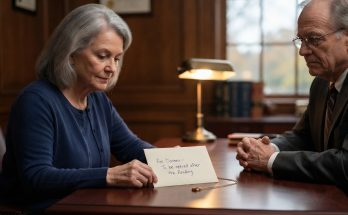
I did not open Harold’s envelope in Bernard’s office that morning. My hands would not cooperate. The paper sat beneath my palm while the radiator clicked and traffic hissed over the wet street below. Bernard gave me time, which was another reason Harold had trusted him.
“How much land is there?” I asked.
“The correction survey contains the answer.”
“That is not an answer.”
“It is the one Harold instructed me to give you after you read his letter.”
I lifted my eyes. “You were his lawyer. You do not have to inherit his talent for irritation.”
A brief smile appeared. “I believe I acquired it through prolonged exposure.”
He placed the survey folder inside a larger envelope and told me to take both documents home. I was not to discuss them with Kevin, Melissa, a buyer, a land agent, or anyone else without calling him first. When I asked why the secrecy mattered, he looked toward the closed door.
“Because Harold believed his children would want the parcel only after learning why somebody else wanted it.”
The rain had stopped by the time I reached the parking lot. Melissa and Kevin were gone. Dark clouds dragged over the courthouse roof, and gutters spilled onto the pavement. I sat in my car with Harold’s envelope on the passenger seat and felt the day divide around it.
I could have driven home. Instead, I turned toward Route 9.
The road narrowed beyond town, following the creek between low wooded ridges. November had stripped the sycamores bare. Their pale limbs showed against the dark slope, and wet leaves clung to the asphalt. Harold used to drive this stretch with one elbow out the window, even in weather that made my hands ache.
We had visited the parcel only three times during our marriage. The first was to inspect storm damage. The second was after somebody dumped a refrigerator beside the entrance. The third was the afternoon Harold showed a young surveyor where an old fence had crossed the creek.
I remembered that third visit now. Harold had stood in rubber boots while the surveyor adjusted a tripod. Two men in clean jackets waited near a white truck. When I asked what they wanted, Harold said they were studying utility access.
“Is there anything valuable out here?” I had asked.
“Depends who needs to get through,” he said.
At the time, I thought he meant the road.
The entrance was easy to miss. A rusted gate leaned beside a gravel pull-off where goldenrod had collapsed beneath the rain. I parked without blocking the road and stepped into mud. The air carried creek water, wet bark, and the faint petroleum smell of passing trucks.
Beyond the gate, the trailer stood among saplings. Fire had peeled its aluminum siding into black curls. The roof sagged above broken windows, and vines threaded through what had once been a kitchen. Harold said a faulty heater caused the blaze fifteen years earlier. No one had lived there since.
Kevin had called it condemned. Melissa had called it a dumping ground. Neither was wrong about the trailer.
They were wrong about the silence.
A strip of orange plastic fluttered from a stake near the ditch. Farther in, another ribbon marked a straight line through the brush. The color was too bright to be old. I followed it until my shoes sank at the creek bank.
Across the water, three more stakes climbed the opposite slope.
The property I knew as ten acres should not have crossed that creek. At least, that was how Harold had always described it: the trailer, the flat ground behind it, and a narrow strip along Route 9. Yet the markers continued toward the ridge as if the surveyor believed the boundary did too.
I took photographs with my phone. The first showed only mud and orange ribbon. I moved closer and photographed the writing on a stake: AIP—ALT. 3. Another, nearer the road, carried blue paint and the letters CM.
Two companies. Two routes.
Ruth Ann’s words returned with uncomfortable clarity. Men with surveying equipment had been there in August. Cardinal Midstream had been studying a corridor. Harold had warned me not to sign.
A truck slowed on the road. Gravel cracked beneath its tires, then the driver accelerated. I stood motionless until the sound disappeared around the bend. The loneliness of the property changed. It no longer felt abandoned. It felt watched.
Near the trailer, I found fresh boot prints pressed into the mud. One set led to the warped front steps. I hesitated, then climbed carefully. The metal gave a low complaint beneath my weight.
Inside, rain had darkened the floor. Charred cabinets hung open along one wall. Someone had recently cleared a space on the old counter. Dust and ash had been swept aside, leaving a rectangle the size of a folder.
I stepped back.
There was no reason for a surveyor to enter the trailer. No boundary marker stood inside it. Yet somebody had used that counter, and the disturbed ash looked recent enough that the edges remained sharp.
On the floor below the counter lay a torn corner of yellow paper. I picked it up by the cleanest edge. Three typewritten words remained: OPTION AND EASEMENT.
The creek seemed louder when I returned outside.
I called Bernard. He answered on the second ring. “You opened the letter?”
“Not yet.”
A pause. “Where are you?”
“At Route 9.”
His silence sharpened.
“There are survey stakes on both sides of the creek,” I continued. “Some say AIP. Others say CM. And somebody has been inside the trailer.”
“Leave.”
“Bernard—”
“Go to your car, lock the doors, and drive home.”
“I found part of a document.”
“Do not touch anything else.”
“It says option and easement.”
“Doreen, this is not a suggestion.”
His fear moved me faster than his order. I crossed the muddy ground, climbed over the leaning gate, and locked myself inside the car. Only then did I notice another vehicle parked fifty yards away in a turnout screened by bare brush.
A dark SUV. Empty, as far as I could tell.
I started the engine. When I pulled onto Route 9, the SUV’s lights came on.
It followed me through the first curve.
I kept both hands on the wheel. The speed limit was forty-five, and I drove exactly forty-five. The SUV remained far enough behind that I could not read its plate. At the junction near the old feed store, I turned toward town without signaling until the last moment.
The SUV continued straight.
My breath left in a slow, uneven stream. Perhaps the driver had been checking a map. Perhaps no one had followed me. Grief could make ordinary things sinister. So could a sealed letter from a dead husband and bright stakes crossing land everyone had called worthless.
At home, I placed the torn paper inside a plastic sandwich bag. Harold would have laughed at the procedure, but Bernard had sounded like a man anticipating evidence. I photographed it, the SUV’s vague outline in my last roadside picture, and every survey marker I had found.
Then I opened the envelope.
Inside were four folded pages. Harold’s handwriting filled the first. It was firm and angular, written before medication softened the lines. The sight of it struck harder than the funeral. Ink had preserved the pressure of his hand after the hand itself had gone cold.
Doreen, the letter began. If Bernard has finally handed this over, then the will is through probate and my children have probably behaved about as well as we expected.
A laugh rose in me and broke apart before it reached my mouth.
Harold apologized for leaving me uninformed. He wrote that Melissa and Kevin had spent too many years seeing price without value, and that he had spent too many years excusing them because he remembered who they had been as children. He warned me not to repeat his mistake.
The house, he explained, still carried a mortgage of one hundred eighty-six thousand dollars. The boat needed an engine. The brokerage account had been reduced by taxes, medical expenses, and secured debt. He had left his children objects that appeared expensive because appearance governed their decisions.
I stopped reading and pressed the page against the table.
His plan was not revenge. I knew that before reaching the sentence where he said so. Harold disliked revenge because it wasted time. What he believed in was consequence. If a man ignored a leaking roof, Harold did not lecture him; he waited for rain.
I continued.
I left you what they would dismiss, he had written. That was necessary.
The next instruction was underlined twice. He warned me against selling parcel 44-118 to the first buyer. I was not to grant an easement, accept an option, or sign even a preliminary letter without Bernard. Cardinal believed the dispute concerned acreage. It did not. The company needed a particular corridor.
And Cardinal was not the only interested company.
I read the names beside the survey stakes again. AIP and CM.
The first survey visit had occurred in March. A second team arrived in August. The woman in the hard hat had represented Appalachian Infrastructure Partners, not Cardinal. Both proposed projects crossed the parcel’s northeastern corner.
Harold’s final line on the first page was shorter than the others.
Before anyone offers you money, ask Bernard to show you the corrected boundary.
I unfolded the survey with hands that had begun to shake. Blue lines followed Route 9, crossed the creek, climbed the old ridge, and enclosed a long, crooked tract extending far beyond anything Harold had shown me.
At the lower corner, beside a surveyor’s seal, a number had been typed in precise black figures.
47.62 ACRES.
I read it once. Then again.
The weeds, the burned trailer, the creek, and the ridge belonged to one parcel. Fresh red lines crossed its narrowest section. Two proposed corridors converged there with nowhere else to go without leaving the valley.
My phone rang before I could reach the second page.
Melissa’s name appeared on the screen.
I let it ring until voicemail answered. Almost immediately, Kevin called. Then Melissa again. A text arrived from her while the phone was still vibrating.
We found a problem with the Route 9 boundary. Kevin has paperwork you need to sign tonight.
I looked from her message to the torn piece of yellow paper sealed inside the plastic bag.
Someone had been inside the trailer before I arrived.
And Harold’s children had learned enough to come for the land.
Click here to continue reading: PART 4: Harold’s Letter Explained the Forty-Seven Acres, but His Children Arrived Carrying Paperwork He Had Warned Me Never to Sign
Before Harold Was Buried, His Children Had Already Decided Which Parts of Our Life Belonged to Them
Part 3 of 20