Cardinal’s revised proposal reached Bernard before I finished my first cup of coffee on Monday. He called at 8:07 and told me to sit down. I remained standing beside the kitchen counter because Harold had used that same phrase whenever a repair estimate exceeded what he considered civilized.
“How bad is it?”
“Bad is not the word I would choose. Cardinal is offering three million nine hundred thousand dollars.”
The refrigerator hummed behind me. “For Route 9?”
“Twenty-two acres, permanent corridor access, and a limited facilities footprint.”
I put my coffee down before I spilled it. “On Friday they offered one million eight hundred fifty thousand.”
“On Friday they hoped you did not know about Appalachian.”
“Do they know now?”
“They know enough to be frightened.”
Appalachian’s formal proposal had arrived seven minutes after Cardinal’s call. It offered three million four hundred thousand for eighteen acres, plus annual access compensation beginning at seventy-two thousand dollars. I would retain the other twenty-nine acres and all rights not expressly conveyed.
“Which offer is better?” I asked.
“That depends on the restrictions, escalation clauses, environmental obligations, access routes, and several hundred pages no sensible person should read before breakfast.”
“Which number is bigger?”
“Cardinal’s.”
“Then why do you sound dissatisfied?”
“Because both companies increased their offers without receiving a counterproposal. That means neither has shown us its limit.”
Harold had written one instruction in capital letters: DO NOT GIVE A NUMBER FIRST. I looked through the rain beginning to bead on the kitchen window and imagined him listening from the porch swing.
“Make them wait until tomorrow,” I said.
Bernard was quiet for a moment. “That is the correct decision.”
“No one enjoys being told they have made the correct decision as much as a lawyer.”
“You are learning.”
The certified letter arrived at 4:43 that afternoon. Thomas Redding’s return address appeared in the upper-left corner. Before I opened it, Bernard instructed me to photograph every side of the envelope and the placement of the seal.
The first page announced an intent to contest Harold’s will and petition the court concerning alleged fraudulent transfers of real property.
My stomach clenched. “They are doing it.”
“They are threatening to do it,” Bernard said through the speakerphone. “Read the allegations.”
Undue influence. Lack of testamentary capacity. Improper execution. Concealment of estate assets. The language transformed my marriage into a scheme conducted against a helpless man. It described me as Harold’s “caregiving spouse,” as though changing his dressings and measuring his medication made my vows suspicious.
“They say I isolated him.”
“You did not.”
“They say I controlled access during his illness.”
“You followed his medical instructions.”
“They say the Route 9 gift was inconsistent with his prior estate plan.”
“That part is true.”
I gripped the pages. “Why would that help them?”
“Because a significant late change can invite examination. It does not prove wrongdoing.”
The next attachment was an affidavit from Dr. Samuel Pike, Harold’s nephrologist. He stated that during November, Harold had experienced intermittent confusion, disorientation, and impaired judgment caused by his declining condition and medication.
Rain struck the metal awning over the back door. I remembered Harold waking at three in the morning and asking whether we had fed a dog that had been dead twelve years. I remembered him forgetting which day dialysis was scheduled, then correcting a nurse’s calculation of his fluid intake ten minutes later.
“Can this invalidate the will?”
“Not by itself.”
“But it matters.”
“Yes.”
“Pike knew Harold had good days.”
“We will obtain the complete medical record.”
“Why would he sign this?”
“Perhaps Redding gave him a narrow question. Perhaps he believes every word. We do not know yet.”
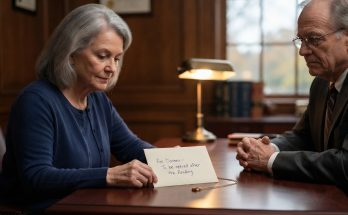
I turned the page and saw Harold’s handwriting.
The note was dated November 11, three days before he signed the will. The original had been photocopied from yellow paper, the same kind Harold kept in his metal filing box.
Need to correct deed before children discover it.
If Doreen knows the full value, she may refuse.
Better she learns afterward.
My mouth dried. Read alone, the lines sounded secretive and manipulative. They made Harold’s protection resemble concealment, and my ignorance resemble proof that he had acted irrationally.
“Bernard, they have one of his notes.”
“Read all of it.”
A fourth line appeared beneath the others.
If challenged, Bernard has the January document.
“What January document?”
He did not answer.
“Bernard?”
“Lock your doors.”
I stood so quickly that the chair scraped the floor. “Why?”
“If they recovered that note from Harold’s filing box, they know another instrument exists.”
“What instrument?”
“I told Harold never to mention it in his working notes.”
“Then you underestimated his devotion to paper.”
“Apparently.”
“What did he sign in January?”
“A deed.”
“To Route 9?”
“No.”
“Then to what?”
Bernard drew a breath. “Another property.”
I walked to the front door and turned the dead bolt. The simple mechanical click made the house feel less safe, not more.
“How much property?”
“One hundred twelve acres in Kanawha County.”
“Harold did not own land in Kanawha County.”
“He owned it for thirty-one years.”
The hallway tilted slightly. I put one hand against the wall. Harold and I had filed joint tax returns, discussed insurance, argued over household expenses, and sat at this kitchen table comparing hospital bills. One hundred twelve acres could not hide inside a marriage.
“Where?”
“Vance Ridge.”
The name meant nothing at first. Then I remembered hearing Harold use it once during a telephone argument years earlier. He had hung up hard enough to ring the kitchen phone and muttered about people digging through a mountain to preserve an old grievance.
“How could I not know?”
“The property produced almost no income. A management account covered taxes and maintenance. Harold acquired it before your marriage and kept its records separately.”
“Did his children know?”
“No.”
“What is it worth?”
“That question has become complicated.”
“Everything you say becomes complicated immediately before it becomes expensive.”
“I need you in my office.”
I arrived twenty-five minutes later with the certified letter in my purse. Bernard had pulled the blinds. A red file lay on the table beside a deed dated January 17, nearly ten months before Harold’s final hospitalization.
The document transferred Vance Ridge from Harold individually into the Harold and Doreen Vance Conservation Trust.
I read my name twice. “I never signed this.”
“You did not need to. Harold was the grantor. The trust agreement names you as successor trustee and lifetime beneficiary.”
“Did he forge my agreement?”
“No. Acceptance was deferred until his death or incapacity. It was a deliberately structured transfer.”
“Why January?”
“That is when Northstar Development approached him.”
Bernard opened the red file. Inside were maps of a ridgeline crossed by colored lines. Three labels appeared repeatedly: POWER, GAS, WATER. Unlike Route 9’s narrow corridor, Vance Ridge seemed to sit where several future infrastructure systems would meet.
“Northstar wanted to buy it?”
“First they wanted an option. Then access. Eventually they discussed purchasing the entire tract.”
“How much?”
“The last written authorization we know about was forty-two million dollars.”
I sat down.
The figure did not feel like money. It felt like a clerical mistake made with too many zeros.
“Harold refused forty-two million?”
“He suspended negotiations.”
“Why?”
“He believed Northstar had concealed something material.”
“What?”
“I do not know. Neither did he, at first.”
Bernard showed me letters between Harold and Northstar’s acquisition director, David Mercer. Early correspondence was courteous. Later letters became terse. Harold demanded engineering data concerning water usage, historic easements, and adjacent tracts. Northstar answered only some questions.
The final letter contained no offer. It contained a warning from Harold.
Until ownership and watershed rights are disclosed in full, no transaction will proceed.
“Why transfer it to a trust with my name?”
“Protection. Continuity. He knew his health was failing, and he did not want his death to fragment the property.”
“Or let his children sell it.”
“That too.”
A vehicle stopped outside. Bernard lifted one edge of the blind. Kevin’s SUV sat across the street, engine running.
“He followed me?”
“Possibly.”
The passenger door opened. Melissa stepped out with Thomas Redding. Kevin joined them on the sidewalk. Redding carried a litigation case and the gray metal filing box from Harold’s study.
My heart struck hard against my ribs.
“They took it,” I whispered.
“Yes.”
“Can they use it?”
“They already have.”
Bernard reached for his telephone, but another call appeared on his private line first. He looked at the display, then at me.
“Northstar Development.”
“Answer it.”
He put the call on speaker. A man introduced himself as Caleb Ross, outside acquisition counsel for Northstar. His voice was warmer than Redding’s and therefore less comforting.
“We understand Mr. Vance’s ownership may now be disputed,” Caleb said. “Our client wishes to resolve matters efficiently.”
Bernard’s expression hardened. “How did your client learn of a dispute that has not been filed?”
A pause.
“Interested parties communicate.”
“Which interested party contacted you?”
Caleb ignored the question. “Northstar may be willing to acquire all competing claims and allow the family to divide the proceeds privately.”
I looked through the blind at Kevin, Melissa, and the box in Redding’s hands.
They had not merely found Harold’s papers.
Someone had read the forty-two-million-dollar correspondence, called Northstar, and offered to sell a property they did not own.
Click here to continue reading: PART 7: The Hidden Ridge Was Worth Forty-Two Million, and Kevin Had Found a Stranger Willing to Buy His Claim Before Court
Before Harold Was Buried, His Children Had Already Decided Which Parts of Our Life Belonged to Them
Part 6 of 20