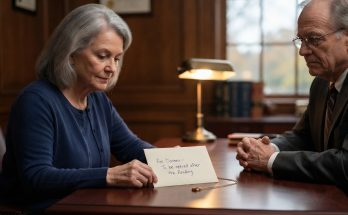
Sixty million dollars waited in Bernard’s inbox with a forty-eight-hour expiration. The proposal required my signature, Kevin’s, Melissa’s, and the surrender of every claim connected to Vance Ridge. Northstar would pay the trust fifty-four million and Vance Family Holdings six million to withdraw its disputed interest.
Kevin had turned a five-hundred-thousand-dollar option into a promise of six million overnight.
“He will accept,” I said.
Julia leaned over Bernard’s desk, reading the conditions. “He cannot accept for you.”
“He can make refusing look like I cost everyone money.”
“That is the strategy.”
Northstar had included strict confidentiality terms, releases covering prior negotiations, and a clause preventing us from asserting any historic water or access rights after closing. The proposal devoted more language to extinguishing unknown rights than to describing the land.
“What are they afraid of?” I asked.
“The same thing Harold discovered,” Bernard said.
“And that answer is probably inside the missing Bible.”
We met Kevin and Melissa that evening in Bernard’s conference room. Redding sat between them. Caleb joined by video from a polished office with no papers visible behind him. His tone suggested that all intelligent people recognized sixty million dollars as the end of an argument.
“The proposal removes litigation risk,” he said. “Mrs. Vance receives extraordinary value. Harold’s children receive recognition of their legitimate family interest. Everyone avoids years in court.”
I looked at Kevin. “When did Caleb tell you he represented Northstar?”
Kevin’s attention stayed on the offer. “It does not matter now.”
“It mattered when he prepared the quitclaim.”
Caleb smiled without warmth. “That draft addressed title uncertainty.”
“It transferred land from me to Kevin’s company.”
“It proposed a potential resolution.”
“At my front door, they called it cleanup paperwork.”
Redding shifted in his chair. He had not known that detail when he accepted them as clients. His growing discomfort was one of the few honest things at the table.
Melissa spoke quietly. “Six million could pay off the house and divide what remains.”
“The house has one hundred eighty-six thousand owed against it,” I said. “You do not need six million to pay it off.”
“That is not the point.”
“No. It never has been.”
Kevin leaned forward. Fatigue had hollowed the skin beneath his eyes. “Dad hid forty-two million dollars from us.”
“He owned land. Land is not cash.”
“He was negotiating a sale.”
“He suspended it.”
“Because you influenced him.”
“In January? You visited him twice that month. Both times you asked about the boat.”
His palm struck the table. “Stop making me sound like some scavenger.”
“I have not described anything you did not do.”
Caleb intervened. “Personal accusations will not help anyone evaluate the offer.”
Julia turned toward the screen. “Then explain why Northstar needs a release of unrecorded watershed rights.”
A flicker crossed his face.
“Standard title language.”
“Nothing in a sixty-million-dollar agreement is standard by accident.”
Caleb’s smile disappeared. “Ms. Hale, if your client prefers speculation to liquidity, that is her right.”
“What volume of commercial water does Northstar’s project require?”
“That information is proprietary.”
“Which source appears in your engineering plans?”
“Also proprietary.”
“Does it cross Vance Ridge?”
Caleb glanced down. “Northstar is acquiring real property, not water.”
“Then remove the water release.”
“No.”
The answer came too quickly.
Franklin Mercer’s warning returned to me: if Caleb had inserted himself into the family dispute, this was evidence. Evidence of what remained unclear, but sixty million dollars and a two-day deadline were not the actions of a company that believed the trust weak.
I looked at Kevin. “Where is Harold’s Bible?”
He stiffened.
Melissa answered for him. “Caleb has it.”
Redding turned sharply. “You gave estate property to corporate counsel?”
“It contained notes about the land,” Kevin said. “Caleb needed to evaluate them.”
Bernard’s voice became quiet. “Return it tonight.”
Caleb folded his hands on the screen. “The item was provided voluntarily for title review.”
“By someone who did not own it.”
“Ownership is disputed.”
“The will specifically leaves it to Doreen.”
For the first time, Kevin looked uncertain. He had spent days accusing me of exploiting Harold’s confusion while trusting a stranger who converted every family possession into leverage.
Caleb promised delivery the next morning. Bernard demanded it within one hour. They compromised only after Redding informed Caleb that retaining a specifically devised item would damage every allegation in their probate petition.
The meeting ended without signatures.
Outside, Kevin followed me to my car. The night smelled of cold asphalt and woodsmoke. He shoved his hands into his pockets.
“Are you really walking away from sixty million?”
“I am walking away from a deadline.”
“You could take fifty-four.”
“And you could receive six million for signing papers you admitted you did not understand.”
His face tightened. “Dad should have told us.”
“He tried to teach you to ask.”
“You think you knew him better because you changed his bandages.”
“I knew him differently.”
“He was our father before he was your husband.”
“Yes.”
The answer stopped him. He had expected competition, a demand that one bond outrank another. Harold had loved them before I entered his life. He had also learned to fear what they became when money appeared. Both facts could exist together.
Kevin stared across the parking lot. “Caleb said Dad meant to sell before you stopped him.”
“Did he show you proof?”
“He showed me notes.”
“From the Bible?”
“He said Northstar’s project would bring jobs. Dad was worried you would refuse because of the environmental impact.”
“Harold created a conservation trust.”
“I did not know that then.”
“What else did Caleb show you?”
Kevin rubbed the back of his neck. “A reference to the Lawson rights.”
The name was new. “Who is Lawson?”
“He did not explain.”
“Yet you signed an option.”
“I signed confidentiality papers.”
“Did you read them?”
His silence answered.
The Bible arrived at Bernard’s office at 9:15 the next morning. A courier carried it inside a padded envelope. The black leather cover was scratched near one corner, and Harold’s name remained stamped in faded gold.
I held it against my chest before opening it. The gesture embarrassed me, but I did not stop. The book smelled faintly of dust and Harold’s aftershave.
Several pages had been marked with paper strips. Caleb had removed whatever interested him and then tried to restore the contents. A pharmacy receipt rested inside Psalms. An old photograph marked Ecclesiastes. A note concerning Route 9 had been returned near Proverbs.
Bernard photographed each item before we moved it.
Near the back, the binding had separated slightly from the cover. Harold often repaired books with glue, but this gap looked deliberate. Julia used a letter opener to lift the loose edge. A narrow envelope slid onto the table.
On its face Harold had written: FRANKLIN—IF DAVID WILL NOT TELL THE TRUTH.
Inside was a copy of a 1963 watershed easement between the Vance and Lawson families. The agreement reserved joint control over commercial withdrawals from a spring system extending beneath Vance Ridge and neighboring tracts.
A handwritten amendment appeared on the final page.
No industrial user could exceed a specified volume without written approval from the holder of the Vance interest and the holder of the Lawson interest.
Julia read it twice. “Northstar needs water for cooling.”
“How much?” I asked.
“Far beyond this threshold if Harold’s project notes are accurate.”
“Then they need my approval.”
“Half of the approval.”
“Who controls the Lawson half?”
“That is the question.”
A second paper named Beatrice Lawson as the last recorded holder. Harold had written beside her name: GRANDDAUGHTER WORKS FOR CARDINAL—R.A.K.
Ruth Ann Kessler.
The woman who had approached me at Harold’s funeral was not merely Cardinal’s land agent. She had inherited the other half of the water right.
I called her with Bernard and Julia listening.
She answered carefully. “Doreen.”
“Who was Beatrice Lawson?”
Silence.
“Your grandmother?”
“Yes.”
“Do you control her watershed interest?”
Another pause. “I may.”
“Why did you not tell me?”
“Harold asked me not to until his trust was secure.”
Julia wrote a question and slid it toward me.
“Did Northstar know about your interest?”
“They knew the Lawson family held something. They assumed the rights had expired or could be purchased cheaply.”
“Did they approach you?”
“Caleb Ross did.”
“How much did he offer?”
“Five hundred thousand dollars.”
The same price Caleb had offered Kevin for his uncertain claim.
“Did you accept?”
“No.”
“Why?”
“My grandmother spent her life warning me never to sign away water rights to someone who called them obsolete.”
I looked at Harold’s hidden agreement. “Did Harold meet you in January?”
“Yes.”
“What did he learn?”
“That Northstar’s forty-two-million-dollar offer covered more than land. Their development plan depended on water they had not priced and rights they hoped no one would enforce.”
Harold had not rejected forty-two million because he feared development. He had rejected it because Northstar wanted the land, the spring, and permanent control while paying for only the visible acreage.
“What did Harold do after your meeting?”
“He told me he would make them pay for everything they needed.”
“Did he name a price?”
“No. He said he first had to make sure you controlled the ridge.”
The January trust deed.
Harold had transferred the property before entering the hospital because he knew Northstar might exploit his death. His children had then supplied the disputed claim the company needed to create confusion.
Ruth Ann lowered her voice. “There is something else. Cardinal knows about Vance Ridge now.”
My grip tightened on the phone. “Because of Kevin?”
“Because Northstar’s option filing became visible to their acquisition team. Cardinal has been talking to Allegheny Energy Partners.”
Julia looked up sharply.
“Who is Allegheny?” I asked.
“Northstar’s largest competitor,” she said.
Ruth Ann continued. “They want the Route 9 corridor, the ridge, and the watershed approval. They are preparing an offer.”
“How much?”
“I have not seen authorization.”
“Estimate.”
“More than sixty million.”
When the call ended, Bernard contacted Franklin Mercer and told him we had Harold’s envelope. Franklin agreed to meet that evening in a private dining room outside town. He insisted that David Mercer and Caleb Ross attend.
Kevin and Melissa arrived separately, carrying Northstar’s unsigned agreement. Caleb entered with David, whose expensive suit and controlled impatience made clear which man expected to command the room. Franklin came last, walking with a cane.
He did not greet his son. He sat opposite me and placed both hands over the cane’s silver handle.
“I founded Northstar,” he said. “Harold called me eleven days before he died because he discovered my company had negotiated in bad faith.”
David stood. “This is not the place.”
Franklin raised one finger. His son sat again.
“The forty-two-million-dollar authorization was genuine,” Franklin continued. “But Harold did not walk away from it.”
“What did he do?” I asked.
“He countered.”
Every person at the table became still.
“How much?”
“Sixty-eight million dollars,” Franklin said, “plus a permanent royalty on commercial water withdrawals.”
Kevin stared at Caleb. “You told me Dad rejected the project.”
Caleb said nothing.
Franklin unfolded an old map and placed it over Northstar’s offer.
“The board was considering Harold’s terms when he died. Afterward, certain people decided fragmented ownership and family litigation might reduce the price.”
His gaze settled on Caleb, then David.
Kevin looked down at the option papers he had signed.
At last, he understood that he had not found a way into Harold’s fortune.
Northstar had used him as a way around Harold’s widow.
Click here to continue reading: PART 9: Franklin Exposed Northstar’s Plan, but the Competing Offer Arrived Through the Company Kevin Had Let Caleb Control
Before Harold Was Buried, His Children Had Already Decided Which Parts of Our Life Belonged to Them
Part 8 of 20