Rebecca remained on speaker while Julia spread the watershed map across the table. The blue line representing the spring began beneath Vance Ridge, widened under the eastern slope, and continued toward Ashwood Lane. A handwritten notation connected the old Vance farmhouse tract to the same 1963 volume restriction.
“They own the house,” I said. “What exactly do I control?”
“Possibly nothing affecting ordinary residential use,” Rebecca replied. “The restriction concerns commercial withdrawal above a specified amount.”
“Could they still live there?”
“Yes.”
“Sell it?”
“Yes, subject to accurate disclosure of recorded rights.”
Kevin lifted his head. “Then this changes nothing.”
Rebecca answered before I could. “It changes any attempt to package the house tract with industrial access. Allegheny’s engineering group believes the eastern portion may be required for pumping equipment, monitoring wells, and a secondary service road.”
Melissa stared at the map. “No one told us the house was part of the project.”
“Northstar’s internal plans may have treated it as a later acquisition,” Rebecca said. “That is one reason Harold suspended negotiations.”
David’s face tightened. “You are discussing unverified proprietary material.”
“Your company was invited to correct the record months ago.”
Franklin tapped his cane against the floor once. “Did Northstar plan to acquire the house after buying the ridge?”
David did not answer.
“That means yes,” Franklin said.
The strategy became visible at last. Northstar would purchase Vance Ridge, secure the water release, and later approach Harold’s children about the house when its industrial value was known only to the buyer. Melissa and Kevin had believed they inherited the obvious prize. Northstar had expected them to sell it cheaply.
Harold had disrupted both transactions by placing the controlling interest in my trust.
Kevin rubbed his palms against his trousers. “Caleb knew.”
“Almost certainly,” Julia said.
“He told me Route 9 was the mistake in Dad’s estate plan.”
“It was the entrance to the larger project.”
“He said the trust deed could be broken.”
“Because a broken trust would scatter ownership among people he could negotiate with separately.”
Melissa looked at Redding. “Can we withdraw the will challenge?”
“You have filed only a notice of intent,” he said. “No full petition has been adjudicated.”
“And the Northstar option?”
“That depends on its language and whether Caleb exceeded his authority.”
Kevin looked ill. “He drafted the authority.”
“He also concealed a conflict. That helps us.”
Redding’s use of us had changed. Until that moment, he had treated me and Bernard as opposing parties. Now Caleb’s conduct threatened all of us, including Redding’s professional reputation.
Rebecca requested a meeting the following morning to verify title and discuss Allegheny’s proposal. Bernard refused to negotiate while Caleb’s representation agreement remained in circulation. Franklin supported him.
“If two companies bid on a title cloud Caleb manufactured,” Franklin said, “he will use the confusion against both.”
David stood again. “Northstar is not responsible for Ross’s independent conduct.”
Franklin looked at his son. “You approved his budget.”
David left without replying.
The meeting ended close to midnight. Melissa and Kevin remained after everyone else had gone. The table was littered with maps, water studies, unsigned agreements, and coffee cups no one remembered ordering.
Melissa sat opposite me. Without the careful hair and funeral voice, she looked younger and more tired. “Did Dad hate us?”
“No.”
“He left you the only things that mattered.”
“He left you the house, the boat, and his investments.”
“Debts and repairs.”
“He also left you a choice.”
“What choice?”
I looked at the six-million-dollar allocation Caleb had promised their company. “Whether to take something because it appears valuable before understanding its cost.”
Kevin flinched. Melissa’s eyes filled but did not spill.
“You make it sound like a lesson,” she said.
“Harold made everything a lesson when a direct sentence would have done.”
That earned the smallest breath of laughter from Kevin. It vanished quickly.
Redding advised them to suspend the probate allegations and revoke Caleb’s authority. Kevin agreed to the revocation but resisted abandoning the Vance Ridge claim. Six million dollars had been placed close enough for him to imagine holding it.
“If the 1992 deed is valid, we own something,” he said.
“If it is valid,” Bernard replied, “you should establish that without allowing Caleb to sell the answer in advance.”
“What happens to my mortgage if the option collapses?”
“That depends on the lender.”
Melissa turned on him. “You risked the house for a document you had not authenticated.”
“My half of the house.”
“You used our company.”
“You signed the formation papers.”
“Because you said it protected us.”
They began circling the same blame again. This time I did not stop them. Some arguments had to exhaust their poison before anyone could hear what remained.
The next morning, federal investigators arrived at Northstar’s regional office with warrants concerning fraudulent title representations, electronic communications, and possible manipulation of acquisition bids. We learned about it when Redding called Bernard.
“Caleb’s office has been sealed,” Redding said. “They seized files, computers, and several original documents.”
“Did they recover Harold’s deed?” I asked.
“They will not confirm.”
David Mercer had been placed on administrative leave pending an independent board investigation. Northstar announced that Caleb was outside counsel and claimed his conduct had not been authorized. Franklin issued a separate statement insisting the review include senior management.
Within an hour, reporters began calling.
Bernard told everyone to say nothing. Melissa ignored him long enough to answer one question outside the courthouse, and her sentence appeared online before lunch: Our family was misled during an emotional time.
When I read it, I nearly called her. Then I decided she had managed one honest sentence and left it alone.
Allegheny’s meeting took place under a confidentiality agreement reviewed by three lawyers. Rebecca brought engineers, title specialists, and a hydrologist named Dr. Priya Shah. The ninety-six-million-dollar authorization covered Vance Ridge, specified access from Route 9, and a long-term water agreement. It did not require acquisition of the house.
Priya explained the spring system using cross-sections of rock beneath the ridge. Water moved through fractured sandstone into a privately recorded watershed. Industrial cooling would not drain household wells under the proposed plan, but it required monitoring, volume limits, and the approval rights Harold had preserved.
“What happens if the companies exceed the limit?” I asked.
“Automatic penalties, suspension rights, and mandatory mitigation if your agreement is drafted properly.”
“Who decides what properly means?”
“You, with independent experts.”
Harold had not left me a faucet I could turn off out of spite. He had left authority carrying obligations to families, creeks, farms, and people who would never know my name.
Northstar submitted a revised proposal that afternoon. Its independent committee offered one hundred five million dollars and accepted third-party environmental oversight. Allegheny increased its authorization to one hundred twelve million.
Bernard watched me read the numbers. “Do not react.”
“I stopped understanding them twenty million ago.”
“That may be useful.”
Yet neither offer could close without Ruth Ann’s Lawson interest. The 1963 agreement required both family approvals. Allegheny believed it could structure around the missing half, but doing so would increase risk and reduce the project’s value.
I called Ruth Ann.
“Are you willing to sell your rights?”
“No.”
The answer came without hesitation.
“Would you lease them?”
“Not by myself.”
“What do you want?”
“To know what Harold intended.”
I looked at the trust deed. “He intended to protect the ridge.”
“That is part of it.”
“What is the other part?”
“He believed the Vance and Lawson families had spent too long letting companies profit from an old feud.”
“What feud?”
“My grandmother accused Harold’s father of recording the 1963 amendment without giving her family a complete copy. Harold believed her brother had hidden an earlier agreement. They stopped speaking. Their children inherited suspicion instead of facts.”
“And you inherited half a water right.”
“Perhaps. The chain of title still needs confirmation.”
Bernard wrote: ASK ABOUT JANUARY.
“Did you and Harold agree to something before he died?”
Ruth Ann remained silent.
“Harold placed Vance Ridge in the trust on January seventeenth. You met him around that time.”
“I promised him I would wait until ownership was settled.”
“It is settled.”
“Not while Kevin’s claim remains.”
The missing original deed still gave her reason to hesitate. So did the Northstar option.
That evening, Kevin came to my bungalow alone. He held a packet from Redding and looked as if he had not slept.
“I revoked Caleb’s authority,” he said.
“Good.”
“I am withdrawing the Vance Ridge claim.”
I studied his face. “Why?”
“Investigators showed Redding an email. Caleb wrote that my claim was weak but useful.”
The words cost him. He stared at the porch floor.
“He called me an emotional heir with liquidity pressure.”
“What does that mean?”
“That he knew I needed money and thought anger would make me careless.”
“Was he wrong?”
Kevin looked at me then. “No.”
He handed me the withdrawal. In exchange, he asked that Bernard help prevent the lender from forcing an immediate sale of his house interest. He did not ask for money. The omission mattered more than an apology would have.
“I will ask Bernard what can be done,” I said.
Kevin nodded and turned toward his car.
“Where is Melissa?”
“At Dad’s house. She found something behind the paneling in his study.”
My body went still. “What?”
“She would not tell me on the phone.”
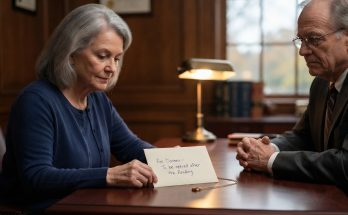
We drove there together. Melissa waited beside Harold’s desk holding a small brass key. A narrow section of wooden trim had been removed near the floor, exposing a compartment between the studs.
Inside lay a sealed document pouch.
Across its face Harold had written two names.
DOREEN VANCE AND RUTH ANN KESSLER.
Click here to continue reading: PART 11: The Compartment Behind Harold’s Desk Contained His Last Bargain, but Ruth Ann Still Had to Decide Whether She Trusted Me
Before Harold Was Buried, His Children Had Already Decided Which Parts of Our Life Belonged to Them
Part 10 of 20