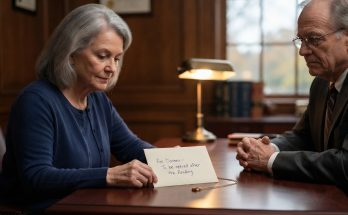
Northstar’s revised calculations arrived before noon. Allegheny’s followed forty-three minutes later. Combining the Vance and Lawson interests had not doubled the value of the watershed right. It had multiplied the project’s certainty, removing the risk that one family might block what the other approved.
Northstar proposed fourteen million five hundred thousand dollars in annual payments for water and corridor access. Allegheny offered fifteen million one hundred thousand. Both retained upfront acquisition components approaching one hundred million dollars.
I read the figures in Bernard’s conference room while Ruth Ann stood beside me with one hand over her mouth.
“What does fifteen million a year feel like?” she asked.
“Like somebody else’s arithmetic.”
Julia had already begun marking the offers. “They are still trying to buy too much control. Northstar wants priority access. Allegheny wants volume flexibility. Neither has committed enough to drought protections.”
“Then we say no,” I replied.
Bernard looked pleased. “Harold would approve.”
“Harold does not have to sit through these meetings.”
The negotiations occupied the next week. Engineers argued over withdrawal thresholds. Corporate lawyers debated whether a creek restoration requirement belonged in a water agreement. Trust counsel fought for inflation adjustments, independent testing, public reporting, and automatic shutdown provisions.
Every afternoon, the numbers increased. Allegheny offered seventeen million annually. Northstar answered with seventeen million four hundred thousand. People began speaking of millions with the casual tone used for lumber estimates.
At a Friday meeting, I pushed both proposals away.
Bernard stared at me. “What are you doing?”
“Stopping the auction.”
Ruth Ann studied my face. “Why?”
“Because the largest number is not the same as the best agreement.”
Franklin, attending as a Northstar shareholder observer, smiled into his coffee.
I asked each company to present its environmental plan without discussing price. Northstar proposed preserving more acreage around the ridge. Allegheny committed greater funding to rural water systems and well replacement. Each plan protected what the other neglected.
“Improve both,” I said.
The company representatives objected. Their projects competed. Their engineering schedules differed. Their boards would never accept shared infrastructure. Julia waited until the objections ended, then displayed the cost of building two separate corridors.
The room became quiet.
A joint corridor would disturb less land, reduce duplicated construction, and allow both projects to use monitored water under the trust’s limits. Neither company would control the route. Both would pay.
“Harold anticipated shared access,” Franklin said.
David was no longer present to silence him.
Over several days, opposition became calculation. Northstar and Allegheny discovered cooperation was cheaper than losing the ridge. Cardinal and Appalachian revised their Route 9 arrangements to serve the joint route.
The combined annual trust payments were projected to exceed nineteen million three hundred thousand dollars in the first full operating year. The companies agreed to upfront payments totaling one hundred four million for infrastructure access tied to Vance Ridge. Route 9 would close separately for eleven million eight hundred thousand plus recurring corridor compensation.
The trust divided net distributions according to Harold’s framework. One quarter funded local water projects. One quarter supported me during my lifetime. The remaining half went to conservation, monitoring, land restoration, and long-term reserves.
Ruth Ann waived a personal distribution beyond her trustee expenses. “My grandmother would haunt me if I got rich from doing what she told me never to surrender.”
“Harold would haunt me if I apologized for receiving anything.”
“Then between them, we should be uncomfortable forever.”
“That sounds like family.”
While lawyers drafted the final language, Kevin and Melissa came to Bernard’s office for a separate meeting. The withdrawal of their challenge had preserved their inheritance, but the Caleb investigation left questions about Vance Family Holdings and the money advanced under the option.
The five-hundred-thousand-dollar payment had never reached Kevin personally. Caleb routed it through an escrow account controlled by his firm and used part of it to fund title work intended to undermine the trust. The rest was frozen.
Kevin’s relief was mixed with humiliation. “I nearly lost the house for money I never received.”
“You nearly lost it for money you expected,” Melissa said.
He looked at her. “You were there.”
“I know.”
The difference in her answer mattered. She did not step away from blame.
Bernard placed another document on the table. During his review of Harold’s estate notes, he had found a reference to a final codicil that did not alter ownership and therefore had not affected the original probate accounting. It created a family foundation activated only if Route 9 generated more than five million dollars.
The proposed corridor agreement had crossed that threshold many times over.
The foundation would receive five percent of my Route 9 proceeds. Harold named me trustee. Kevin and Melissa each received one board seat, but neither would draw a salary or possess withdrawal rights.
Kevin read the mission statement. “Emergency housing. Medical debt. Trade-school scholarships. Caregiver assistance.”
“Your father wrote the categories himself,” Bernard said.
Melissa found the handwritten line at the bottom.
FOR PEOPLE WHO ARE LEFT WITH WHAT EVERYONE ELSE CALLS WORTHLESS.
She pressed her fingers against her lips.
Harold had transformed the insult he expected his children to make into the purpose of an institution. The widow, the weeds, the burned trailer, families with bad wells, students without tuition—he had connected them before any of us understood the size of the inheritance.
“Do we have to accept the board seats?” Kevin asked.
“No,” Bernard replied.
“What happens if we refuse?”
“Doreen appoints community members instead.”
Melissa answered immediately. “I accept.”
Kevin did not.
He folded the mission statement and slid it back. “I need time.”
No one pressured him. Harold had called it one chance, not one command.
That night, I returned to Ashwood Lane alone. The legal right to occupy the house remained with Melissa and Kevin, but they had delayed listing it while the industrial-access question was resolved. Melissa had given me a key so I could retrieve anything overlooked.
Harold’s desk stood where it always had. The secret compartment remained open, a dark rectangle behind the removed trim. I ran my fingers over the pencil arrow that had led Melissa to it.
He had counted on someone searching eventually.
Inside the bottom drawer, beneath warranty papers and old seed catalogs, I found a red notebook the investigators had returned with the filing box. Kevin had placed a strip of paper between two pages.
The entry was dated January 18, one day after Harold signed the trust.
Bernard thinks the property may become worth twenty million, Harold had written. Franklin thinks more. They both misunderstand.
I turned the page.
Doreen may think money is the point unless someone slows her down. The point is to leave her enough power that nobody can put her in the second row again.
My eyes blurred.
He had known. Even before the funeral, before Melissa moved my card, Harold understood the place his children assigned me. He had watched them speak over me in hospitals, introduce me as his second wife with emphasis on second, and treat my marriage as an administrative detail.
Another line followed.
If the children ever understand that, perhaps they can become people I am proud of again. Not wealthy. Not impressive. Kind. That will be harder.
A folded page waited inside the back cover. Its heading read: IF THEY FIGHT OVER EVERYTHING.
Beneath it, Harold had written that I received the final say. Kevin received one opportunity to do something decent. Melissa received one too. If either wasted the chance, the choice belonged to them.
I sat in Harold’s chair until the room darkened.
Three days later, Kevin called.
“I will take the foundation seat,” he said.
“Why?”
“Because I think Dad wanted me to learn how to give money away instead of spending my life trying to catch it.”
“That sounds possible.”
“Do you believe I can do it?”
“I believe Harold left you the chance.”
“That is not the same answer.”
“No.”
Kevin breathed quietly on the line. “Fair enough.”
On the morning before the infrastructure signing, he arrived at my bungalow holding the gray metal filing box. Federal investigators had released it after copying the relevant records.
“There is one more thing inside,” he said.
The original 1992 deed lay beneath the survey files. So did Northstar’s correspondence, Beatrice Lawson’s records, and the red notebook. At the bottom rested a photograph I had never seen.
Harold stood beside the Route 9 trailer when it was still white and intact. He was perhaps forty. A younger woman stood beside him, one hand resting on the old gate.
On the back, Harold had written: BEATRICE LAWSON AND ME—1984.
Ruth Ann’s grandmother.
Below that appeared another sentence.
SHE KNOWS WHERE THE ORIGINAL AGREEMENT IS.
I called Ruth Ann.
When I described the photograph, she went silent.
“What original agreement?” I asked.
“The 1963 watershed document is not the original,” she said.
“What is it?”
“An amendment.”
“To what?”
“A family compact signed in 1948.”
My fingers tightened around the photograph. “What did the first agreement cover?”
“Water,” Ruth Ann replied. “Timber. Minerals. Surface access.”
“How much land?”
“Several thousand acres, divided among different owners now.”
“Where is the compact?”
“My grandmother hid it.”
“Did she tell you where?”
“No.”
“Then who would know?”
Ruth Ann hesitated.
“My uncle Samuel.”
“I thought the recorded Lawson line ended with you.”
“It does. Samuel’s interest was never recorded.”
“Where is he?”
“Kentucky. I have not spoken to him in twenty-seven years.”
“Why?”
“Because he and Harold hated each other.”
Before I could ask for an address, someone knocked on my front door.
Three slow knocks.
Through the window, I saw an old pickup with Kentucky plates. A tall man stood on my porch holding a dented metal document tube.
He raised his voice so I could hear through the door.
“Doreen Vance? My name is Samuel Lawson. Harold told me to bring you the paper our families have been fighting over for seventy-eight years.”
Click here to continue reading: PART 13: Samuel’s Metal Tube Held a Forgotten Compact That Turned Decades of Unpaid Use Into a Claim No Company Expected
Before Harold Was Buried, His Children Had Already Decided Which Parts of Our Life Belonged to Them
Part 12 of 20