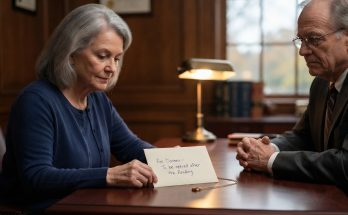
That night, rain began tapping the roof of my bungalow.
It was the same sound I heard the morning Ruth Ann first called about parcel 44-118, back when I believed I had inherited ten acres of weeds and a burned trailer. Back when Kevin and Melissa laughed in Bernard’s office because they thought Harold had left me the unwanted remainder.
The house, boat, and brokerage account carried obvious prices.
The dirt did not.
Harold understood that people chased what shone. They fought over objects whose value had already been named, then congratulated themselves for taking the recognizable prize. Meanwhile, real value could remain quiet, underground, and patient.
Sometimes it was water.
Sometimes land.
Sometimes an agreement rolled inside a metal tube.
Sometimes it was the dignity of a woman everyone had spent fourteen years refusing to call by her proper place in the family.
My name is Doreen Vance.
Not the roommate.
Not the companion.
Not simply Harold’s second wife.
Not the woman who received the worthless lot.
Doreen.
The companies eventually paid extraordinary sums to use the land. The trust became larger than anything Harold or I had imagined. The old compact generated resources for communities whose connection to the Vance and Lawson families had been forgotten for generations.
Kevin and Melissa learned what they had almost surrendered.
But their faces when the numbers were announced were never the best part.
The best part was Tyler’s mother standing on her own porch with keys in her hand.
It was Marjorie Bell sleeping through the night after her well was repaired.
It was Walter Greene learning he would not die owing money for his wife’s final illness.
It was a scholarship student opening a tool bag on the first morning of training.
The trust did not make suffering disappear. It could not restore every stream, erase every debt, or repair every family. Money remained limited even when the numbers looked limitless. Each decision excluded someone, delayed another project, or accepted an imperfect answer.
Responsibility did not become easier merely because we could afford more of it.
That was why Harold had chosen control instead of cash.
A fortune could be divided, spent, or used to keep score. Authority required someone to answer for what happened next.
The old Route 9 trailer remained behind its fence.
Companies asked periodically whether they could move it to improve traffic visibility or simplify maintenance. Engineers supplied neat diagrams. Lawyers offered replacement monuments.
I always refused.
The missing window remained open to weather. Fire-blackened metal curled around one corner. The roof leaned despite its supports. It was ugly, inconvenient, and honest.
Workers stopped there after shifts. Scholarship graduates posed beside it. Families traveling Route 9 pulled over to read the plaques.
THEY TOOK WHAT THEY COULD SEE.
And beneath Harold’s name:
HE KEPT THE DIRT.
People who knew only those words invented their own meaning. Some assumed the trailer represented poverty. Others thought Harold had resisted a highway project. A few recognized the Vance name from the foundation and searched for the larger story.
I did not correct every interpretation.
The trailer had become useful precisely because no one needed the entire legal history to understand it. Most lives contained something dismissed too quickly: work no one noticed, land no one valued, care no one counted, a person seated where others decided she belonged.
On January seventeenth, I visited Route 9 as usual. Samuel met me there in his old pickup. Ruth Ann arrived ten minutes later and accused him of driving on tires that needed replacing.
“They passed inspection,” he said.
“Inspection is not immortality.”
“Neither is nagging.”
“It may feel longer.”
Their argument followed us to the trailer.
Samuel touched the metal tube depicted on the public archive sign. The original compact now rested in climate-controlled storage, but he still carried the key on his watch chain.
“Beatrice would hate all this attention,” Ruth Ann said.
“She would charge admission,” Samuel replied.
“She would make you stand at the gate.”
“She did that for free.”
They had recovered enough affection to tease the years that could not be restored.
Franklin died the following winter. His final gift funded environmental-engineering scholarships and independent community representation in large land negotiations. He left instructions that David’s name not be removed from family records despite their estrangement.
“A record should tell what happened,” Franklin wrote. “Not what makes the living comfortable.”
David completed his cooperation with investigators and moved away. He never joined the foundation or asked for forgiveness. Change did not come equally to everyone, and Harold’s plan had never promised that it would.
Caleb served his sentence. After his release, he sent Bernard a letter asking whether the trust would support legal training on conflicts of interest and title fraud.
Bernard returned it without a commitment.
“Why not fund the program?” I asked.
“Because remorse and reputation repair can look identical at first.”
“Will you reconsider?”
“Eventually.”
Even caution could leave a door open.
Melissa became executive director of the foundation after years of refusing the title. She drew a salary set by an independent board and complained it was too high. Kevin chaired the scholarship committee and continued welding on weekends because sitting through meetings made him restless.
They still argued.
The difference was what happened afterward.
They no longer treated disagreement as proof that someone had to lose. They could leave a room angry, return the next morning, and continue the work.
The Ashwood house remained a respite center and archive. Harold’s bedroom became a quiet apartment for caregivers. His black Bible rested in a glass-fronted cabinet inside the study, though I took it home on anniversaries.
The brown jacket still hung behind the door.
I kept three pieces of his clothing: the jacket, one green flannel shirt, and the ridiculous fishing hat he wore even after the brim tore. Everything else went where it should have gone years earlier.
One November evening, the foundation board met at Ashwood Lane to approve its largest rural-water commitment yet. The project served several counties and required cooperation among towns that had fought over rates for decades.
The final vote was unanimous.
Afterward, Melissa made coffee in Harold’s kitchen. Kevin found an apple pie in the refrigerator and accused her of buying it only because the date was near their father’s anniversary.
“I bought it because it was reduced,” she said.
“That is what Dad would say.”
“It was reduced.”
“Then he approves.”
They carried the pie to the porch.
The replacement swing hung from Harold’s original chains. Rain drifted beyond the roofline. We sat close because Kevin’s children had occupied the other chairs before running inside.
Melissa looked toward the hydrangeas. “Do you think he would recognize us?”
“Yes.”
“That is not what I meant.”
“I know.”
Kevin cut the pie with a real knife this time. “He would complain about the foundation budget.”
“He would complain about the coffee,” I said.
“He would complain about the trust’s attorney fees,” Melissa added.
From inside the house, Bernard called, “He would be correct.”
We laughed.
Seven years earlier, I sat behind them at Harold’s funeral and watched their shoulders form a wall. Now we shared the porch he loved while people receiving help from his land slept in the rooms above us.
No victory could have been more complete.
Not because Kevin lost the house. He did not.
Not because Melissa begged me to forgive her. She did not.
Not because I defeated them in court. The contest never reached trial.
Those endings would have been easy. They would have preserved each of us in the role grief first assigned: greedy children, injured widow, clever dead father.
Harold chose something harder.
He gave us enough freedom to reveal who we were, enough consequence to make that revelation painful, and enough grace to become different people afterward.
Forgiveness did not make Melissa’s funeral speech kind. It did not turn Kevin’s quitclaim into innocent paperwork or erase the missing filing box. It allowed those actions to remain true without becoming the only truth about them.
The next spring, the foundation’s trade program held another graduation at Route 9. Tyler attended with his mother, who wore a blue dress and carried photographs of her house for anyone willing to look.
Kevin stood beside the trailer after the ceremony.
Students and families had begun leaving. The evening light stretched across the protected grass. Beyond the fence, workers headed home along the corridor. Water-monitoring equipment blinked beneath the trees.
“Doreen?” Kevin said.
“What?”
“Dad did not leave you the leftovers, did he?”
I looked across the ridge.
At the restored creek.
At the corridor serving two companies under restrictions they could not evade.
At the trailer everyone once laughed at.
At the plaque bearing Harold’s words.
At Melissa speaking with the mother of a student whose medical debt the foundation had paid.
At Kevin, no longer asking what share he might have owned.
“No,” I said. “Your father left me the future.”
He nodded.
For the first time since the will was read, neither of us needed another word.
Harold’s story did not end with the amount companies paid.
It continued through every well, scholarship, protected acre, and family given room to breathe. It continued through Ruth Ann and Samuel eating Sunday dinner after twenty-seven silent years. It continued through Melissa learning that care performed without witnesses still counted. It continued through Kevin discovering that responsibility could be inherited even when ownership was not.
It continued through me.
Harold left me the ability to say no—to his children when they demanded more, to corporations when they offered less, to lawyers who assumed complexity would frighten me, and to the guilt that once made surrender resemble kindness.
Then he left me reasons to say yes.
Yes to clean water.
Yes to work that gave someone a future.
Yes to shelter, treatment, restoration, and second chances.
That was what the worthless land was worth.
When people ask for a number, I still tell them they are asking the wrong question. The millions mattered because money can build, repair, and protect. But numbers alone did not explain why Harold kept the dirt.
The parcel was worth exactly what he intended.
A second chance.
His children received one.
Samuel and Ruth Ann received one.
Franklin received one before he died.
Even I received one—the chance to stop confusing peace with silence and kindness with surrender.
A second chance is the rare inheritance that grows more valuable whenever it is given away.
So if someone drives Route 9 and sees an ugly trailer standing behind a careful fence, I hope they do not laugh.
I hope they stop long enough to read.
I hope they remember that visible price is not the same as value, that overlooked people may understand what powerful people miss, and that the thing called worthless can become priceless in the hands of someone willing to protect it.
Harold’s children took the house.
They took the boat.
They took the brokerage account.
They left me the burned trailer, the creek, the tax bill, and the dirt.
Years later, we stood together on that same ground while scholarship students posed for their graduation photograph.
The land remained.
The family changed.
The future opened.
And Harold, who had always preferred repairs to apologies, had fixed more than any of us believed possible.
The End
Read more original stories on Feel Every Story.
Before Harold Was Buried, His Children Had Already Decided Which Parts of Our Life Belonged to Them
Part 20 of 20