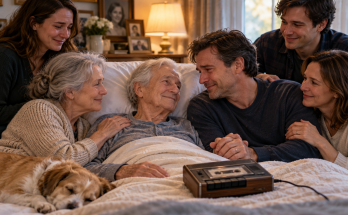
“Hello, my boy.”
Those three words undid him.
My son bent forward as if someone had struck him in the chest. His bride immediately put both arms around him, but he shook his head, straightened, and wiped his face with the heel of his hand.
Nobody in the ballroom moved.
The recording carried the faint hum of our old refrigerator behind my wife’s voice. I could picture exactly where she had been sitting: kitchen table, morning light through the blinds, probably wearing the gray sweater she refused to throw away even after one cuff unraveled.
“If your father followed instructions,” she said, “you’re standing at your wedding wondering why your mother has managed to embarrass you from beyond the grave.”
A few people laughed through their tears.
My son did too.
It was the first sound he made.
My wife continued, telling him she wished she could see the person he had become. She said she hoped he had learned to cook something besides eggs and hoped he had finally stopped leaving wet towels on the bathroom floor.
His bride leaned close to him.
“You still do that.”
The people nearest them laughed.
My son nodded helplessly.
“That sounds like her.”
It did.
Not the sick version of her.
Her.
The woman who could make fun of you while handing you a sandwich. The woman who remembered birthdays but lost her keys twice a week. The woman whose absence had gradually been turned into something our household was expected not to mention too often.
Then her voice addressed the bride.
She said she did not know her name and could not imagine what she looked like, but she trusted her son’s choice. She joked that anyone patient enough to marry him deserved advance warning about his tendency to become silent when worried.
The bride looked at him.
His face crumpled again.
My wife told her not to interpret that silence as anger. Sit nearby, she advised. Bring him food. Give him time. Eventually he would talk.
I glanced at Carol.
She was no longer watching my son.
She was watching the cassette deck.
Her hands were clenched together.
The recording moved between humor and tenderness. My wife reminded our son of an argument he once had with a stubborn mailbox when he tried opening it from the wrong side. She described the expression he made when he knew he was wrong but had not yet decided whether admitting it was worth the humiliation.
The ballroom laughed again.
Then her tone changed.
“My boy, look at your wife.”
My son looked at his bride.
“Take her hands.”
He obeyed.
People around them shifted backward instinctively, creating space.
“There will be easy days,” my wife said. “There will be mornings when you cannot believe you were lucky enough to wake beside this person. There will also be nights when one of you faces the wall because saying ‘I’m sorry’ feels harder than staying angry.”
My son’s bride tightened her fingers around his.
“When that happens, remember the hands you are holding now. They belong to the person beside you, not the person against you.”
The bride lowered her head.
My son whispered something to her.
She nodded.
I could hear the old kitchen clock ticking during a pause in the recording.
Carol shifted beside me.
“I think that’s enough,” she whispered.
I turned.
“What?”
“She said what she needed to say.”
“The tape isn’t finished.”
“She has already taken over the reception.”
I stared at her.
“This is our son’s choice.”
“He is overwhelmed.”
“He asked to hear it.”
Carol’s mouth tightened.
Before she could answer, my wife’s voice returned.
She asked the guests to step away from the dance floor because the next few minutes belonged to her son and the woman who would share the life she could not stay to see.
Then music began.
I recognized the melody after three notes.
Every Sunday morning when our son was small, my wife played that song while making breakfast. When he was four, she used to put his feet on top of hers and shuffle him around the kitchen while pancakes burned on the stove.
My son recognized it sooner than I did.
His legs buckled.
His bride caught him.
He wrapped himself around her and buried his face against her shoulder.
They danced.
Nobody reached for a phone.
That detail stayed with me.
Two hundred people were present, nearly all carrying cameras in their pockets, yet somehow everyone understood that recording this would cheapen it.
My son cried openly.
I had seen him break his arm without crying.
I had watched him stand beside his mother’s grave without crying.
Now eleven years of disciplined grief came out against his wife’s shoulder.
A hand closed around mine.
Carol.
For a moment I thought the tape had reached her too.
Then her fingers moved from my hand to my wrist.
“Stop it.”
I looked at her.
Her face had gone pale.
“Why?”
“She has had her moment.”
The words were so cold that I almost did not recognize the woman speaking them.
“Let go.”
“Please.”
“Why are you afraid of this tape?”
“I’m not.”
“You are.”
Her eyes moved toward the cassette deck.
The song ended.
My wife’s voice returned.
She mentioned the possibility of a memorial photograph being displayed somewhere at the reception. If there was one, she said, she was grateful. If there wasn’t, she told her son not to let it ruin his wedding.
Everyone near us turned toward the memory table.
Four framed photographs stood there.
None showed my first wife.
My stomach dropped.
I had given the wedding planner a photograph of her three days earlier.
I knew I had.
My son saw the empty space.
Then he looked directly at Carol.
Carol released my wrist.
My wife continued speaking.
She said people sometimes confused honoring the living with eliminating the dead. Love did not require that bargain. Remembering one person did not diminish another.
My son kept staring at Carol.
I remembered the vanished photographs.
The donated toolbox.
The missing mug.
The Christmas cards.
Every compromise I had called reasonable.
Then the recording addressed me.
My wife said she hoped I had found happiness again.
My throat closed.
She said she meant it. She did not want me spending the rest of my life treating grief as loyalty.
Carol’s shoulders loosened slightly.
Then came the sentence that changed everything.
“Just remember, peace and silence are not the same thing.”
I gripped the back of a chair.
Carol stared straight ahead.
For years she had asked for silence under another name.
Peace when photographs disappeared.
Peace when my son objected.
Peace when stories about his mother made her uncomfortable.
Peace when I stopped defending memories because defending them required an argument.
My wife apologized to our son for dying.
There was nothing sentimental in the way she said it. She told him she had fought to stay. She wanted him to understand that death was not abandonment.
My son covered his face.
His bride held him.
The recording urged him to build a noisy home. Burn meals. Disagree over paint. Get a dog. Have children if they wanted them. Fill rooms with the ordinary disorder of people who were not afraid to belong there.
Then she told him never to make the person he loved feel like a visitor in their own life.
Carol picked up her purse.
“I’m going.”
I did not turn.
The tape continued.
My wife announced there was one more message.
On the other side.
Carol stopped.
“This one,” my wife said, “is for the woman my son married.”
The bride looked toward the cassette.
I moved toward the DJ.
Carol seized my arm.
“No.”
Several people heard her.
My son stepped away from his bride.
“What is wrong with you?”
Carol lowered her voice.
“This has gone far enough.”
“My mother is talking.”
“She is dead.”
His expression hardened.
“Yes. That’s why this is all I have.”
Carol looked at me.
“Don’t turn that tape over.”
Now there was no possibility I had imagined her fear.
“You know what’s on it,” I said.
“No.”
“You do.”
“I don’t.”
My son came closer.
“Then why are you trying to stop us?”
Carol said nothing.
The DJ removed the cassette.
Before I could take it, the bride did.
She turned it over.
Two handwritten words appeared on the label.
FOR HER.
My son’s bride held the cassette against her palm.
“I’m listening.”
“You shouldn’t,” Carol said.
“Why?”
“Because people who know they are dying say things without understanding what those words will do later.”
My son stared at her.
“How would you know what Mom said?”
Carol froze.
Whispers moved through the tables.
I suddenly hated that strangers were witnessing this.
I asked the wedding planner to begin sending everyone home.
Carol gave a bitter laugh.
“You played a dead woman’s recording in front of two hundred guests, and now you want privacy?”
I faced her.
“You removed her photograph from the memorial table.”
Her face changed.
That was answer enough.
My son heard it too.
“You did?”
Carol picked up her purse.
“It was inappropriate.”
“It was my wedding.”
“I was trying to prevent exactly this.”
“This what?”
He pointed toward the cassette.
“My mother being remembered?”
Carol’s eyes filled.
“I have spent years being compared with someone who can never make another mistake.”
Nobody answered.
The bride pressed the cassette to her chest.
“I’ll hear Side B alone.”
Carol looked at her with naked panic.
“If you listen to that recording tonight, your wedding will become something you cannot undo.”
My son stepped between them.
“What did you do?”
Carol shook her head.
“I protected this family.”
“From what?”
She looked at me.
“From finding out why your mother made that tape.”
The last guests left.
The ballroom doors closed.
Only my son, his bride, Carol, the DJ, and I remained.
The bride handed the cassette back.
The DJ turned it over and inserted it into the deck.
Carol stood near the exit.
The bride pressed PLAY.
Static.
Then my wife’s voice came quietly through the speakers.
She addressed her future daughter-in-law.
She said that if this side of the tape had reached her, then a woman she trusted must have kept a promise.
Carol shut her eyes.
My wife explained that she had left that woman a walnut box carved with a rose.
Inside, she said, were her wedding pearls, a private letter for our son, and documents concerning the house I believed belonged to me.
I stared at Carol.
She began moving backward.
Then my wife said the words that stopped every person in the room.
“The woman I trusted with that box is Carol—the woman your father may someday call his second wife.”
The tape hissed.
Carol reached for the door.
And for the first time since I married her, I understood that my first wife had entrusted Carol with something neither my son nor I had ever received.
Click here to continue reading: PART 3: My First Wife Had Trusted Carol With a Walnut Box, but the Secret Inside It Had Been Missing for Eleven Years
Eleven Years After His Mother Died, My Son’s Wedding Forced Me to Choose Between Peace and One Last Promise
Part 2 of 47