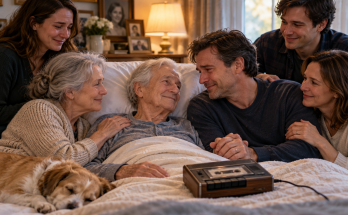
Clara’s first birthday happened in our backyard.
Our backyard.
I noticed myself calling it that again.
Carol had moved back seven months earlier.
Slowly.
First weekends.
Then three nights a week.
Then her clothes returned.
Then books.
Then the blue mug permanently claimed the second shelf.
We never recreated the old bedroom exactly.
Carol insisted.
New paint.
New bedding.
Furniture moved.
Not because the room was contaminated.
Because rebuilding deserved visible choices.
We remained in therapy.
Less often.
Still useful.
Clara’s birthday brought everyone together.
My son and his wife arrived early.
Rachel brought too much food.
Helen Vale sent a gift but did not attend.
The detective came with his husband and immediately announced he was off duty and would arrest anyone who mentioned financial records.
My son pointed at him.
“Finally useful law enforcement.”
Clara wore a yellow dress.
No family heirloom.
No pearls.
No symbolic ribbon.
She spent most of the afternoon trying to eat grass.
My son followed her everywhere.
His wife eventually grabbed his belt.
“Sit.”
“She has something.”
“It’s a leaf.”
“Could be toxic.”
“It came from your father’s maple.”
“Trees are suspicious.”
I laughed.
“You were worse,” he told me.
“I know.”
He sat.
Clara survived the leaf.
Cake came at three.
She destroyed it.
Frosting in her hair.
On her nose.
Inside one ear somehow.
Carol took photographs.
At one point she lowered the phone.
Her face changed.
I knew why.
Anna had photographed our son’s first birthday.
Same chaos.
Different backyard.
Different woman behind the camera.
I touched Carol’s arm.
“You okay?”
“Yes.”
Then:
“Mostly.”
Good answer.
After guests left, my son and his wife took Clara home.
Rachel helped clean.
By eight, the house became quiet.
Carol and I sat outside.
Paper plates still stacked on the patio table.
One yellow balloon trapped in the maple branches.
Carol said:
“I need to ask you something.”
That sentence once terrified me.
Now I waited.
“Do you wish you never married me?”
There it was.
The question beneath everything.
Not whether I loved her.
Not whether I forgave her.
Whether our marriage itself had been a mistake.
I could have answered quickly.
No.
Reassure.
Protect.
Old habit.
Instead I thought.
Carol watched.
“Take your time.”
“I wish we had married differently.”
She nodded slowly.
“What does that mean?”
“I wish you had told me why you came back after Anna died.”
“Yes.”
“I wish I had asked why you were so determined to remove things.”
“Yes.”
“I wish we had told my son that loving you didn’t require him to make his mother smaller.”
Carol looked down.
“So you regret it.”
“Parts.”
She waited.
“I regret the marriage we pretended we had.”
That landed.
“What about the real one?”
“I’m still in it.”
She started crying.
I continued before emotion could turn the answer into something simpler than it was.
“I don’t know who we would’ve become if you hadn’t married me.”
“Maybe better people.”
“Maybe.”
“Maybe you would’ve found someone else.”
“Maybe.”
“You might’ve been happier.”
“Maybe.”
She laughed through tears.
“You’re terrible at romance now.”
“I’m trying honesty.”
“It’s annoying.”
“Yes.”
I asked her the same question.
“Do you wish you never married me?”
She thought longer.
“Sometimes.”
That hurt.
I let it.
“When?”
“When I look at what Malcolm got access to because of me.”
“That isn’t the marriage itself.”
“No. But I brought him close.”
“Yes.”
“I also think I used you.”
“How?”
“To prove Anna forgave me.”
I had suspected that.
Hearing it still hurt.
Carol continued.
“If I became your wife, then maybe it meant she really trusted me. Maybe it meant I wasn’t Elaine’s frightened daughter or Malcolm’s niece. I could be someone Anna chose.”
“You were.”
“For a role.”
“Yes.”
“Not for every role.”
Exactly.
Carol had turned Anna’s limited trust into permission for an identity.
Then defended that identity when guilt threatened it.
She looked at the dark yard.
“I loved you too.”
“I know.”
“That makes it worse sometimes.”
“I know.”
We sat quietly.
The yellow balloon moved in the branches.
Carol asked:
“Do you forgive me?”
Another question we had avoided.
I hated the word because it wanted a clean answer.
“I think I have forgiven some things.”
“Some?”
“Yes.”
“Which?”
“I don’t keep a list.”
She smiled.
“Helpful.”
“I don’t wake up angry that you packed Anna’s mug anymore.”
“That’s something.”
“I still get angry about the bank.”
She nodded.
“You should.”
“I still think about our son at nineteen.”
“So do I.”
“I don’t know if forgiveness means I eventually stop.”
“I don’t think it does.”
Neither did I.
Carol said:
“I forgive you.”
“For what?”
“Not seeing me.”
That surprised me.
She explained.
After we married, I liked the version of Carol who made life easier.
Organized bills.
Handled appointments.
Smoothed conflict.
Removed painful objects.
I praised her for making the house peaceful.
I did not ask what that peace cost her.
Or my son.
I had benefited from her compulsive fixing.
Then resented the consequences.
“That’s fair.”
She shook her head.
“Don’t do that.”
“What?”
“Agree because you feel guilty.”
I smiled.
She knew me.
“I’ll think about it.”
“Good.”
We went inside.
The kitchen looked destroyed.
Frosting.
Cups.
Wrapping paper.
Carol picked up Clara’s smashed paper crown.
“She’s going to hear about all this someday.”
“Yes.”
“How much?”
“Her parents decide.”
Carol nodded.
That boundary came naturally now.
A year earlier, we would have debated what Anna wanted.
Now Clara’s parents got to parent.
Simple.
The following week, my son asked whether we would babysit overnight.
First time.
Carol panicked more than I did.
She bought outlet covers despite our outlets already being tamper-resistant.
My son arrived carrying enough equipment for an expedition.
His wife kissed Clara.
Then handed us instructions.
Feeding.
Bath.
Bedtime.
Emergency numbers.
All normal.
At the bottom my son wrote:
DO NOT PLAY ANY CASSETTES.
I looked at him.
He grinned.
Carol laughed.
They left.
Clara cried for nine minutes.
Then became fascinated by a wooden spoon.
We survived dinner.
Bath nearly drowned the bathroom.
At bedtime, I carried her through the hall.
She pointed at framed photographs.
One of my son’s wedding.
One of Anna.
One of Carol and me.
One of Clara as a newborn.
No hierarchy.
No shrine.
She touched Anna’s photograph.
“Who?”
Her first question about her.
I froze.
Carol stood behind me.
Clara pointed again.
“Who?”
I said:
“That’s Grandma Anna.”
Clara repeated something approximating Anna.
Then pointed at another picture.
“Who?”
That was it.
No forty-seven-minute explanation.
No inheritance.
No death.
Just a name.
Age-appropriate truth.
My son’s wife had been right.
Development was not deception.
I put Clara to bed.
She woke twice.
At four fifteen she decided morning had arrived.
I disagreed.
She won.
By the time my son collected her, I looked destroyed.
He smiled.
“How’d it go?”
“Never again.”
“Great. Next Saturday?”
“No.”
Carol said:
“Yes.”
Traitor.
My son looked at the photographs.
“Did she ask?”
“Yes.”
“What did you say?”
“Grandma Anna.”
He nodded.
“Perfect.”
No more required.
Later that month, prosecutors notified us that Malcolm’s remaining cooperation obligations were complete.
No more interviews expected.
No more family involvement unless appeals raised unusual issues.
The detective said:
“You can stop answering calls from us.”
My son replied:
“Promise?”
“Please.”
The active case chapter was closing.
Not all legal proceedings.
But our role.
That evening my son came over with a small device.
A cassette player.
Newly manufactured retro model.
He placed it on the table.
“What’s that?”
“I got the original tape back.”
The evidence hold had finally lifted.
Anna’s cassette.
The real one.
He placed it beside the player.
Carol stared.
So did I.
For years, that object carried enormous weight.
Now it looked small.
Plastic.
A handwritten label.
My son said:
“I thought we should decide where it goes.”
I looked at him.
“Your house.”
“Why?”
“She made it for you.”
He nodded.
Carol agreed.
His wife had already cleared a drawer.
Not a safe.
Not a vault.
A drawer.
Climate-controlled archival case inside, because his wife had more sense than the rest of us.
My son laughed.
“She says ordinary doesn’t mean careless.”
Correct.
Before leaving, he asked whether I wanted to hear it.
I thought.
“No.”
He looked surprised.
“Why?”
“Not tonight.”
No fear.
No avoidance.
Just choice.
The tape would still exist tomorrow.
That was perhaps the largest change of all.
We no longer had to open every envelope immediately.
Play every recording.
Chase every clue.
Truth was no longer running away from us.
Click here to continue reading: PART 40: The Forty-Seven-Minute Tape Finally Became a Family Recording Again, Until Clara Asked One Question None of Us Had Prepared to Answer
Eleven Years After His Mother Died, My Son’s Wedding Forced Me to Choose Between Peace and One Last Promise
Part 39 of 47