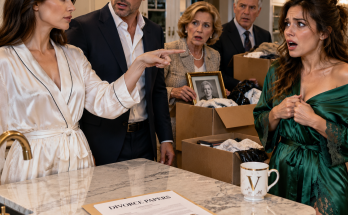
By the time the last Hayes relative left, my condo looked as though someone had searched it during an evacuation.
Drawers remained open. Boxes crowded the hallway. David’s clothes were scattered across our bedroom carpet. Books had been removed from shelves and stacked without care. The inventory sheet lay folded on the dining table, its neat columns suddenly obscene.
Eleanor was the final person at the door.
Marcus had already gone downstairs.
Chloe waited in the hallway.
My mother-in-law turned before leaving.
“You think a recording makes you powerful.”
“I think a deed makes the condo mine.”
Her mouth tightened.
“Property can be challenged.”
“So challenge it.”
“You don’t understand the history behind any of this.”
“You had nine years to tell me.”
“It wasn’t your business.”
“It became my business when you used an unauthorized key to enter my home after my husband’s funeral.”
Her eyes flicked toward the blue folder under my arm.
I saw the calculation.
“What did David write?”
“You heard what he wanted you to hear.”
“I’m his mother.”
“He knew that.”
Her face hardened.
For an instant I saw why David had spent so much effort planning around her.
Eleanor did not expect obedience because she was persuasive.
She expected it because resistance offended her understanding of the world.
She stepped into the hallway.
“Blood has consequences, Sarah.”
“So does trespassing.”
The elevator arrived.
She entered without answering.
I closed the door.
Locked it.
Engaged the security chain.
Then I stood with my forehead against the wood.
My legs began shaking.
Until that moment anger had been holding me upright.
Without Eleanor in front of me, it vanished.
I slid down the door and sat on the floor.
The condo was quiet except for traffic below and the soft hum of the refrigerator.
David’s urn sat among the funeral flowers.
I looked at it.
“You knew.”
My voice sounded small in the room.
“You knew they would do this.”
I wanted to be comforted by the fact that he had protected me.
Instead I felt wounded.
He had known enough to transfer the condo.
Enough to create recordings.
Enough to arrange medical evaluations.
Enough to leave clues.
Yet he had allowed me to spend the final months believing the only enemy in our lives was cancer.
I cried then.
Not neatly.
I cried until breathing hurt and my face was wet and I had to pull my knees against my chest.
Eventually Max padded out of the bedroom.
The old Labrador had spent most of the afternoon hiding from the crowd.
He lowered himself beside me and placed his gray muzzle on my leg.
I stroked his ears.
“Your dad left us homework.”
Max sighed.
That sounded about right.
After a while I stood.
Grief could have the floor later.
Right now I needed information.
I carried the blue folder to the dining table and photographed every page before touching anything else.
Property records.
Bank statements.
Letters from law firms.
Old corporate filings.
Several photographs.
Most meant nothing to me.
One statement came from a bank I did not recognize.
The account had existed for fourteen years.
The current balance was unremarkable.
The transaction history was not.
Once a year, on the same date, ten thousand dollars had been withdrawn.
I traced the pattern with my finger.
Same month.
Same day.
Again and again.
Then the final withdrawal broke it.
Two hundred fifty thousand dollars.
Three months before David’s cancer diagnosis.
I checked the description.
HARPER.
The name stirred a memory.
Thomas Harper.
David had mentioned him perhaps twice.
An attorney connected to his father.
I opened David’s laptop.
His password still worked.
That almost broke me again.
I typed Harper into the email search.
Hundreds of irrelevant results appeared.
Then I restricted the search by sender.
Thomas Harper.
Several old messages.
Most dated long before our marriage.
I opened one.
The subject referred to his father’s instructions.
The body was brief.
Thomas warned David that the ownership structure had to remain outside Eleanor’s reach.
Then came a second sentence.
A sentence containing my name.
I read it three times.
Thomas had written about when Sarah should be told.
The email was fourteen years old.
I had met David nine years ago.
I pushed away from the laptop.
“No.”
Max lifted his head.
I checked the date.
No mistake.
Five years before I met my husband, an attorney associated with David’s father had apparently known my name.
I searched for more.
Sarah appeared nowhere else in that email thread.
Had there been another Sarah?
Had David known someone with my name?
Had Thomas edited the email later?
I checked the metadata as far as I knew how.
Nothing obvious.
My phone buzzed.
Unknown number again.
The earlier warning remained on the screen.
They are watching you.
A second message had followed.
Do not go alone.
Now a third appeared.
An address.
South Side.
Underneath:
Come before they find what you are looking for.
I stared at it.
The warning said not to go alone.
The new instruction effectively demanded urgency.
I typed the address into a search.
The building appeared.
Then another result.
Thomas Harper.
Attorney.
My pulse quickened.
The same man connected to the bank transfer.
The same man who had discussed me before I supposedly knew David.
I returned to the folder.
One photograph showed David as a young man beside his father.
Another man stood with them.
I assumed it was Thomas.
Eleanor was visible behind them.
She was younger, but unmistakable.
Her expression was severe.
I turned the photograph over.
No writing.
The picture of David and me was different.
We were standing outside the coffee shop near Northwestern.
David wore his awful gray sweater.
I held the drink he would knock over minutes later.
At least, that was how I remembered the day.
But something about the photograph bothered me.
If it showed the day we met, who had taken it?
I sat very still.
David and I had always told the story the same way.
I was reading at a small table.
He reached past me for a newspaper.
My coffee went over.
He apologized.
Bought another.
Asked what I was reading.
We talked for two hours.
There had been no friend with him.
No friend with me.
So who had taken a photograph?
I zoomed in using my phone.
Behind us, reflected in the shop window, was the faint outline of a man.
Impossible to identify.
I turned the photo over again.
Ask for Daniel.
Not the Daniel you remember.
Daniel.
The name felt deliberate.
Maybe not a person.
A password?
A company?
A location?
My phone buzzed.
Another message.
You have less time than David expected.
I stood.
Enough.
I called building security.
“Did anyone come to my unit today besides the Hayes family?”
The guard checked.
“One visitor asked for you earlier.”
“Name?”
There was a pause.
“Thomas Harper.”
My mouth went dry.
“When?”
“Before you got back from the funeral.”
“Did he go upstairs?”
“He signed in, but I don’t think he reached your unit. Your family arrived around then.”
“Did he leave?”
Another pause.
“I believe so.”
“You believe so?”
“I didn’t personally see him leave.”
I looked toward the windows.
Chicago glittered beyond the glass.
Suddenly every lit apartment across the street felt like an eye.
I closed the curtains.
Then I did something David would have approved of.
I made copies.
I uploaded the folder photographs to two separate cloud accounts.
I emailed them to myself.
I photographed the inventory sheet Eleanor had made.
I saved David’s recording in three places.
Then I called a lawyer recommended by a friend and left an urgent message.
Only after that did I put on my coat.
The warning had told me not to go alone.
The other message had given me an address.
I decided I would not obey either blindly.
I texted my sister the address and told her to call me in one hour. I also shared my live location with her.
Then I put the blue folder in my bag.
At the elevator, I noticed a man near the stairwell.
Gray jacket.
Dark cap.
Phone in his hand.
He did not look at me until the elevator doors opened.
Then our eyes met.
He turned away.
I stepped inside.
At the last moment, he began walking toward the elevator.
I pressed the close button.
The doors met before he reached them.
My heart hammered all the way down.
In the lobby I stopped at security.
“Was that Thomas Harper upstairs?”
The guard looked confused.
“Who?”
“The man who signed in.”
He pulled up the visitor log.
Thomas Harper’s name was there.
The guard turned the monitor slightly.
“He arrived before you.”
“Did you see him?”
“Older gentleman. White hair.”
The man upstairs had been perhaps forty.
“Did anyone else sign in?”
“No.”
I looked through the glass doors.
The man in the gray jacket emerged from the side exit.
He crossed the street.
Stopped beside a dark sedan.
And waited.
I ordered a taxi rather than using my own car.
When it arrived, I got in quickly.
“Where to?” the driver asked.
I gave Thomas Harper’s address.
We pulled away.
Through the rear window I watched the dark sedan enter traffic behind us.
It stayed there for six blocks.
Then ten.
I leaned forward.
“Can you make a turn here?”
The driver glanced at me in the mirror.
“Here?”
“Yes.”
He turned.
The sedan turned too.
My hands became cold.
“Another turn.”
The driver frowned but complied.
The sedan remained behind us.
“Someone following you?”
“I don’t know.”
That was a lie.
I knew.
I simply did not know who.
We reached the address forty minutes later.
I paid before the taxi stopped completely.
The building was older than the surrounding structures, four stories of weathered brick with narrow windows and a faded sign above the entrance.
I looked back.
The sedan had disappeared.
That did not reassure me.
Inside, the hallway smelled of dust, radiator heat and old paper.
Thomas Harper’s unit was on the third floor.
3B.
I knocked.
Nothing.
Again.
“Mr. Harper?”
Silence.
I tried the handle.
The door opened.
I almost left.
Every sensible instinct told me to.
Then I saw papers scattered across the floor.
A chair had been overturned.
“Hello?”
No answer.
I stepped inside.
A lamp glowed beside the sofa.
Books covered one wall.
Legal boxes covered another.
And hanging above a desk was the photograph from the blue folder.
David.
His father.
Thomas.
Eleanor.
I approached it.
The frame contained a wider version than mine.
There were more people at the edges.
One face caught my attention.
A young woman stood near the far corner.
Dark hair.
Profile turned toward David’s father.
Something about her seemed familiar.
Before I could examine her, a floorboard creaked behind me.
I spun around.
An elderly man stood in the kitchen doorway.
White hair.
Thin shoulders.
Cane in one hand.
He looked exhausted but alert.
“Sarah.”
My hand went to my chest.
“Thomas Harper?”
He nodded.
“You came.”
“How do you know me?”
His expression changed.
Not surprise.
Sadness.
“I’ve known who you are for fourteen years.”
The number hit me again.
“Then tell me how.”
He lowered himself carefully into a chair.
“First lock the door.”
I did not move.
“Why?”
“Because Eleanor knows David is dead.”
“That isn’t news.”
“No.”
Thomas looked toward the window.
“But what she doesn’t know yet is whether he managed to give you what his father protected from her.”
I tightened my grip on my bag.
“What did his father protect?”
Thomas studied me for a moment.
Then he reached beneath the table and placed a small wooden box between us.
“Control of everything.”
Click here to continue reading: PART 4: The Old Lawyer Opened a Box David Had Protected for Fourteen Years, and Three Familiar Names Changed the Meaning of His Death
Before the Funeral Flowers Had Wilted, My Husband’s Family Was Already Deciding Which Pieces of Our Life Belonged to Them
Part 3 of 32