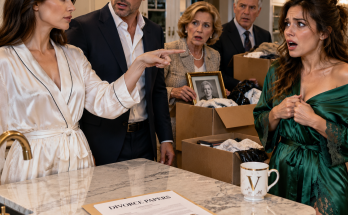
Rachel picked up the photograph before I could.
Her hands trembled.
“That’s Mom.”
Daniel nodded.
“I know.”
“No.”
Rachel looked at me as though I might deny it for her.
“That’s really her.”
I recognized the cardigan.
Not because I had seen that exact one.
Because our mother wore the same kind throughout our childhood.
Plain wool.
Pearl buttons.
Practical shoes.
Her younger face was unmistakable.
She was smiling.
Not broadly.
But comfortably.
Like a woman standing among people she knew.
Richard Hayes stood on one side.
His business partner, Martin Vale, on the other.
I looked at Daniel.
“What was my mother doing with them?”
“She worked for Martin.”
Rachel frowned.
“Doing what?”
“Administrative research.”
“That means nothing.”
“It meant quite a lot in Martin’s company.”
Daniel folded his hands.
“Your mother was good with records.”
That sounded painfully plausible.
Mom had spent her life correcting everyone’s filing systems.
Even our kitchen pantry had labels.
“She worked for him before the library?”
“Yes.”
“How long?”
“Three years.”
I tried to reconstruct our family timeline.
Mom had rarely discussed her twenties.
She married our father late.
Rachel was older than me by three years.
There was enough room.
Too much room.
“Why didn’t she ever tell us?”
Daniel looked at the photo.
“Because Martin died.”
“That doesn’t explain decades of silence.”
“No.”
“What does?”
“Fear.”
Rachel scoffed.
“Our mother was not afraid of rich people.”
“You knew her later.”
That silenced us.
I hated him for the sentence.
Not because it was cruel.
Because it was true.
Children inherit the finished version of their parents.
We rarely know what existed before us.
Daniel continued.
“Your mother discovered irregularities in vendor records.”
“The transfers?”
“Early versions.”
“She told Martin?”
“Yes.”
“And Martin told Richard.”
“Eventually.”
“Eleanor found out?”
“We believe so.”
“Believe?”
Daniel remained careful.
“Again, I’m not going to claim evidence I don’t have.”
Thomas nodded reluctantly.
“Good.”
Daniel ignored him.
“Martin started collecting records. Your mother helped him.”
Rachel put the photograph down.
“Then why wasn’t she on Richard’s tape by full name?”
“She was.”
“He only said Sarah.”
“Because he expected me to know which Sarah.”
I stared at him.
“You knew our mother.”
“Yes.”
“How well?”
Daniel hesitated.
“Well enough to promise her something.”
My pulse quickened.
“What?”
“That if this family conflict resurfaced, her daughters would never be pulled into it.”
A hollow laugh escaped me.
“You failed.”
“Yes.”
No defense.
No excuse.
Just yes.
That made it harder to stay angry.
Rachel remained standing.
“Did David know?”
Daniel looked at me.
“Eventually.”
“When?”
“Before he met Sarah.”
The room tilted again.
I stared at him.
“No.”
“He knew of you.”
“That is not the same as knowing me.”
“No.”
“Did he meet me deliberately?”
Daniel’s silence was catastrophic.
Rachel whispered, “Oh my God.”
I stood.
The chair fell backward.
Thomas reached for it.
I did not care.
“The coffee shop.”
Daniel said nothing.
“He knew I would be there.”
Still nothing.
“Answer me.”
“Yes.”
The word hit harder than Eleanor’s cruelty.
Harder than the trust.
Harder than the secret company.
Because this was mine.
The beginning of us.
The story I had told for nine years.
Coffee spilled.
Conversation.
Chance.
A life built from an accident.
Not an accident.
I walked away from the table.
Rachel came after me.
“Sarah.”
“Don’t.”
She stopped.
I needed air.
The room had none.
I opened the hallway door and stepped outside.
The corridor was empty.
I pressed both hands to the wall.
David had known my name.
He had known my mother.
He had known where I would be.
Everything after that suddenly felt contaminated by the question of intention.
Did he choose the newspaper?
Did he spill the coffee deliberately?
Did he rehearse the apology?
Had our first conversation been an interview?
I felt sick.
Rachel stood a few feet behind me.
“He loved you.”
I turned.
“You don’t know what he was doing when we met.”
“Neither do you.”
“That is the problem.”
She looked stricken.
I hated that I was angry at her too.
Not because she had caused anything.
Because she was close enough to absorb it.
I returned to the room.
Daniel remained seated.
I picked up my chair.
“Tell me exactly what happened.”
He nodded.
“David found your mother’s name in Martin’s old research notes.”
“When?”
“About a year after Richard died.”
“So thirteen years ago.”
“Yes.”
“He found us?”
“He found your mother first.”
“My mother died twelve years ago.”
“I know.”
The room went still.
“You met her?”
“No.”
“David?”
Daniel hesitated.
“Yes.”
My heart seemed to stop.
“What?”
“Once.”
I grabbed the edge of the table.
“When?”
“About six months before she died.”
I could not breathe properly.
“Where?”
“At the library.”
Of course.
The library.
Her territory.
Her safest place.
“What did he say to her?”
“He told her Richard had died and asked whether she still had copies of Martin’s records.”
“And?”
“She denied having anything.”
“Did he believe her?”
“No.”
“What else?”
“She asked about you and Rachel.”
I stared.
“Why?”
“Because she wanted to know whether David had contacted either of you.”
“He hadn’t.”
“Correct.”
“What did she tell him?”
Daniel leaned forward.
“That if he had any decency, he would leave you both alone.”
The sentence cut deep.
Rachel whispered, “That sounds like Mom.”
Yes.
It did.
“What changed?”
“Your mother died.”
“So David ignored her after she couldn’t stop him.”
“That is one interpretation.”
“What’s yours?”
Daniel considered.
“He believed the danger had changed.”
“That sounds convenient.”
“It probably was.”
I laughed without humor.
“Did he deliberately arrange to meet me?”
“Yes.”
“Why?”
“To determine whether your mother had left you anything.”
There it was.
The ugliest version.
A stranger approaching me because I might possess evidence.
Rachel said, “And after?”
Daniel looked at me.
“After two hours, he called me.”
“What did he say?”
Daniel’s expression softened slightly.
“He said he had made a mistake.”
“What mistake?”
“He said you knew nothing.”
“That would have been useful.”
“He also said he wanted to see you again.”
I looked away.
I did not want comfort.
Not yet.
Daniel continued.
“I told him not to.”
“You?”
“Yes.”
“Why?”
“Because your mother had been explicit.”
“What did David say?”
“He said he would not use you.”
I turned back.
“That is exactly what he had already done.”
“Yes.”
Daniel did not flinch.
“He knew that later.”
“Later?”
“He carried guilt about it.”
“How noble.”
Rachel said softly, “Sarah.”
“No. I’m allowed this.”
“You are.”
She looked at Daniel.
“But keep going.”
He did.
David did not mention the Hayes records on our second meeting.
Or third.
Or tenth.
He did not search my apartment.
Did not ask about my mother’s papers.
Daniel claimed David stopped discussing the investigation with him for nearly a year.
Then our relationship became serious.
I remembered that year.
Cheap dinners.
Long walks.
David teaching me to drive his manual-transmission car badly.
Me taking him to a disastrous family barbecue where Rachel burned chicken and our father argued with a neighbor over property lines.
Those memories remained real.
But they now had another shadow.
“Did he ever tell you he found anything through me?”
“No.”
“Then why stay?”
Daniel looked almost irritated.
“Because he loved you.”
I said nothing.
“That does not erase how he met you.”
“No.”
“It does not make your mother’s warning less important.”
“No.”
“But it is still true.”
I hated him for being reasonable.
Thomas asked, “Did Richard know Sarah Cole personally?”
“No.”
“Then his tape saying ‘if Sarah is present, trust her’ must refer to her mother.”
“Yes.”
That solved one mystery.
And created another.
“Why would my mother be present when Daniel retrieved the records?”
Daniel looked at the old photograph again.
“Because Richard expected she might be the only surviving person who understood Martin’s indexing system.”
“What indexing system?”
“The records were disguised.”
“How?”
“Martin knew someone was searching his office. He stopped labeling files by company names.”
“What did he use?”
Daniel looked at me.
“Library classifications.”
For one strange moment Rachel and I simply stared.
Then we both understood.
Mom.
Of course.
She had helped build the concealment.
The boring, orderly system she loved became camouflage.
Thomas said, “That explains why the documents were difficult to reconstruct.”
Daniel nodded.
“Without the index, the papers look unrelated.”
“Does the index still exist?”
Daniel looked at me.
“That is the question David spent years trying to answer.”
My mother’s house had been sold after she died.
Our father had moved two years later.
Most of her belongings were divided between us.
Books.
Photographs.
Recipe cards.
Boxes of papers.
I felt a sudden chill.
“Rachel.”
She looked at me.
“What did you keep?”
Her face changed.
Not dramatically.
Just enough.
“Rachel.”
She sat slowly.
“What?”
“You kept Mom’s desk.”
“Yes.”
“Anything inside it?”
“Old stationery.”
“That isn’t everything.”
Her silence answered.
I stared.
“You know something.”
“No.”
“You just reacted.”
She rubbed her palms together.
“After Mom died, I found an envelope.”
My anger returned.
“What envelope?”
“It wasn’t addressed to me.”
“To whom?”
She looked at me.
“You.”
Nobody moved.
“You had a letter for me?”
“I didn’t know whether to give it to you.”
“How long?”
“Twelve years.”
The betrayal felt absurdly intimate.
After everything else, this small family secret somehow hurt.
“Twelve years?”
“I was twenty-eight. Dad was falling apart. You were barely functioning.”
“That was not your decision.”
“I know.”
“Where is it?”
“At my house.”
“What does it say?”
“I never opened it.”
“Why not?”
“Because it had your name.”
I stared at her.
“You respected my privacy by hiding my mail?”
Rachel flinched.
“I thought Mom might have written it when she was confused.”
“She wasn’t confused.”
“At the end she was on heavy medication.”
The echo was unbearable.
Eleanor saying David was impaired.
Us assuming the dying were unreliable because that made their inconvenient words easier to dismiss.
“Why didn’t you tell me later?”
Rachel’s eyes filled.
“Because by then too much time had passed.”
“That is not an answer.”
“It’s the only one I have.”
The room went silent.
Then Daniel said, “We need that letter.”
I turned on him.
“You don’t get to order us.”
“No.”
He accepted that too.
“But if your mother preserved Martin’s index, she may have put the key in something only you would recognize.”
My phone rang.
Unknown number.
Again.
I almost declined.
Then I answered.
No voice.
Only static.
Then someone played a recording.
My mother’s voice.
Older than in the photograph.
Younger than at the end.
“Sarah, if this reaches you, I’m sorry.”
Every person in the room froze.
The recording continued for only seven seconds.
“Do not trust the red file.”
Then the call ended.
I stared at the phone.
Rachel whispered, “Mom.”
I called back.
Disconnected.
Daniel looked shaken.
“Did you know that recording existed?”
“No.”
Thomas asked, “What red file?”
Daniel shook his head.
Rachel’s face had gone pale.
I turned toward her.
“What?”
She swallowed.
“Mom’s letter.”
My chest tightened.
“What about it?”
Rachel looked at me.
“It’s inside a red folder.”
Click here to continue reading: PART 11: My Mother’s Hidden Letter Sent Rachel and Me Back Into Our Childhood, Where a Red Folder Had Been Waiting for Twelve Years
Before the Funeral Flowers Had Wilted, My Husband’s Family Was Already Deciding Which Pieces of Our Life Belonged to Them
Part 10 of 32