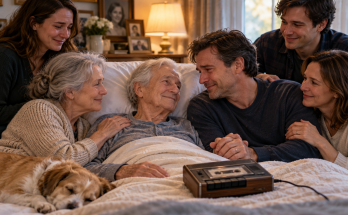
The cassette had been in my breast pocket since breakfast, pressing against my ribs every time I bent forward, hugged a relative, or pretended I was enjoying my son’s wedding.
It was an ordinary plastic cassette in a cracked clear case. The label had yellowed around the edges. My first wife’s handwriting still crossed the front in blue ink, slightly slanted because her hands had already begun to shake when she wrote it. I had owned expensive watches, signed mortgage papers worth hundreds of thousands of dollars, and once carried my newborn son through an emergency room believing I might lose him. Nothing I had ever held felt heavier than that tape.
My son was twenty-seven now. At four that afternoon, beneath white flowers and strings of warm lights, he had married the woman he loved. I stood in the first row while he said his vows and kept thinking about the empty chair that should have belonged to his mother.
She had been dead eleven years.
He was sixteen when cancer took her. Old enough to understand exactly what death meant, young enough to believe he could survive it by refusing to talk about it. At the funeral he stood beside me in a black suit that no longer fit his shoulders, his jaw clenched so hard that a muscle jumped near his ear. People kept trying to hug him. He endured each embrace like another piece of bad weather.
My second wife, Carol, sat beside me at the wedding reception.
She wore a silver dress and a calm expression. To anyone watching us, we probably looked like what people call a healed family: widower remarries, boy grows up, years pass, everyone learns how to continue.
That version was easier to explain.
It was also incomplete.
Carol had known my first wife long before I married her. For years I avoided explaining the depth of that friendship, even to my son. Carol had been around during hospital visits and bad treatment weeks. After the funeral she disappeared from our lives for nearly a year, then returned one wet afternoon carrying a casserole and asking whether we needed anything.
I needed everything.
Two years later, I married her.
At first I thought Carol understood that loving me meant living beside a memory. She never complained when my first wife’s photograph stayed on the bedroom dresser. She listened when my son told stories about his mother. She even helped me sort some of the boxes I had been unable to open after the funeral.
Then, slowly, the photographs began moving.
One went from the living room to the hallway. Another went from the hallway into a drawer. My first wife’s favorite blue mug disappeared from the kitchen. Her gardening gloves vanished from the garage. One Christmas, my son asked why his mother’s name was no longer written beneath an old family photograph we included with our cards.
Carol said we had to make room for the living.
I agreed with her because agreement was easier than conflict.
That became a habit.
Whenever my son objected, I asked him to understand Carol. Whenever Carol said the house felt crowded by someone who was no longer there, I asked my son to compromise. I told myself I was protecting the family I still had.
Years passed before I noticed how often protecting peace required my son to surrender something.
The cassette survived because Carol never knew I had it.
My wife recorded it during one of her better weeks near the end. I remembered coming home and finding an old portable tape recorder on the kitchen table. She quickly covered it with a dish towel and told me she was making something for our son.
“What?”
“None of your business yet.”
She smiled when she said it.
I had almost forgotten what that smile looked like.
After she died, I found the cassette inside an envelope addressed to me. There were instructions written on one sheet of paper.
Save this for his wedding.
That was all.
For eleven years, I kept it hidden.
First it lived in a locked desk drawer. When Carol and I moved, I slipped it into a box of tax records. Later I put it inside an old metal toolbox in the garage because Carol never touched my tools.
Then the toolbox disappeared.
Carol said she had donated it during a cleanup.
The cassette had already been moved.
That should have told me something.
Instead, I treated my suspicion as disloyalty.
On my son’s wedding day, I retrieved the tape from a safe-deposit envelope I had kept elsewhere and carried it against my chest from the ceremony through dinner.
I still had not decided whether I would play it.
My son and his bride moved from table to table, laughing, accepting congratulations, stopping every few minutes because someone wanted another photograph. He looked happier than I had seen him in years.
That made the decision harder.
Perhaps the tape belonged to another time.
Perhaps opening it now would turn a celebration into a memorial.
Carol seemed to read my thoughts.
“You’re distracted,” she said.
“I’m fine.”
“You’ve touched your jacket pocket about twenty times.”
My hand stopped halfway toward it.
She looked at the pocket.
“What’s in there?”
“Nothing important.”
Her eyes stayed on me for another second.
Then someone called her name from another table and she turned away.
I should have felt relieved.
Instead, a small uneasiness settled in my stomach.
The wedding planner approached just before the parent dances. She carried a clipboard and spoke softly because the DJ had started announcing the next part of the reception.
“Your son said you wanted a few minutes before the last dance.”
I had mentioned it weeks earlier without explaining why.
“Yes.”
“Do you need a microphone?”
I touched the cassette through my jacket.
“I might need something older.”
She smiled uncertainly.
When I showed her the tape, her eyebrows lifted.
“I think our DJ actually has a deck that can play that.”
“Seriously?”
“He does retro events. Let me ask.”
Carol had come up behind me.
“Play what?”
I turned.
There was no graceful way to hide it anymore.
I removed the cassette.
The instant Carol saw my first wife’s handwriting, something changed in her face.
Not sadness.
Not surprise.
Fear.
It vanished so quickly I almost convinced myself I had imagined it.
“What is that?” she asked.
“A recording.”
“I can see that.”
“She made it before she died.”
Carol stared at the cassette.
“For whom?”
“For our son.”
“And you brought it here?”
“She asked me to play it on his wedding day.”
Carol took a step closer.
“You never told me.”
“I didn’t tell anyone.”
“You’ve had this for eleven years?”
“Yes.”
Her lips tightened.
“This is his wedding reception.”
“I know where we are.”
“Then why would you do this to him tonight?”
The question irritated me more than it should have.
“Do what?”
“Drag him backward.”
“She was his mother.”
“And I have spent fifteen years helping you both move forward.”
There it was again.
Forward.
Peace.
Living.
Words that sounded generous until I considered everything they had been used to remove.
The wedding planner glanced between us and quietly excused herself.
Carol lowered her voice.
“You have no idea what is on that tape.”
“That’s true.”
“She could have been medicated. She could have been frightened. She might say something he doesn’t need to hear tonight.”
“She made it specifically for tonight.”
Carol’s fingers closed around my wrist.
“Then wait.”
“For what?”
“Tomorrow. Next week. Give it to him privately.”
I looked at her hand.
She released me.
Across the ballroom, my son laughed at something his bride whispered. For one second he looked sixteen again—not the sixteen-year-old at the cemetery, but the boy before that, the one who danced badly in our kitchen just to make his mother laugh.
I made my decision.
“No,” I said. “Tonight.”
Carol’s face became very still.
The DJ found me five minutes later.
He was younger than the cassette.
“I can play it,” he said, “but old tapes can be fragile. If it’s important, I’ll keep the volume low at first and make sure the mechanism doesn’t pull it.”
“Thank you.”
My son noticed us talking.
“What are you plotting?”
His bride slipped an arm through his.
“Your father has had the face of a man hiding something all evening.”
I took the cassette from my pocket.
My son stopped smiling.
He recognized the handwriting immediately.
I watched his eyes move across the label.
“Is that Mom’s?”
“Yes.”
He did not reach for it.
“Where did you get it?”
“She made it before she died.”
His bride looked from him to me.
“What’s on it?”
“I don’t know.”
My son’s eyes lifted sharply.
“You’ve never listened?”
“No.”
“Eleven years?”
“She told me not to.”
His mouth opened, then closed.
The noise of the ballroom seemed to recede around us.
“What did she tell you to do?”
“Keep it until your wedding.”
His bride pressed her fingertips against her lips.
My son looked toward the dance floor, then toward the tables filled with friends and relatives.
“You were supposed to play it here?”
“That was my understanding.”
He rubbed the back of his neck.
His mother used to do exactly the same thing when she was nervous.
I nearly lost my nerve.
“We don’t have to,” I said. “I can give it to you.”
He looked at the cassette for a long time.
Then he asked, “Did she make it when she knew?”
“Yes.”
He understood what I meant.
When she knew the treatment had failed.
His bride took his hand.
“What do you want?”
My son stared at his mother’s handwriting.
“Play it.”
Carol appeared beside us.
“No.”
All three of us turned.
She seemed to realize how forcefully she had spoken.
“I mean,” she said, softer, “maybe think about this first.”
My son frowned.
“Why?”
“It could be painful.”
He gave a humorless little laugh.
“My mother dying was painful. Hearing her voice isn’t going to make her more dead.”
Carol flinched.
I had never heard him speak to her that way.
His bride squeezed his hand.
“Are you sure?”
“Yes.”
He looked at the DJ.
“Play it.”
The DJ carried the cassette toward his equipment.
Carol caught my elbow.
“You don’t know what you’re starting.”
Something about the sentence chilled me.
“What does that mean?”
“Nothing.”
“That didn’t sound like nothing.”
She glanced toward the DJ.
“Please. Just give it to him privately.”
“Why?”
“Because some things belong in the past.”
“My wife’s message to her son doesn’t.”
Carol stared at me.
For years, whenever we reached this point, I had been the one to yield.
I didn’t.
The DJ inserted the cassette.
A mechanical click came through the speakers.
My son stood beside his bride in the center of the dance floor.
Guests gradually stopped talking.
The first sound was static.
Then a chair scraped somewhere on the recording.
A clock ticked faintly in the background.
My knees almost gave way.
I knew that clock.
It had hung above our kitchen door.
Then my dead wife laughed.
A small, nervous laugh.
Eleven years disappeared.
My son covered his mouth.
Carol went rigid beside me.
And the woman we had buried more than a decade earlier began to speak.
Click here to continue reading: PART 2: When My Dead Wife’s Voice Filled the Ballroom, One Person Reacted as Though She Already Knew What Came Next
Eleven Years After His Mother Died, My Son’s Wedding Forced Me to Choose Between Peace and One Last Promise
Part 1 of 47