I drove Maya to school that morning only because she begged me not to make a scene in front of Mark. He had already left for work, but she seemed terrified that staying home would create questions before she was ready to answer them. I agreed on one condition: I would call her out before lunch, and we would go directly to the hospital. She made me promise I would not tell her father until after a doctor had examined her.
I should have understood the importance of that request immediately.
Instead, part of me was still trying to preserve the marriage I thought I had.
I spent the first two hours of my workday pretending to work. Emails appeared on my screen. People spoke to me. My supervisor asked whether I had finished a report, and I answered automatically. Underneath every conversation ran the same sentence: I stopped telling Dad when it hurts.
At 10:14, I opened our health insurance portal.
Mark usually handled insurance paperwork because he liked handling anything involving numbers, passwords, forms, or official documents. He had always described it as taking something off my plate. That morning I realized how little I actually knew.
I searched Maya’s recent claims.
Nothing obvious appeared from five weeks earlier.
I refreshed the page.
Still nothing.
Maybe the clinic had not submitted yet. Maybe Mark paid cash. Maybe Maya remembered the timing incorrectly. I tried to build harmless explanations, but each one felt thinner than the last.
At 10:37, I closed my laptop and told my supervisor I had a family emergency.
The school secretary recognized me when I arrived.
“Maya isn’t feeling well?”
“Yes.”
“She’s been coming to the nurse quite a bit lately.”
I stopped signing the checkout sheet.
“How much is quite a bit?”
The secretary glanced toward the nurse’s office. “You’d have to ask Mrs. Kelley.”
Maya appeared before I could.
She had her backpack slung over one shoulder and one hand pressed against her stomach.
“Ready?”
I looked at her face.
“Not yet.”
She stiffened.
“What?”
“I want to talk to the nurse.”
Her eyes widened. “Why?”
“Because apparently you’ve been coming here often.”
She stared at the secretary.
I saw the exact moment she realized another secret had escaped.
“Maya.”
“It’s not a big deal.”
I had heard that phrase too many times already.
The nurse, Mrs. Kelley, invited us into her office. She was a practical woman in her fifties with reading glasses hanging from a chain around her neck. When I asked how frequently Maya had visited, she opened a log.
“Six times this month.”
I felt the blood leave my face.
“For what?”
“Abdominal discomfort twice. Nausea. Dizziness. Fatigue. One headache.”
I turned toward Maya.
She was staring at the tile floor.
“Why wasn’t I called?”
Mrs. Kelley looked surprised. “Her father was contacted.”
My entire body went cold.
“Every time?”
“His number is listed as the primary daytime contact.”
I had never agreed to that.
At least, I did not remember agreeing.
“What did he say?”
“He usually said he was aware of the issue.”
Usually.
The word scraped through me.
“One time he picked her up,” Mrs. Kelley continued. “Another time he asked us to let her rest here for thirty minutes.”
I looked at Maya. “Was that when you got sick after those pills?”
Her eyes flashed toward me.
Mrs. Kelley’s expression changed. “What pills?”
Maya shook her head quickly. “Nothing.”
I did not know what pills she meant yet. I only knew I had seen fear.
“Did your father give you medication?”
“He gives me vitamins sometimes.”
“What vitamins?”
“I don’t know.”
The nurse stopped writing.
I asked, “Prescription?”
“No.”
“Bottle?”
“He keeps them.”
“Where?”
Maya wrapped both arms around herself.
“At home.”
I could see she was shutting down.
We left.
In the car, she stared out the window while I drove to the hospital. September sunlight flashed through the trees. People walked dogs. Delivery trucks stopped at houses. The normal world continued around us with insulting ease.
After ten minutes she said, “You’re mad.”
“Yes.”
Her face tightened.
“Not at you.”
She did not believe me.
“Maya, listen carefully. I am angry that you have been hurting and somehow learned that the safest thing to do was hide it. That is not anger at you.”
She looked at the windshield.
“What if Dad had a reason?”
“For what?”
“For not telling you.”
There it was again. The reflex to protect him.
“I’m willing to hear his reason.”
She whispered, “He’ll say I made it sound worse.”
“Did you?”
“I don’t know.”
“How can you not know?”
“Because he says I do.”
I gripped the steering wheel.
For years Mark had corrected the emotional temperature of our house. If I was angry, I was overreacting. If Maya cried, she was dramatic. If someone disagreed with him, they were making a simple issue complicated.
I had thought it was a personality flaw.
Now I wondered whether it was a system.
At the hospital, triage moved faster once Maya described where the pain was located and how long it had lasted. The nurse asked whether it had worsened recently.
Maya nodded.
“How much?”
“Sometimes it wakes me up.”
I turned toward her sharply.
“You never told me that.”
She looked ashamed.
The nurse noticed.
“Anything else? Vomiting?”
“A few times.”
“Fever?”
“I don’t think so.”
“Changes in appetite?”
“Yes.”
“Weight?”
Maya’s eyes shifted.
The nurse looked at me.
“I’m not sure,” I said.
“Any previous evaluation?”
Maya froze.
I answered for her.
“Her father apparently took her to a clinic about five weeks ago.”
The nurse typed.
“Which clinic?”
I looked at Maya.
She gave the name.
The nurse searched her system.
Her forehead tightened.
“Was it one of our affiliated urgent-care sites?”
“I don’t know.”
“Do you have paperwork?”
“No.”
“Imaging discs?”
“No.”
“Records?”
“No.”
I heard my own voice becoming thinner. “Her father handled it.”
The nurse stopped typing.
She looked at Maya.
“What did they do?”
Maya described bloodwork, an examination, and an initial ultrasound. Then she mentioned the recommended scan.
The nurse asked, “Did you complete that follow-up imaging?”
“No.”
“Why?”
Maya stared at her shoes.
I said, “Her father declined it.”
The nurse’s expression remained professional, but something shifted.
“How old are you?” she asked Maya.
“Fifteen.”
“Was your father given a reason the scan was recommended?”
Maya whispered, “They said they couldn’t see everything clearly.”
I closed my eyes.
The nurse excused herself.
Maya immediately looked at me. “You’re doing that thing.”
“What thing?”
“Your face.”
“What about my face?”
“You look like you want to kill someone.”
Despite everything, I almost laughed.
Instead, I took her hand.
“I want answers.”
“They might say it’s nothing.”
“I hope they do.”
“And then Dad will be right.”
The sentence hurt.
“This is not about your father being right.”
“It always is with him.”
I looked at her.
She seemed surprised by her own honesty.
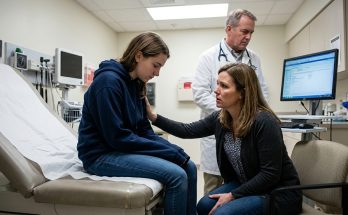
A doctor came in twenty minutes later. He introduced himself, asked Maya to describe the pain from the beginning, then examined her carefully.
When he pressed low on one side of her abdomen, she gasped.
He stopped.
“That tender?”
She nodded.
He asked me to step closer to the computer.
“We’re going to run bloodwork and repeat imaging.”
“What kind?”
“We’ll start with ultrasound. Depending on what we see, possibly CT or MRI.”
Maya whispered, “Dad said scans have a lot of radiation.”
The doctor looked at her.
“Some do. Some don’t. We choose imaging based on what we need and what’s safest.”
She nodded.
He studied her for another second.
“Did your father tell you not to have more tests?”
Maya went very still.
I felt my pulse jump.
The doctor noticed too.
“You’re not in trouble,” he said.
She rubbed her thumb against the cuff of her hoodie.
“He just thought they weren’t necessary.”
“Did the previous doctor think they were necessary?”
She hesitated.
“Yes.”
The doctor leaned back.
“Do you remember whether they said the follow-up was optional?”
“No.”
“Did they ask you to return if symptoms continued?”
“Yes.”
My hands turned cold.
“How long have the symptoms continued?”
Maya answered, “Every day.”
I stared at her.
Every day.
For five weeks.
Maybe longer.
The doctor looked at me, and I saw something in his face that made my stomach drop.
“What?” I asked.
“I’m going to request those previous records.”
“Is something wrong?”
“I don’t know yet.”
I hated those words.
He stood.
“I do know we shouldn’t keep waiting.”
After he left, I sat beside Maya.
Her eyes had filled again.
“What?”
She shook her head.
“Tell me.”
“He’s going to find out.”
“Your father?”
She nodded.
“That is not the thing I am worried about right now.”
“It is for me.”
The words were quiet but absolute.
I studied my own daughter and realized she was more frightened of her father discovering this hospital visit than she was of the reason we were in the hospital.
“Maya.”
She wiped her eyes quickly.
“What did he say would happen if you told me about the other doctor?”
She did not answer.
“What did he say?”
Her breathing changed.
“He said you’d blame him.”
“For what?”
“He didn’t say.”
I felt the room narrow.
“Blame him for not doing the scan?”
“No.”
“Then what?”
She shook her head.
“I don’t know.”
But her face told me she knew more than she was saying.
The doctor returned sooner than I expected.
He had a printout in his hand.
“We received part of the previous clinic note.”
My heart began hammering.
“And?”
He looked directly at Maya.
“The earlier physician documented that additional imaging was recommended promptly.”
“How promptly?”
His eyes moved to me.
“The wording says within several days if the pain persisted.”
Five weeks.
I felt sick.
“Was her father told?”
“The note states that the recommendation was discussed with the parent present.”
Maya stared at the floor.
I asked the question I already knew the answer to.
“Was there anything else?”
The doctor hesitated.
“Yes.”
My hand tightened around the chair.
“The clinic documented that they tried to contact the family afterward.”
I stopped breathing.
“How many times?”
“Three.”
Maya looked up.
I whispered, “Who answered?”
The doctor studied the page.
“According to the note, her father.”
The room went silent.
Then he added, “The final entry says he declined further follow-up.”
Maya began crying.
And I understood that whatever explanation Mark gave me later, one fact could no longer be softened, misunderstood, or explained away.
He had not forgotten.
He had made a decision.
Click here to continue reading: PART 3: The Doctor’s Records Proved My Husband Had Been Warned, but My Daughter Was Still Protecting a Secret From Me
The Sentence My Daughter Whispered Before School Made Me Question Every Ordinary Morning We Had Lived Through
Part 2 of 27