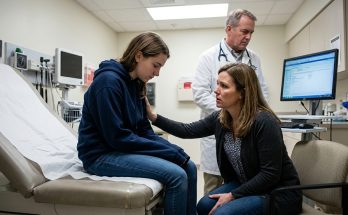
The patient advocate arrived ten minutes after I showed Mark’s messages to the doctor. Her name was Erin Walsh, and she had the composed, careful manner of someone accustomed to entering rooms where families had already begun falling apart.
She did not start by questioning me.
She sat across from Maya.
“Your doctor asked me to check in because you seem uncomfortable about your father coming here.”
Maya looked at me.
I nodded.
Erin said, “You can answer only what you want to answer.”
That mattered.
I could see it in Maya’s face.
“Do you feel safe going home with both of your parents?”
My first instinct was to defend Mark.
He has never hit her.
He has never hit me.
He gets angry, but—
I swallowed every sentence.
This was not my question to answer.
Maya stared at her hands.
“No.”
The word was so quiet that I nearly missed it.
Erin did not react dramatically.
“Can you tell me why?”
Maya’s eyes filled.
“Mom’s going to hate me.”
I moved closer.
“There is nothing you could tell me that would make me hate you.”
“Dad said there is.”
My stomach dropped.
“What did he say I’d hate you for?”
She shook her head.
“I can’t.”
“You can.”
“No.”
Her breathing grew faster.
I stopped pressing.
Erin said, “You’re not in trouble.”
Maya stared at her.
Then she whispered, “He takes my medicine.”
I frowned.
“What medicine?”
“The pills from the clinic.”
The doctor, who had remained near the computer, looked up.
“The pain prescription?”
Maya nodded.
He opened her earlier medical record.
I watched his expression while he read.
“What was she prescribed?” I asked.
“A limited medication for pain.”
“Why would Mark keep it?”
Maya wiped her cheeks.
“He said I didn’t need it.”
“And then?”
“He took it upstairs.”
“Did he use it?”
“I don’t know.”
“Did you ever see him with the bottle?”
“A few times.”
“Where?”
“In his office.”
Erin exchanged a look with the doctor.
I had begun to hate professional looks.
They often meant everyone else in the room understood how serious something was before I did.
My phone rang.
Mark again.
I rejected the call.
Immediately, a text appeared.
I’m coming upstairs. We’re leaving.
I showed the doctor.
“She isn’t leaving.”
“No,” he said. “Not until we finish the evaluation.”
Erin stood.
“I’m notifying security.”
Maya grabbed my wrist.
“Mom.”
Her hand was shaking.
“What?”
“There’s something else.”
I turned toward her.
She glanced at the door.
“I think Dad knew they would find something.”
Every person in the room went still.
“What are you talking about?”
“At the clinic.”
“The first clinic?”
She nodded.
“He kept asking the doctor questions.”
“What questions?”
“If medicine could cause stomach problems.”
The doctor stepped closer.
“What medicine?”
“I don’t know.”
“Did your father give you anything before the pain began?”
Maya hesitated.
Then I watched recognition move across her face.
“Oh.”
“What?”
“The vitamins.”
I stared at her.
“What about them?”
“He asked the doctor if supplements could make scans look strange.”
The doctor’s expression changed.
“Do you remember exactly what he said?”
“No.”
“Did he tell the clinic what supplements you were taking?”
“I don’t think so.”
“Did he bring the bottle?”
“No.”
“Did they ask?”
Maya nodded.
“What did he say?”
“That I took normal vitamins.”
The doctor looked at me.
I felt suddenly sick.
“What does that mean?”
“It may mean nothing. But we need to identify everything she has been taking.”
“Can you test for it?”
“Some things, yes. Not everything.”
“We need the bottle.”
Maya whispered, “There are lots of bottles.”
I turned.
“What?”
“In his office.”
“How many?”
“I don’t know.”
“Vitamins?”
She shook her head.
“I went in once.”
“When?”
“Maybe three months ago.”
Mark’s office stayed locked so consistently that I had long ago stopped trying the handle.
“How did you get in?”
“He forgot to lock it when he took a shower.”
“What did you see?”
“Medicine.”
“How much medicine?”
“A lot.”
“Five bottles?”
“More.”
“Ten?”
She thought.
“Maybe twenty.”
My stomach turned.
“Were they all yours?”
“No.”
“Dad’s?”
She shook her head.
“Some had other people’s names.”
The doctor’s posture changed completely.
“Prescription bottles?”
“I think.”
I sat down.
Mark worked—or I believed he worked—in commercial property management.
There was no legitimate reason for him to have twenty prescription bottles labeled for different people.
“Do you remember any names?” Erin asked.
Maya shook her head.
“Did you see your father give medication to anyone else?”
“No.”
Then she stopped.
“Maybe.”
I leaned toward her.
“What does maybe mean?”
“There was a man.”
“What man?”
“He came over.”
“When?”
“Sometimes when you worked Saturdays.”
Cold moved through me.
I had taken extra Saturday shifts for almost a year because Mark kept saying we needed to rebuild savings.
He had encouraged every one of them.
“What did the man do?”
“Dad took him into the office.”
“How often?”
“Three or four times.”
“Did you know him?”
“No.”
“Did you hear them talk?”
“Not really.”
“What happened after he left?”
“Nothing.”
“Did Dad have anything in his hands?”
She frowned.
“Once, maybe a bag.”
“What kind?”
“Paper.”
“What was in it?”
“I don’t know.”
My phone vibrated again.
Please don’t involve police.
I stared at the screen.
Nobody had mentioned police to Mark.
Not me.
Not Maya.
Not the doctor.
I turned the phone toward Erin.
She read the message.
Her expression sharpened.
“Has anyone told him law enforcement might be involved?”
“No.”
“Did you?”
“No.”
She looked at the doctor.
Maya whispered, “Why would he say that?”
I had no answer.
And for the first time that day, I wondered whether the medical secret was only one corner of something much larger.
A nurse entered to take Maya for imaging.
She looked frightened.
I walked beside her until the technician told me I had to wait outside.
Before the doors closed, she caught my hand.
“Mom.”
“I’m here.”
“Don’t answer him.”
“Your dad?”
She nodded.
“I won’t.”
“Promise?”
“I promise.”
The doors closed.
I stood alone in the hallway holding a phone that would not stop vibrating.
Mark called twice.
Then another message appeared.
You are turning this into something it isn’t.
A minute later:
I handled the clinic. She was fine.
Then:
You need to trust me.
I stared at the last sentence.
Trust.
For eighteen years, I had thought trust meant assuming the best explanation before asking difficult questions.
Maybe that was not trust.
Maybe sometimes it was surrender.
Thirty minutes later, the imaging technician emerged and told me they needed additional views.
“How long?”
“Not much longer.”
“Did you find something?”
“I can’t interpret results.”
The sentence made my heart pound.
Mark called again.
I declined.
This time he left a voicemail.
I did not listen.
When Maya returned, she looked exhausted.
“Can we go home?”
“Not yet.”
She closed her eyes.
“I knew you’d say that.”
“I wish I could.”
She opened them again.
“Dad’s going to blame me.”
“No.”
“You don’t know that.”
“You’re right.”
She looked surprised.
I sat beside her.
“I don’t know what he’ll say. But I know this: whatever happens between your father and me is because of choices adults made. Not because you spoke.”
She stared at me.
“He told me you’d leave.”
The words came out without warning.
My chest tightened.
“Leave whom?”
“Both of us.”
“Why?”
“If you found out.”
“Found out what?”
She began crying again.
I moved closer.
“What did he say I would leave over?”
“I don’t know how to explain it.”
“You don’t need to explain it perfectly.”
Her eyes flicked toward the door.
“He said if you knew everything, our family would be over.”
The doctor entered before I could ask another question.
He was not alone.
A second physician came with him.
That frightened me immediately.
The first doctor sat down.
“We have more information from the scan.”
I reached for Maya’s hand.
“There is a mass associated with the lower abdominal area, likely involving one of the ovaries.”
The word mass seemed to change the air pressure in the room.
Maya whispered, “Cancer?”
“We don’t know.”
“What do you know?” I asked.
“It’s large enough to explain at least some of her pain. There is also inflammation and pressure on surrounding structures.”
“What happens now?”
“We’re admitting her.”
“Tonight?”
“Yes.”
Maya turned toward me.
“I have school tomorrow.”
The absurdity of the sentence nearly broke me.
“You’re not going.”
Her face crumpled.
The doctor continued.
“We need additional laboratory work, specialist evaluation, and possibly surgery depending on how she progresses.”
I heard the words separately.
Admitted.
Specialist.
Surgery.
My fingers tightened around Maya’s.
“Could this have been seen five weeks ago?”
The doctor paused.
“The earlier study was incomplete.”
“That’s not what I asked.”
He met my eyes.
“Earlier follow-up may have changed the timing of diagnosis.”
May have.
Not definitely.
Not a promise.
But enough.
I looked at Maya.
She was staring at her hands.
“This is not your fault,” I said again.
She whispered, “I know.”
But she did not sound convinced.
Erin returned.
She crouched slightly so she was closer to Maya’s eye level.
“Your dad has arrived downstairs.”
Maya’s hand became rigid in mine.
Already?
He should have been at work across town.
“Security knows he’s coming up?”
“Yes.”
My phone vibrated.
Mark.
I declined it.
Another text appeared.
I’m here.
Maya stared at the words.
Then another.
Do not sign anything.
Another.
Do not let them give her anything until I talk to the doctor.
The doctor looked at my screen.
“Why would he say that?”
“I don’t know.”
Maya made a small sound.
I turned.
“What?”
She looked terrified.
“Those vitamins.”
“What about them?”
“They weren’t always the same.”
The doctor leaned forward.
“Explain.”
“At first they were blue.”
I stared at her.
“Blue capsules?”
“No. Pills.”
“When?”
“Before Christmas.”
“How long did you take them?”
“A few weeks.”
“What happened?”
“I got sick.”
“How sick?”
“I threw up at school.”
I remembered none of this.
“Why didn’t the school call me?”
“Dad picked me up.”
My hands began shaking.
“What happened to the blue pills?”
“He said they were the wrong vitamins.”
“And after that?”
“He stopped them.”
“For how long?”
“A few weeks.”
“Then the white capsules?”
She nodded.
The doctor asked, “Do you remember markings on the blue tablets?”
“No.”
“Did you ever see the packaging?”
Maya closed her eyes.
“A box.”
“What kind of box?”
“I don’t know.”
“Any name?”
She frowned.
“Maybe.”
“A medicine name?”
“No.”
“What kind of name?”
“A person.”
I felt the hair rise on my arms.
“What person?”
“A woman.”
Before I could ask more, raised voices sounded in the hallway.
Maya froze.
Mark.
I knew his voice before I could make out the words.
“Where is my daughter?”
A security officer answered.
Mark spoke louder.
“I am her father. You cannot keep me from her.”
Maya’s fingers dug into my wrist.
I stood.
“Mom.”
“I’m right here.”
The door handle moved.
Once.
Then again.
Security must have blocked him because the door did not open.
Mark shouted my name.
I had heard my husband angry hundreds of times.
I had heard him irritated over bills, traffic, contractors, restaurants, late appointments, broken appliances, and people who did not move quickly enough for him.
I had never heard him sound like this.
Not angry.
Desperate.
The hallway went quiet for half a second.
Then Mark shouted something that made every person in our room turn toward the door.
“You don’t understand what they’re going to find!”
Nobody moved.
I felt the blood drain from my face.
Even Mark seemed to realize what he had said.
The doctor slowly crossed the room and opened the door only a few inches.
Mark stood between two security officers.
His face was pale.
The doctor looked directly at him.
“What exactly are we going to find?”
Mark did not answer.
He looked past the doctor.
At me.
Then at Maya.
For eighteen years I had watched my husband win arguments through certainty.
That certainty was gone.
“Claire,” he said quietly.
I stepped toward the doorway.
“Tell me.”
“Not here.”
“Tell me what you gave her.”
His face changed.
Behind me, Maya began crying.
“It wasn’t supposed to hurt her,” Mark said.
The hallway became perfectly still.
I heard Maya inhale sharply.
“What wasn’t supposed to hurt her?”
Mark opened his mouth.
Before he could answer, the doctor’s pager sounded.
He looked down at it.
His expression changed.
Then he looked at Maya.
Then at Mark.
“We just received part of her bloodwork.”
Mark closed his eyes.
Not in confusion.
In recognition.
The doctor saw it too.
“You know what we’re looking for, don’t you?”
Mark said nothing.
The doctor’s voice hardened.
“What has your daughter been taking?”
Mark swallowed.
“Supplements.”
“What supplements?”
“They’re safe.”
“That wasn’t the question.”
Mark looked at me.
“I can explain.”
“Then explain.”
He glanced toward Maya.
For one terrible second, I saw him calculating.
Choosing what truth he could survive.
The doctor repeated, “What did you give her?”
Mark’s shoulders sagged.
And when he finally spoke, the first words out of his mouth told me that the secret inside our house had started long before five weeks ago.
“They weren’t really vitamins.”
Click here to continue reading: PART 5: The Pills Were Not Vitamins, and My Husband’s Explanation Forced the Doctors to Ask Questions I Was Terrified to Hear Answered
The Sentence My Daughter Whispered Before School Made Me Question Every Ordinary Morning We Had Lived Through
Part 4 of 27