For three weekends, the kitchen table disappeared beneath blue-and-white cotton, paper patterns, pins, thread, chalk, and my mother’s coffee cups.
We found an old dress pattern my cousin Ellen had used two years earlier. The neckline was simple. The skirt had enough fullness to move when I danced. The sleeves were short, which saved fabric. My mother studied the pieces like an engineer trying to build a bridge with half the expected steel.
“We have enough,” she announced.
“You said that already.”
“I’m saying it again because you keep looking worried.”
“I’m not worried.”
“You have been worried since 1958.”
“That’s not possible.”
“It feels possible.”
She laid the pattern over the cloth.
The first cut frightened me.
Until then, the fabric could still become anything. Once the scissors opened and closed through it, possibility narrowed.
My mother noticed my hesitation.
“You want to do it?”
I shook my head. “You.”
She made the cut.
That sound stayed with me: steel blades moving through cotton on a kitchen table beneath a yellow lamp.
We worked after supper. I stood barefoot on a chair while she pinned the waist. She held three straight pins between her lips and told me not to move.
“I’m not moving.”
“You’re breathing.”
“I can stop.”
She gave me a look.
I started laughing.
She tried not to, because of the pins, which only made both of us laugh harder.
Those evenings became some of my happiest memories, though humiliation later buried them for years.
The radio played softly beside the sink. My mother hummed when she forgot I was listening. We drank weak tea. I practiced seams on scraps. She corrected my work without pretending mistakes were charming.
One sleeve puckered.
She removed it after midnight and started over.
The zipper we bought was too short.
I returned it the following afternoon and spent seven cents more on the correct one.
The checks refused to align perfectly near my left hip.
I thought this was catastrophic.
My mother said anyone examining my hip closely enough to complain about pattern alignment deserved to be slapped.
“Mother.”
“I didn’t say you should slap him.”
“You implied it.”
“I’m broadening your education.”
The finished dress was not fashionable enough to make Brenda envious. It was not meant to.
But when my mother zipped it up for the first complete fitting, the kitchen became quiet.
I turned.
She had one hand pressed against her mouth.
“What?”
She blinked quickly.
“What’s wrong?”
“Nothing.”
“Then why are you crying?”
“I’m not.”
“You are.”
She stepped forward and adjusted the shoulder even though it did not need adjusting.
“You look beautiful, Martha.”
I looked into the narrow mirror in our hallway.
I saw the same thin girl I always saw. Brown hair. Narrow shoulders. A face that never seemed to know what expression to make when someone looked directly at it.
But the dress changed my posture.
Not because it looked expensive.
It did not.
Not because it disguised where I came from.
It did not do that either.
I looked like someone who had been cared for.
Every seam contained an evening my mother could have spent resting.
Every alteration contained attention.
I touched the skirt.
For once, being seen did not frighten me.
Prom night arrived warm enough that my mother opened the front windows. Tommy came in his father’s Buick wearing a rented tuxedo slightly too broad across the shoulders.
He carried a small box.
Inside was a wrist corsage with white flowers.
“I didn’t know what color your dress was,” he said.
“White works.”
“That was the theory.”
His nervousness made mine easier.
My mother took photographs on the porch. In one, Tommy stood so straight he looked as if someone had threatened him. In another, the wind blew my hair across my face and I laughed while trying to push it away.
That second photograph survived every purge of my belongings.
For years I could not look at it.
The girl in it had no idea what would happen forty minutes later.
Oakridge had transformed the gymnasium with paper stars, crepe streamers, rented lights, and enough decorations to make us pretend the basketball hoops did not exist above our heads.
Tommy bought us punch.
We danced badly.
I stepped on his shoe.
He apologized.
“You didn’t do anything.”
“I put my foot there.”
“It’s a dance floor.”
“That seems like poor planning.”
I laughed.
For twenty minutes, perhaps thirty, I forgot to monitor the room for Brenda Vance.
That was my mistake.
A slow song began.
Tommy placed one hand carefully against my waist. I rested mine on his shoulder. We were trying to find the rhythm when his attention shifted past me.
His fingers stiffened.
I knew before I turned.
Brenda approached in pale pink with pearls at her throat. Her blond hair had been arranged into a structure that probably contained enough hairspray to resist weather.
Two girls followed her.
Brenda stopped beside us.
“Sorry.”
She did not sound sorry.
I felt Tommy’s hand leave my waist.
Brenda reached toward my sleeve.
I stepped back, but not quickly enough.
She pinched the cotton between two fingers.
“Well.”
My mouth went dry.
“Brenda.”
She examined the checks.
“This is interesting.”
“Leave it alone.”
That should have been enough.
It was not.
She looked at Tommy.
“Did Martha tell you what her dress is made from?”
Tommy glanced at me.
I could hear the music. I could hear shoes sliding across the gym floor. I could hear somebody laughing twenty feet away about something entirely unrelated.
I wanted to disappear before Brenda finished.
She lifted my sleeve slightly.
“My mother has picnic cloth exactly like this.”
One of the girls behind her smiled.
“It’s fabric,” I said.
Brenda’s eyebrows rose.
“So it wasn’t a tablecloth?”
“It was never used as one.”
I hated myself for explaining.
Explanations handed Brenda control. She could ask the questions, and I could stand there proving I deserved whatever I had.
“Oh,” she said. “It was only supposed to be one.”
People nearby began listening.
Tommy shifted his weight.
I looked at him.
He could have taken my hand.
He could have said we were dancing.
He could have told Brenda to go away.
I did not require bravery from the whole school.
I required one person.
Brenda turned toward the nearest couples.
“Well, that’s practical. After the dance, maybe they can put Martha over the refreshment table.”
Laughter came from behind her.
Another person heard and repeated it.
More laughter.
Memory eventually enlarged that sound until it seemed every student in Oakridge had joined in.
They had not.
Maybe ten people laughed.
Perhaps twelve.
Some did not understand the joke.
Some looked uncomfortable.
Some pretended not to hear.
But at seventeen, humiliation has no accurate measuring instrument.
I looked at Tommy.
He was staring toward a group of boys.
Then he laughed.
It was not Brenda’s laugh.
That almost made it worse.
His was small and nervous, a frightened little sound meant to protect himself from becoming the next target.
He looked at me immediately afterward.
“Martha—”
Something in me shut.
I stepped away.
“Martha, wait.”
I walked off the dance floor.
He followed several steps.
“I didn’t mean—”
I kept going.
“Martha.”
I passed the refreshment table.
Someone called my name from behind me.
I crossed the lobby.
My coat was in the gym.
I knew that.
I did not go back for it.
The school doors opened onto cool darkness. Wind touched my bare arms. For a moment I stood beneath the entrance lights, hearing music through the walls.
Then I started walking.
Our house was nearly two miles away.
My new shoes lasted four blocks.
Blisters had formed against both heels, and every step made them worse. I removed the shoes and carried them by their straps.
I cried for the first mile.
Whenever headlights approached, I turned my face away.
The absurdity of that only became clear decades later.
I was walking alone at night, barefoot and cold, and my greatest concern remained whether someone from school might see me.
Brenda was nowhere near me.
Yet I was still arranging my behavior around her.
At seventeen, I did not recognize that as power.
I only knew the blue checks now felt enormous.
Every square seemed to announce what I had tried so hard not to announce.
Poor.
Homemade.
Different.
By the time I reached our street, I was shivering.
One lamp burned in our front window.
My mother had waited up.
The door opened before I touched the handle.
She took one look at my face.
“Where’s Tommy?”
I shook my head.
“Where is your coat?”
Another shake.
Her expression changed.
“You walked?”
“I don’t want to talk about it.”
She stepped aside.
I entered.
She did not demand an explanation. She went to the closet, brought me her old cardigan, and draped it around my shoulders.
Then she put the kettle on.
I sat at the same kitchen table where we had made the dress.
That felt unbearable.
The sewing machine still occupied one end. A tiny blue thread clung near its base.
My mother placed tea in front of me.
“Did Tommy hurt you?”
“No.”
She sat opposite me.
“Did someone?”
I watched steam rise from the cup.
“Brenda told everybody.”
My mother’s face became still.
“Told them what?”
“About the fabric.”
“What about it?”
“That it was supposed to be a tablecloth.”
My mother exhaled through her nose.
“It was supposed to become a table covering. It never did.”
“It doesn’t matter.”
“It matters if she changed the truth to hurt you.”
“She said they could use me on the refreshment table.”
My mother closed her eyes.
Then I said the part I had been trying not to say.
“Tommy laughed.”
My voice broke.
My mother came around the table.
I covered my face.
She put both arms around me.
For several minutes, she said nothing.
That was another thing she understood: comfort did not always require language.
When I finally stopped crying, she pulled out the chair beside mine.
“I want to ask you something.”
“I don’t want to talk about Brenda.”
“This isn’t about Brenda.”
It was, of course.
She touched the skirt of my dress.
“Was this dress beautiful before she spoke?”
I looked at her.
“What?”
“Before Brenda said anything. When you came downstairs tonight. Did you like it?”
“Yes.”
“When Tommy arrived?”
“Yes.”
“At the dance before she came over?”
I swallowed.
“Yes.”
My mother nodded.
“Then Brenda did not change the dress.”
“It feels changed.”
“I know.”
“That’s the same thing.”
“No.”
She took my hand.
“That difference will matter someday.”
I did not believe her.
My mother looked toward the sewing machine.
“People can make you ashamed of almost anything if you give them enough authority to name it for you.”
“She made everyone laugh.”
“She made some people laugh.”
“Tommy laughed.”
“Yes.”
That answer hurt because she did not excuse him.
“He was embarrassed.”
“So were you.”
I stared at my tea.
My mother squeezed my fingers once.
“You can forgive frightened people if you choose. But do not confuse fear with kindness.”
I looked toward the blue skirt.
“What am I supposed to do Monday?”
“Go to school.”
“I can’t.”
“Yes, you can.”
“They’ll laugh.”
“Some may.”
“You don’t understand.”
Her face changed then.
Not anger.
Something older.
“I understand more than you think.”
Before I could ask what she meant, she stood and touched the dress again.
“Take it off carefully.”
“I never want to see it again.”
“That is your choice.”
“I hate it.”
“No.”
She met my eyes.
“You hate what happened while you were wearing it.”
I wanted to argue.
Instead, I went upstairs.
Behind my bedroom door, I unzipped the dress and stepped out of it.
I almost threw it onto the floor.
Then I remembered my mother’s hands making that sleeve twice.
I hung it carefully in the closet.
I told myself I did it for her.
I would need decades to understand I had also done it for the girl I had been before Brenda spoke.
Click here to continue reading: PART 3: I Returned to School Expecting Laughter, but My Mother’s Quiet Rule Began Shaping Every Choice I Made Afterward
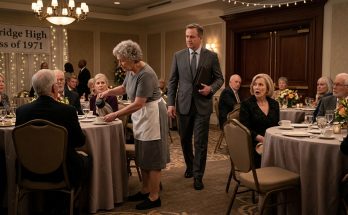
At Seventy-Three, One White Apron in Brenda Vance’s Hand Made Fifty-Five Years Collapse Into a Single Cruel Moment
Part 2 of 50