Thursday’s St. Anne’s tour began at ten.
I arrived at eight.
This time David arrived at eight-fifteen.
I checked my watch theatrically.
“You’re late.”
“For a meeting that starts in one hour and forty-five minutes?”
“Standards matter.”
“You are enjoying this too much.”
“Yes.”
Evan Pike arrived with four St. Anne’s representatives.
He was younger than I expected.
Early forties.
Tall, carefully dressed, carrying a tablet instead of a folder.
I had constructed him in my mind as an accountant who measured human beings in decimal points.
That was unfair.
Possibly.
David introduced us.
“Mr. Pike, my mother, Martha Caldwell.”
Pike shook my hand.
“I’ve wanted to meet you.”
“That makes one of us.”
David closed his eyes.
Pike laughed.
Good.
“I’ve heard you started with a laundromat.”
“My husband and I did.”
“One location?”
“Twelve washers. Eight dryers. One broken on the first day.”
“Seven,” David said.
“What?”
“Washer Seven.”
“I know the number.”
“You said one broken.”
“That was sufficient.”
Pike smiled.
“I’d like to hear how this became this.”
He gestured toward the production floor.
“Slowly.”
“That’s it?”
“That is the useful version.”
David gave me a warning look.
I relented.
We began the tour.
I let David lead.
That required more discipline than I expected.
He explained receiving.
Sorting.
Batch identification.
Wash formulas.
Quality controls.
Energy recovery.
Finishing.
Packing.
Route staging.
Pike asked intelligent questions.
That irritated me because I had prepared to dislike him.
At the tunnel washers, he asked about water reuse.
Leah answered.
At inspection, he asked Rosa how defects were tracked.
Rosa answered more directly than the executive team probably preferred.
“If something is wrong, we stop it.”
Pike smiled.
“Even if it delays delivery?”
“If you want dirty linen on time, hire somebody else.”
David coughed.
I looked away so nobody saw me smiling.
Pike said, “Fair enough.”
Then Kayla approached me.
The new employee I had helped with folding.
“Mrs. Caldwell?”
“Yes?”
She looked nervous.
“Can I ask something?”
“Of course.”
Her eyes moved toward the visitors.
“Later?”
I checked the tour.
David had everything under control.
“Now.”
We stepped aside.
Kayla lowered her voice.
“Is it true you started doing the same jobs we do?”
“Yes.”
“Like folding?”
“Yes.”
“Loading?”
“Yes.”
“Cleaning?”
“Yes.”
She hesitated.
“What?”
“Then why don’t the office people eat with us?”
The question caught me completely unprepared.
I looked toward the employee break room.
“What do you mean?”
“There’s an upstairs cafeteria.”
“Yes.”
“And our break room.”
“Yes.”
“People say managers used to eat down here.”
I knew.
Arthur had.
I had.
As the company grew, we added an administrative cafeteria near the offices because schedules differed and visitors needed meeting space.
Practical.
Efficient.
Separating.
“Who told you to ask me this?”
“Nobody.”
“Rosa?”
From across the floor, Rosa shouted, “Leave me out of it.”
Kayla flushed.
I almost laughed.
“Why does it bother you?”
She looked down.
“It doesn’t.”
“That means it does.”
She smiled nervously.
“My dad works at a warehouse.”
I waited.
“He says you can tell what a company thinks of people by which doors they’re supposed to use.”
That sentence struck hard.
Our production employees entered through the east staff entrance.
Office employees generally used the front or north lot.
Again, practical.
Parking.
Shift timing.
Security.
But practical arrangements could accumulate meaning nobody intended.
I looked around Caldwell differently.
Blue work shirts downstairs.
Business clothes above.
Break rooms separated by architecture.
A company built by people who had once eaten sandwiches beside washers had become large enough to reproduce the distinctions I claimed not to believe in.
“Your father sounds troublesome.”
Kayla smiled.
“He is.”
“Good.”
I pointed toward her station.
“Get back before Rosa blames me for ruining productivity.”
Kayla left.
I rejoined the tour.
But I stopped hearing half of it.
At lunch, St. Anne’s representatives ate in the executive conference room.
Catered sandwiches.
Coffee.
White napkins.
Caldwell napkins.
I looked at them.
Pike noticed.
“Something wrong?”
“No.”
Then I corrected myself.
“Possibly.”
David gave me a warning glance.
I ignored him.
“Mr. Pike, why did you consider Eastline?”
The room became quiet.
Pike put down his sandwich.
“Price.”
“Only price?”
“No.”
“What else?”
He considered.
“Your company looked comfortable.”
David shifted.
I waited.
“What does that mean?”
“Your performance is excellent.”
“That sounds terrible.”
Pike smiled.
“But when I arrived, every answer from Caldwell was some version of ‘we’ve done it this way successfully for years.’”
I looked at David.
He did not look away.
Pike continued.
“Long relationships can create blind spots.”
“Yes.”
“I wanted to know whether your pricing reflected value or history.”
“And?”
“Both.”
Fair.
“What changed your mind?”
“The meeting Monday.”
“David?”
“His team.”
Good answer.
“He didn’t defend the past. He showed what the next five years could look like.”
I sat back.
There it was again.
The same lesson arriving from another direction.
My mother had preserved a dress without demanding I keep wearing it.
The past could be honored without becoming operating procedure.
After the tour, Pike asked for the photographs for the centennial exhibit.
I gave him three.
The first laundromat.
Arthur beside the truck.
Our first commercial washer.
I kept sleeping-cart David for private leverage.
When the St. Anne’s group left, I found David.
“We need to talk.”
“That sentence from you never improves my day.”
“Why didn’t you tell me about the cafeteria?”
“What about it?”
“The separation.”
He frowned.
“Production has a break room. Administration has the upstairs cafeteria.”
“I understand architecture.”
“Do you?”
He stared.
“What happened?”
“Kayla asked why office people don’t eat downstairs.”
David sighed.
“Mom.”
“What?”
“We have four hundred and eighty employees across this site.”
“I know.”
“Different shifts. Different schedules. Different safety requirements.”
“I know.”
“Not everything is symbolic.”
“No.”
I paused.
“But some things become symbolic whether we intend them to or not.”
David folded his arms.
“What do you want to do?”
“I don’t know.”
“That’s new.”
“Be respectful.”
He smiled.
I looked through the glass.
“Your father used to eat lunch with maintenance.”
“Dad ate everywhere.”
“True.”
“He once ate chili sitting on a boiler housing.”
“He was an animal.”
David laughed.
Then I said, “When did I stop?”
His expression changed.
“Stop what?”
“Eating downstairs.”
“I don’t know.”
Neither did I.
That bothered me.
Success had arrived through hundreds of reasonable changes.
An office because paperwork required quiet.
A conference room because clients needed somewhere to sit.
Administrative staff.
Management floors.
Reserved parking for visitors.
Different entrances.
Nothing cruel.
Nothing dramatic.
Yet enough reasonable distance could eventually become hierarchy.
“I want lunch downstairs tomorrow.”
David groaned.
“Not a company event.”
“No speeches.”
“No executives descending upon production to demonstrate solidarity.”
“Agreed.”
“Because that will be unbearable.”
“Agreed.”
“You just want lunch.”
“Yes.”
“Fine.”
The next day, I carried soup and a sandwich into the production break room.
Nobody applauded.
Thank God.
Rosa moved her handbag off a chair.
“You finally lost your office?”
“Temporary demotion.”
Kayla smiled from across the table.
I sat.
Conversation stopped for thirty seconds.
Then resumed.
Children.
Rent.
A broken car.
A supervisor’s terrible music.
Someone complaining about vending-machine prices.
Ordinary life.
I listened.
Eventually people forgot to monitor me.
That was when I learned the most.
A loading employee said the new scheduling app made shift swaps harder.
A finishing worker said upstairs management rarely understood how hot Station Three became after lunch.
Someone complained that the east entrance flooded during heavy rain.
None of these problems were strategic.
All were real.
After lunch, I found David.
“The east entrance floods.”
“I know.”
“Why?”
“Drainage.”
“Fix it.”
“It’s on facilities.”
“When?”
“Next quarter.”
“Why?”
“Budget.”
I stared.
“How much?”
He told me.
I stared harder.
“That is less than the conference-room display system.”
“Yes.”
“Which we replaced last month.”
“Yes.”
“While employees walked through water.”
David closed his eyes.
“Point taken.”
“Good.”
He called facilities.
I should have felt victorious.
Instead I felt embarrassed.
The company had not betrayed my values.
I had simply stopped standing where some consequences were visible.
That evening, I took Arthur’s note from my handbag.
You always think the next problem proves the work isn’t finished.
Maybe someday you’ll notice the work was the life.
I understood it differently now.
The work was not only building Caldwell.
The work was noticing when what we built began teaching lessons we never meant to teach.
At home, I received an email from Brenda.
The subject line read:
I did something.
Dangerous.
I opened it.
She had attached a photograph.
A handwritten letter addressed to the Fairmont banquet staff.
Not a donation.
Not a gift.
An apology.
She wrote that she had spoken disrespectfully to people whose work made her event possible, that frustration did not justify treating service as invisibility, and that she expected no response.
At the bottom, she had added:
I am learning embarrassingly late that gratitude is not the same as good manners. One is felt. The other must be practiced.
I read the sentence twice.
Then I called Chloe.
“Did she send this?”
“Yes.”
“What did you do?”
“Posted it in the staff room.”
“Did anyone care?”
“Nina took a picture.”
“Why?”
“She said her aunt would enjoy the plot twist.”
I laughed.
“Rosa?”
“I assume.”
“Yes.”
The world had become too connected.
Chloe said, “Brenda also asked whether she could contribute to the employee emergency fund.”
I became wary.
“How much?”
“I told her that wasn’t my business to discuss with you.”
“Good.”
“She asked anonymously.”
That changed something.
Not everything.
Enough.
After the call, I forwarded Brenda’s email to no one.
Her change did not need an audience.
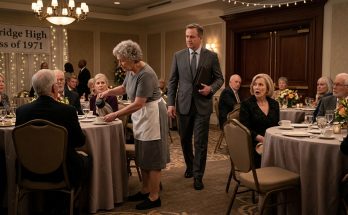
Then I opened the photograph Susan had sent from the reunion.
Me in the apron.
Brenda watching.
For the first time, I stopped studying her face.
Instead I noticed Nina in the background.
Carrying a tray.
Working.
A person I had barely registered when I first saw the image.
That was how hierarchy worked.
It taught the eye where not to look.
I closed the photograph.
The next morning, I asked Human Resources for a report on employee retention by department.
Then wages.
Then promotion rates.
Then internal applications.
My assistant looked alarmed.
“Is something wrong?”
“I don’t know yet.”
That was the problem.
By noon, I did.
People hired into Caldwell’s production floor rarely moved upstairs.
Not never.
Rarely.
Far less often than I had assumed.
We had built training programs.
Tuition support.
Internal postings.
Yet the numbers were stubborn.
Entry doors had become tracks.
I stared at the report.
My mother’s voice returned.
Something being worn doesn’t mean it has stopped being useful.
Maybe institutions were like fabric.
They could be altered.
But first somebody had to admit the fit was wrong.
I called David.
“Come to my office.”
He arrived ten minutes later.
“What now?”
I turned the report toward him.
He read.
His expression became serious.
“I’ve seen this.”
“You knew?”
“Yes.”
“And?”
“We’ve been working on it.”
“How?”
He opened the second page.
“These numbers are why.”
A pilot program.
Paid technical training.
Supervisor apprenticeships.
Tuition assistance redesigned for hourly employees.
Shift-protected classes.
I looked at him.
“When did you start this?”
“Four months ago.”
“Why didn’t you tell me?”
“I did.”
“No.”
“You said it sounded expensive.”
I stared.
A memory surfaced.
A budget meeting.
David proposing expanded training.
Me asking for return-on-investment projections.
My stomach dropped.
“I said that?”
“Yes.”
“Exactly?”
“Pretty much.”
I sat back.
For several seconds, neither of us spoke.
Then I said, “Fund it.”
David blinked.
“All of it?”
“Within reason.”
“That phrase ruins everything.”
“You know what I mean.”
He smiled slowly.
“You changed your mind.”
“I received additional information.”
“You changed your mind.”
“Leave before I reverse it.”
He stood.
At the door, he turned.
“Mom.”
“What?”
“Dad would be proud.”
I looked down at the report.
“Your father would ask what it cost.”
“He would.”
“Then complain.”
“Definitely.”
“And approve it.”
David smiled.
“Definitely.”
After he left, I looked through the glass wall at Caldwell.
For years I had thought the great achievement was that a poor girl in a homemade dress had become the owner upstairs.
Now another question seemed more important.
How many people downstairs had the ability to come up if they wanted to?
I picked up the phone.
There was work to do.
Click here to continue reading: PART 16: Brenda Invited Me to Her Father’s Empty House, Where One Locked Desk Drawer Held the Truth She Had Feared Finding
At Seventy-Three, One White Apron in Brenda Vance’s Hand Made Fifty-Five Years Collapse Into a Single Cruel Moment
Part 15 of 50