David arrived seven minutes after my call.
Not ten.
Not fifteen.
Seven.
That told me he was worried.
He entered my office carrying no laptop, no folder, no coffee. He closed the door behind him and remained standing.
“What happened?”
“Nothing happened.”
“You said succession.”
“Yes.”
“People don’t say succession when nothing happened.”
“Sit down.”
“That is exactly what people say before delivering bad medical news.”
“I do not have bad medical news.”
“Legal trouble?”
“No.”
“Did you sell something?”
“No.”
“Are you secretly married?”
I stared at him.
He sat.
“Fine. I’m listening.”
I folded Arthur’s note and placed it beside my mother’s letter.
“I want us to decide what happens to Caldwell before circumstances decide for us.”
David’s face remained tense.
“You already have an estate plan.”
“That determines ownership.”
“Yes.”
“I’m talking about leadership.”
“I run most of the company already.”
“I know.”
His eyes narrowed.
“That sounded dangerous.”
“It shouldn’t.”
“You correct my decisions before I make them.”
“Only when I anticipate mistakes.”
“You anticipate all decisions as possible mistakes.”
“That is called experience.”
“That is called being my mother.”
I almost smiled.
“Both.”
He leaned back.
“So what are you proposing?”
“I move out of daily operating authority.”
He did not speak.
I continued before he could.
“Not tomorrow. Not suddenly. We create a timetable.”
“What timetable?”
“Twelve months.”
His eyebrows rose.
“You’re serious.”
“Yes.”
“You stop signing operational approvals?”
“Most.”
“Hiring?”
“Department heads become yours.”
“Capital?”
“We create thresholds.”
“Contracts?”
“You lead all renewals.”
“You already let me handle St. Anne’s.”
“That was one contract.”
“It was your favorite contract.”
“I do not have favorite contracts.”
“You kept the first St. Anne’s purchase order in your desk for twenty years.”
“That was historical documentation.”
“That was sentimentality with staples.”
I ignored him.
“In twelve months, you become chief executive in title as well as practice.”
David looked through the glass wall toward the production floor.
“And you?”
“Chair.”
“Full-time?”
“No.”
The word felt strange leaving my mouth.
For decades, work had supplied structure when life failed to.
After my father died, my mother worked.
After Arthur died, I worked.
After difficult nights, failed contracts, funerals, illnesses, and arguments, work remained available in the morning.
It did not ask whether I was ready.
Perhaps that had been its gift.
Perhaps also its trap.
David turned back.
“How many days?”
“What?”
“In the office.”
“I don’t know.”
“Yes, you do.”
“Three.”
He laughed.
“What?”
“You’re proposing retirement at forty percent.”
“I said chair.”
“Three days is not chair. Three days is a hostage situation.”
“Two.”
“Two mornings.”
“Absolutely not.”
“One full day.”
“David.”
“One day plus board meetings.”
“That is ridiculous.”
“You asked for succession.”
“I asked for civilized succession.”
“Civilized succession requires the former ruler leaving the palace.”
“I am not a ruler.”
“You have a reserved parking space.”
“I founded the company.”
“You have a private bathroom.”
“That was here before the renovation.”
“You insisted nobody remove it.”
“Because plumbing already existed.”
David smiled.
I hated when he became charming during negotiations.
Arthur had done the same thing.
“Two full days,” I said.
“One.”
“Two.”
“One and one half.”
“That is not a work schedule.”
“It is for you.”
I leaned back.
“Fine.”
He stopped smiling.
“Really?”
“One full day. One morning.”
He stared.
“That was too easy.”
“I am capable of compromise.”
“No, you are capable of concealed strategy.”
“Perhaps I intend to arrive unannounced.”
“That is exactly what I mean.”
We both laughed.
Then David became serious.
“Why now?”
I looked at the papers on my desk.
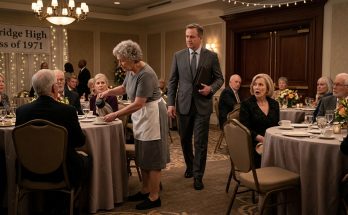
How to explain without turning my mother, Brenda, Arthur, the reunion, the apron, and one repaired employee entrance into a false revelation?
People like turning points because they create clean stories.
Most change is less elegant.
It accumulates.
A sentence.
A photograph.
An employee asking why office people eat upstairs.
A son winning a contract without his mother.
A dead husband leaving a note that irritates you into wisdom.
“I realized something,” I said.
“What?”
“I have spent years confusing being useful with being necessary.”
David did not answer.
“That sounds dramatic.”
“No.”
“It is dramatic.”
“It’s also true.”
He looked down at his hands.
“Dad used to say that.”
I became still.
“What?”
“That you needed people to need you.”
“He said that?”
“Not exactly.”
“Then what exactly?”
David hesitated.
“He said, ‘Your mother would rescue a sinking ship and then complain nobody asked how tired she was.’”
I stared.
“That is extremely rude.”
“It is also extremely Dad.”
“Yes.”
I looked toward Arthur’s photograph.
“Why didn’t he say it to me?”
“He probably did.”
“That seems unlikely.”
David laughed.
Then his face softened.
“You know why I wanted St. Anne’s alone?”
“Because you’re ungrateful.”
“Because when you’re in the room, everybody waits for you.”
I looked at him.
“Even when I’m talking.”
“I don’t interrupt that much.”
“You don’t have to.”
He leaned forward.
“You founded this company. People look at you before they trust me.”
“That is not my fault.”
“No.”
“But?”
“But if you always remain the final authority, I’ll always be acting chief executive no matter what my business card says.”
That hurt.
Not because it was unfair.
Because it was precise.
My mother had understood something similar when she refused to save me from school.
She could protect me completely only by preventing me from discovering I could stand alone.
Perhaps founders could do the same thing to successors.
Call it devotion.
Create dependence.
“I understand,” I said.
David’s expression shifted.
“You do?”
“Yes.”
“You’re not going to argue?”
“I can if you need familiarity.”
“No.”
“Good.”
He stood.
“Then we should build the plan.”
“We should.”
“And tell the executive team.”
“Eventually.”
“Soon.”
“Eventually soon.”
“That phrase is meaningless.”
“It has served management for generations.”
David reached the door.
“Mom.”
“Yes?”
“I’m not trying to push you out.”
“I know.”
“I need you here.”
That was the dangerous sentence.
I felt my chest tighten.
Then he added, “Just differently.”
Better.
“I know.”
He left.
I remained in my office.
For years, I had feared disappearance in forms I did not name.
When Arthur died, part of my terror was that life would continue without consulting me.
When David became competent, part of my pride came tangled with the knowledge he required less help.
When Caldwell built systems that functioned without my direct attention, I celebrated and interfered simultaneously.
Perhaps stepping back threatened the same wound Brenda had once touched.
If no one was looking at me, did I still exist?
At seventeen, invisibility had felt like safety until humiliation taught me that disappearing could also become a prison.
At seventy-three, I faced the opposite problem.
I had become so visible inside Caldwell that other people could not always see themselves clearly around me.
The next day, I met with Leah.
She listened to the succession proposal without interrupting.
Then said, “Good.”
I stared.
“Good?”
“Yes.”
“That is your entire reaction?”
“You should have done it three years ago.”
“Arthur liked you. I’m reconsidering his judgment.”
“He liked me because I told him unpleasant things.”
“I know.”
Leah closed the plan.
“David is ready.”
“You sound confident.”
“He’s been ready.”
“Then why did nobody say anything?”
“We did.”
“No.”
Leah smiled.
“You interpreted every suggestion as a request for additional mentorship.”
I felt offended.
Then remembered three conversations that might support her case.
“That seems exaggerated.”
“It isn’t.”
“Fine.”
I stood.
“What am I supposed to do with the time?”
Leah laughed.
“I am operations. Not recreation.”
“I have no hobbies.”
“That is alarming.”
“I read.”
“For work.”
“I garden.”
“You employ a gardener.”
“I supervise.”
“That is work.”
I frowned.
“Arthur handled hobbies.”
“Yes.”
“He was selfish.”
“Obviously.”
When I left Leah’s office, I found Rosa near inspection.
“Lunch?”
She looked suspicious.
“Are you firing me?”
“No.”
“Then yes.”
We ate downstairs.
I told her I was stepping back.
Rosa chewed slowly.
Then nodded.
“That’s good.”
I put down my fork.
“Why is everyone so enthusiastic?”
“Because you’re seventy-three.”
“That is age discrimination.”
“You started it.”
“I am healthy.”
“I know.”
“I work.”
“I know.”
“Then what?”
Rosa wiped her mouth.
“You trained people well.”
“And?”
“And then you keep doing their jobs.”
“I do not do your job.”
“You rejected a gown last week.”
“It was defective.”
“So?”
“So I noticed it.”
“I noticed it first.”
“That is irrelevant.”
“That is exactly relevant.”
She leaned closer.
“You think showing up proves you care.”
“It does.”
“Sometimes.”
“What does that mean?”
“Sometimes trusting us proves it.”
Again.
The same lesson wearing different clothes.
I disliked how often life repeated itself until I stopped pretending not to understand.
That Friday, David sent the draft succession plan.
Twelve months.
Three stages.
Quarterly governance reviews.
Ownership unchanged.
Operating authority gradually transferred.
My office retained.
My title becoming Executive Chair.
My weekly presence reduced to one full day and one morning by the final stage.
I read the final paragraph.
Founder role: strategic counsel, institutional relationships, culture stewardship, board leadership, limited special projects.
Culture stewardship.
I called David.
“What does culture stewardship mean?”
“It means you tell stories and criticize values.”
“That sounds like retirement-home programming.”
“It means you stop approving toner purchases.”
“I have never approved toner.”
“You rejected a printer lease last month.”
“It was overpriced.”
“Culture stewardship.”
I hung up.
Then Brenda called.
“I have a question.”
“Everybody does.”
“Bad time?”
“No.”
She sounded different lately.
Less polished.
More cautious.
“I’m going through my father’s estate papers.”
“Yes.”
“There’s a scholarship fund.”
I waited.
“He created it through Oakridge.”
“That sounds unexpectedly charitable.”
“It was for children of Vance Motors employees.”
“That sounds less unexpected.”
“It still exists.”
“And?”
“The trustees asked whether I want to remain involved.”
“Do you?”
“I don’t know.”
I leaned back.
“What’s the problem?”
“The criteria.”
“What criteria?”
“Academic ranking, leadership, community reputation, family recommendation.”
“Family recommendation?”
“From a supervisor or senior manager.”
I understood immediately.
People with closer proximity to power received stronger visibility.
“What are you asking me?”
“What would your mother say?”
I smiled.
“My mother would ask why you’re asking a dead woman to make your decision.”
Brenda laughed.
“Probably.”
“Then she would tell you to read the actual outcomes.”
“What outcomes?”
“Who gets the scholarships.”
Silence.
Then Brenda said, “That sounds like you.”
“No. That sounds like bookkeeping.”
“I’ll look.”
A week later she called again.
“You were right.”
“How unfortunate.”
“Almost every recipient’s parent worked management or sales.”
“Not factory?”
“Very few.”
“Then the criteria are doing what they were designed to do.”
Brenda became quiet.
“Designed?”
“Maybe intentionally. Maybe culturally.”
I thought about Caldwell’s promotions.
“Doesn’t matter much if the result repeats.”
“What would you change?”
“You’re asking me again.”
“Yes.”
“Stop.”
She laughed.
“You really are irritating.”
“I have a son who says the same.”
“Fine. I’ll decide.”
“Good.”
After we ended the call, I noticed something.
Brenda was doing what I had done.
Looking outward for authority when choice frightened her.
Perhaps that was what hierarchy trained into people on both sides.
The powerful learned to decide for others.
Everyone else learned to wait for decisions.
Breaking either habit required discomfort.
At the end of the month, we announced the Caldwell succession plan to senior leadership.
No ceremony.
No press release.
Just facts.
David would assume chief executive authority over twelve months.
I would remain chair.
No sale.
No merger.
No retirement date.
Questions came.
Some practical.
Some emotional.
One manager asked whether the company’s direction would change.
David answered before I could.
“Yes.”
The room became still.
I looked at him.
He continued.
“Because companies that never change direction eventually discover the road moved.”
Arthur would have liked that.
I did too.
Then he added, “But our principles don’t change.”
He looked toward me.
“Quality. Reliability. Respect for the work and the people doing it.”
No mention of my name.
Good.
That mattered.
After the meeting, people surrounded David.
I stood near the edge.
For several minutes, nobody spoke to me.
Old instinct whispered.
You are being left out.
I let the feeling exist.
Then Rosa appeared beside me.
“Hard?”
“Yes.”
“Good.”
“I am tired of people telling me discomfort is healthy.”
She shrugged.
“Still true.”
Across the room, David answered questions confidently.
He did not look for me.
That hurt.
Then I realized it was exactly what success was supposed to look like.
I left before the meeting ended.
Not angrily.
Deliberately.
Outside, I walked toward the east entrance.
Rain had started.
Water ran along the new drainage channel and disappeared exactly where it should.
Kayla entered under an umbrella.
“Mrs. Caldwell?”
“Yes?”
“I heard Mr. Caldwell’s taking over.”
“He is.”
“Are you leaving?”
The question landed softly.
“No.”
She smiled.
“Good.”
Then she hurried inside.
I stood beneath the awning for another moment.
Not leaving.
Just changing where I stood.
That might be harder.
It might also be the first honest version of succession I had ever attempted.
Click here to continue reading: PART 18: Brenda Changed Her Father’s Scholarship Rules, Then Asked Me to Attend a Ceremony I Had No Intention of Surviving Politely
At Seventy-Three, One White Apron in Brenda Vance’s Hand Made Fifty-Five Years Collapse Into a Single Cruel Moment
Part 17 of 50