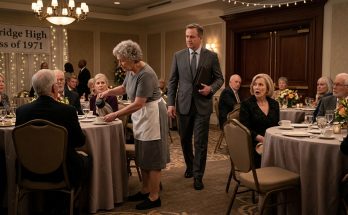
The silence after I sat down lasted perhaps four seconds.
It felt longer.
Brenda recovered first.
Of course she did.
She gave a small laugh into the microphone and said, “Well, Martha always did know how to make an entrance.”
The sentence was designed to reset the room.
To convert what had happened into light entertainment.
At seventeen, I would have let her.
Susan did not.
“No,” she said from beside me.
Her voice carried farther than she intended.
Brenda looked toward our table.
Susan’s face had gone red.
“That wasn’t funny then either.”
The ballroom became completely still.
I turned toward her.
Susan looked as surprised by her own words as anyone else.
Brenda lowered the microphone slightly.
“What?”
Susan pushed back her chair and stood.
She was seventy-three years old, five feet four inches tall, and had spent thirty-five years as a public-school principal.
Apparently some professional habits were permanent.
“You made fun of her dress at prom.”
Brenda’s expression hardened.
“Oh, for heaven’s sake.”
“You did.”
“We were children.”
“We were seventeen.”
I almost smiled.
The same sentence again.
Tommy looked down at the table.
Brenda glanced around the room.
“I don’t remember it that way.”
Tommy stood.
“I do.”
Now I wanted everyone to sit down.
This had become dangerously close to the dramatic confrontation I had explicitly told Chloe I was not planning.
Brenda stared at Tommy.
He swallowed.
“I laughed.”
His voice was not strong.
It did not need to be.
“I laughed because Brenda made a joke about Martha’s dress, and I didn’t want her making one about me.”
Brenda’s face changed.
“Tommy, honestly.”
“No.”
He looked at me.
Then back at Brenda.
“She walked home.”
A few people murmured.
Brenda’s eyes moved to me.
“You walked home?”
I almost laughed at the absurdity.
“Yes.”
“You never said.”
“To you?”
She opened her mouth.
Closed it.
Then she shook her head.
“This is ridiculous. It was fifty-five years ago.”
There it was.
The arithmetic of harm, as if years reduced its original value automatically.
I stood again.
Not because I wanted the room.
Because I wanted the moment back under control.
“Brenda.”
She looked at me.
“You’re right about one thing.”
Her chin lifted slightly.
“It was fifty-five years ago.”
I buttoned my jacket.
“I did not come here for an apology.”
Susan began to speak.
I touched her arm.
She stopped.
“I did not come for a trial either.”
The room relaxed slightly.
Good.
“I came because I realized I had spent too long thinking this room still belonged to the people who frightened me when I was seventeen.”
Brenda’s face remained unreadable.
“It doesn’t.”
I sat.
This time nobody clapped.
I was grateful.
Brenda returned to the program.
Her voice was smoother than I expected.
She introduced a memorial slide for classmates who had died.
That quieted the room for a different reason.
Names appeared.
Faces.
People murmured recognition.
One photograph stopped me.
Ellen Morris.
My cousin.
The one whose dresses I had worn.
She had died eight years earlier.
I knew that.
Still, seeing her school portrait among the dead felt cruelly specific.
The slideshow moved on.
Arthur was not there, of course.
He had gone to another school.
Yet grief brought him into the room anyway.
I imagined his hand finding mine beneath the table.
For the next half hour, conversation remained careful.
Then alcohol, dessert, and human adaptability began smoothing the edges.
Music started.
Some people danced.
Others wandered toward displays.
I stepped into the hallway.
Not fleeing.
I told myself that firmly.
I simply needed quiet.
The corridor outside the ballroom was empty except for a Fairmont employee adjusting a side table.
I walked toward the windows.
Night covered the city below.
“You okay?”
Tommy.
I turned.
“Yes.”
“You always say that quickly.”
“So do most people.”
He stood beside me.
For a while neither of us spoke.
Then he said, “I should’ve told people years ago.”
“Told them what?”
“What happened.”
“Why?”
“I don’t know.”
“That’s not your story to confess for me.”
He nodded slowly.
“You’re right.”
“I appreciate what you said in there.”
“I meant it.”
“I know.”
Tommy looked toward the ballroom doors.
“Brenda really doesn’t remember.”
“You believe that?”
“I think she remembers making fun of you. I don’t think she remembers how much it cost you.”
That sounded right.
Cruelty often occupied more memory in the person receiving it than the person delivering it.
That fact had once enraged me.
Now it mostly seemed inefficient.
Tommy said, “You know what I remember most?”
“What?”
“You taking off your coat.”
“I didn’t have my coat.”
“At the dance. Earlier. You were wearing your mother’s sweater when you arrived.”
I frowned.
“No.”
“Yes.”
“I left my coat there.”
“You did. But when you came into the gym, you had a cardigan over the dress. Blue.”
I searched my memory.
Nothing.
Tommy smiled faintly.
“You took it off before we danced and asked me to hold it because you were warm.”
“Why do you remember that?”
“Because I dropped it.”
I laughed.
A tiny memory surfaced.
Tommy bending over, embarrassed, retrieving a blue cardigan from the gym floor.
I had forgotten.
“See?” he said.
“What?”
“There was more to that night.”
I looked through the ballroom doors toward the projected photographs.
“Yes.”
“There was more than Brenda.”
“Yes.”
That mattered.
We returned inside separately.
I stopped near the bar for water.
A man approached me.
I recognized him as Frank Delaney only after reading his name tag.
Frank had been one of Brenda’s orbiters in high school.
Not close enough to her to matter.
Close enough to laugh.
He looked uncomfortable.
“Martha.”
“Frank.”
“Can I say something?”
“You can.”
“I laughed too.”
I waited.
“At prom.”
“I assumed.”
His face tightened.
“I don’t remember exactly what I said.”
“I don’t either.”
“That almost feels worse.”
“Why?”
“Because you remember walking home and I don’t even remember what I contributed.”
I considered that.
“That probably tells us something about how humiliation works.”
He nodded.
“I’m sorry.”
“Thank you.”
He looked relieved but not absolved.
That seemed appropriate.
Over the next hour, three more classmates approached me.
One remembered.
Two did not but had heard enough to suspect they had joined the laughter.
None asked me to forgive them.
I appreciated that.
They apologized.
I accepted the apologies.
Those are different acts.
Then something unexpected happened.
I started enjoying myself.
Leonard persuaded a group of us onto the dance floor when an old Motown song played.
My knees objected.
Susan danced as if her dignity had already retired.
Tommy moved with cautious enthusiasm.
For the first time, I danced in an Oakridge event without monitoring where Brenda stood.
When the song ended, I was laughing hard enough to hold my side.
Susan leaned toward me.
“If my cardiologist asks, this did not happen.”
“Agreed.”
We returned to the table.
The room had become warmer.
Jackets came off.
Ties loosened.
The immaculate reunion Brenda had designed was slowly becoming human.
Then the ballroom doors opened.
A hotel employee entered quickly and spoke to Chloe.
I recognized the expression on Chloe’s face.
Operational trouble.
She excused herself and moved toward the service corridor.
Another employee followed.
Then another.
Most guests noticed nothing.
I did.
I had spent too many years running facilities not to recognize the choreography of a problem people were trying to keep invisible.
I checked the time.
9:42.
A banquet supervisor appeared near the service doors.
His name was Marcus Reed.
I knew him.
He saw me.
For half a second, professional instinct overrode Chloe’s instructions and his eyes widened.
I stood.
He immediately looked away.
That was enough.
I walked toward the service corridor.
Chloe met me near the door.
“Martha.”
“What happened?”
“Nothing you need to worry about.”
“That phrase has never once preceded nothing.”
She exhaled.
“Staffing problem.”
“How bad?”
“Two servers went home sick. One dishwasher left after an injury. We have another event upstairs running late, and half the relief staff are there.”
“What does this room need?”
“Coffee refresh, dessert clearing, breakdown later.”
“You’re short.”
“We’ll manage.”
“Chloe.”
“Yes. We’re short.”
I glanced through the service door.
Trays had begun accumulating.
Not disaster.
Pressure.
There is a stage in every operation before failure when everything still looks acceptable to outsiders.
Inside, everyone is running ten percent faster than they should.
That stage rarely lasts.
“Call your relief list.”
“We did.”
“Agency?”
“Forty-five minutes minimum.”
“What about banquet staff from the wedding upstairs?”
“They can’t leave yet.”
I nodded.
“Fine.”
Chloe narrowed her eyes.
“No.”
“I didn’t say anything.”
“I know that face.”
“What face?”
“The same one David has when he decides a problem is his.”
I almost laughed.
“I can clear tables.”
“No.”
“I have two working hands.”
“You are a guest.”
“I have been both before.”
“Martha.”
A young server rushed past carrying a tub of glassware.
His sleeve caught the edge of a metal shelf.
The tub tilted.
I grabbed one side before it fell.
He stared at me.
“Sorry.”
“Don’t apologize. Adjust your grip.”
He did.
We set it down.
Chloe closed her eyes briefly.
“This is exactly what I’m afraid of.”
“What?”
“You helping.”
“That is an unusual fear.”
“You own the company that services half our textile operation.”
“Which means I have folded more banquet napkins than anyone in that ballroom.”
“That was thirty years ago.”
“I remember.”
Chloe glanced toward the ballroom.
“If Brenda sees you working—”
I understood.
The old joke.
The old hierarchy.
The apron.
For one second, my body reacted before my mind did.
Then I looked into the service corridor.
People were working.
Actually working.
Not symbols.
Not social positions.
Work.
My mother had cleaned medical offices after dark.
Arthur had crawled beneath machines.
I had stood ankle-deep in gray water.
There was no insult in labor unless somebody decided there should be.
“Do you have an apron?” I asked.
Chloe stared at me.
“Martha.”
“Do you?”
“Yes.”
“Then give me one.”
She shook her head.
“No.”
“Chloe.”
“No.”
Then a voice behind us said, “There you are.”
Brenda.
She had followed me.
Her eyes moved from Chloe to the service corridor.
Then to me.
“Is something wrong?”
Chloe opened her mouth.
I answered first.
“They’re short-staffed.”
Brenda frowned.
“Again?”
Again.
That single word told me this had happened earlier.
She looked at Chloe.
“I was promised full service.”
“We are maintaining service, Ms. Vance.”
“The coffee is slow.”
“We’re addressing it.”
Brenda sighed.
Then she looked at me.
And smiled.
The smile from 1971.
Light.
Careless.
Automatic.
“Well,” she said, “Martha always did know her way around this sort of thing.”
Chloe went completely still.
I knew what Brenda meant.
So did Chloe.
Perhaps Brenda knew too.
Perhaps not.
Then she reached through the open service doorway, took a clean white apron from a hook, and held it toward me.
“Go ahead, Martha.”
The past did not return.
It simply stood in front of me holding out a piece of cloth.
And this time, I reached for it.
Click here to continue reading: PART 8: I Tied Brenda’s White Apron Around My Waist, Then the People She Looked Past Began Calling Me by Name
At Seventy-Three, One White Apron in Brenda Vance’s Hand Made Fifty-Five Years Collapse Into a Single Cruel Moment
Part 7 of 50